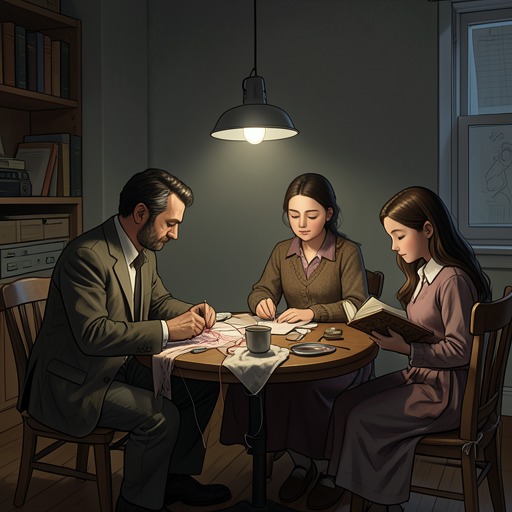
Grete Samsa
The MetamorphosisGrete Samsa is Gregor Samsa’s sister and, after his transformation, the family member most directly responsible for his daily care. At first she approaches him with fear softened by patience: she brings food, studies his changing tastes, gives him privacy, and helps adapt his room to his altered body. Yet the same intimacy that makes her Gregor’s principal ally also places her closest to the labor and disgust of his confinement. As the family’s economic and emotional arrangements change, Grete changes with them, eventually denying that the creature in Gregor’s room can still be her brother and demanding that it be removed. Her arc makes visible how devotion, dependence, resentment, and self-preservation can occupy the same domestic relationship.
Identity and Early Position
Grete is introduced through the closed doors of the Samsa family apartment, where she calls anxiously to Gregor and asks whether he needs anything. Gregor answers from inside his locked room, trying to make his altered voice sound normal, and Grete remains part of the family’s first attempt to understand what has happened. Unlike the Chief Clerk, who hears an animal voice and treats Gregor’s failure to appear at work as suspicious, Grete is initially associated with concern and practical help.
Her position within the family had previously been comparatively sheltered. Gregor’s work as a travelling salesman supported the household after the collapse of Mr. Samsa’s business, and Gregor had been able to think of Grete’s future in terms of music rather than immediate employment. He knew that she was a gifted and expressive violinist and secretly planned to send her to the conservatory, despite the expense, with the intention of announcing this plan on Christmas Day. The plan reveals both his affection for her and the economic structure that made her aspirations possible: Gregor imagined himself continuing to bear the family’s obligations so that Grete could develop a different life.
Care After Gregor’s Transformation
Grete becomes the first person to establish a workable routine around Gregor’s new condition. On the morning after the transformation, she discovers him hiding under the couch and is initially shocked, closing the door abruptly. She then returns on tiptoe, enters as if visiting someone seriously ill or a stranger, notices that he has not touched the sweetened milk, and removes it with a rag rather than her bare hands. Her response combines solicitude with visible revulsion; she is willing to serve him, but the manner of serving already marks him as physically disturbing and socially separated.
To discover what he can eat, Grete places a selection on an old newspaper: half-rotten vegetables, bones covered in hardened white sauce, raisins and almonds, cheese Gregor had previously declared inedible, a dry roll, and bread spread with butter and salt. She also provides water in a dish apparently reserved for his use. Knowing that he will not eat while watched, she leaves and turns the key so that he can make himself comfortable. This arrangement preserves a fragment of his dignity by giving him privacy, even as it confirms that meals now occur outside ordinary family life.
Grete continues this service while the rest of the family stays away. For the first fourteen days, Mr. and Mrs. Samsa cannot bring themselves to enter Gregor’s room; instead, they wait outside while Grete tidies it and ask her what he has eaten, how he has behaved, and whether any improvement is visible. Their dependence on her turns her from a girl previously regarded as somewhat useless into the household’s necessary caretaker. At the same time, Gregor’s mother wants to see her son, but Mr. Samsa and Grete initially restrain her, creating a temporary alliance between father and daughter around controlling access to Gregor.
Grete also accommodates Gregor’s changing movement. When he begins crawling on the walls and ceiling, leaving traces of adhesive from his feet, she concludes that the furniture is obstructing him and proposes removing the chest of drawers and desk. She cannot obtain help from Mr. Samsa, and the maid refuses the task, so she brings in Mrs. Samsa while Mr. Samsa is away. Grete takes the heavier part of the work and ignores her mother’s warnings that she may strain herself. Her practical initiative is genuine, but the proposed clearing of the room carries a deeper consequence: it threatens to remove the familiar human environment that still connects Gregor to his former identity.
From Sisterly Alliance to Family Conflict
The furniture dispute exposes the difference between Grete’s adaptive logic and Mrs. Samsa’s emotional understanding. Grete sees empty space as useful for an animal body that needs to crawl; her mother sees the furniture as evidence of Gregor’s past and fears that taking it away will make him feel abandoned. Gregor, hidden beneath a sheet, understands both positions and becomes increasingly uncertain whether preserving the room or transforming it would better serve him. Grete’s care therefore helps produce the very identity crisis that later separates them: she responds to Gregor’s body by reorganizing his surroundings, while he experiences that reorganization as a possible erasure of the person he had been.
The conflict intensifies when Gregor tries to protect the framed picture of the woman in furs. He clings to the glass, and Mrs. Samsa sees the enormous brown shape against the wallpaper before recognizing him, then faints. Grete calls directly to him in anger, the first time she has spoken to him directly since the transformation. When Gregor tries to help Grete find smelling salts, a bottle breaks, a splinter cuts his face, and caustic medicine splashes over him. His attempt to behave as he once would—as a brother offering assistance—only deepens the crisis because the family can no longer read his intention through his altered body.
Mr. Samsa returns and interprets Grete’s report that Gregor has escaped as evidence of a dangerous act. Gregor presses himself against the bedroom door to demonstrate that he intends to return peacefully, but his father is too angry and frightened to recognize the gesture. Grete runs to her father and begs him to spare Gregor’s life while the attack proceeds. Gregor is injured by an apple lodged in his flesh, and the wound remains for more than a month. The injury limits his mobility and makes his confinement more permanent, while Grete’s position shifts from mediator between Gregor and the household toward participation in a stricter regime of separation.
Economic Reorganization and Reversal
Grete’s transformation is inseparable from the family’s economic reversal. Gregor had believed that the family’s financial resources had been exhausted after Mr. Samsa’s business collapsed five years earlier, and he had worked with unusual intensity to rise from junior salesman to travelling representative. He brought his earnings home, supported all three family members, and hoped eventually to clear his father’s debt to his employer. After Gregor’s confinement, Mr. Samsa reveals that some savings and accumulated interest remain, while the family has also preserved part of Gregor’s monthly income. This news weakens the practical necessity of Gregor’s continued labor and begins a redistribution of responsibility.
Grete eventually takes a sales job and studies shorthand and French in the evenings in the hope of obtaining a better position. Her mother sews fancy underwear for a fashion shop, while Mr. Samsa resumes a more active and authoritative role. Grete is therefore no longer simply the dependent younger sister whom Gregor intended to finance. She becomes one of the family’s workers, and her new contribution changes the emotional balance inside the apartment. Her care for Gregor is now performed alongside employment and household duties, making his continued presence increasingly legible to her as an intolerable demand rather than a temporary emergency.
Rejection and the End of the Relationship
The decisive break occurs after the family takes in three lodgers and Grete plays the violin for them. Gregor, weakened and isolated, remains deeply responsive to the music, while the lodgers treat the performance as something that can be judged according to their convenience. When Grete’s violin falls from her trembling hands, she strikes the table and declares that the family cannot continue living as it has. She refuses to call the creature in Gregor’s room her brother and argues that the family has done everything humanly possible to care for it.
Grete’s rejection is framed as a conclusion drawn from communication failure. Mr. Samsa wonders whether Gregor could understand them, but Grete insists that this is impossible. In her reasoning, if he were truly Gregor, he would have recognized that human beings could not live with an animal like that and would have left voluntarily. She therefore converts the question of identity into a test of acceptable behavior: the brother is defined as the person who would understand the family’s limits, while the animal is defined as the body that remains and imposes itself on them. Her language does not merely describe Gregor’s condition; it authorizes the family to stop treating him as a member.
Grete also claims that Gregor has driven out the tenants and is attempting to take over the flat, even though his immediate movement is an effort to return to his room. The family’s interpretation of his body has become more powerful than his intention. His attempt to withdraw frightens them, and Grete retreats behind Mr. Samsa for protection. The earlier sister who had entered his room, tested his appetite, and rearranged his furniture now helps establish the boundary beyond which he cannot return.
After Gregor’s death, Grete does not lead a period of mourning. When the Charwoman announces that the body is dead, Grete looks at it and observes that he has become thin because he had eaten almost nothing. Mr. and Mrs. Samsa then draw her into the bedroom, and the family’s attention turns quickly toward relief, work, and future plans. The household leaves the apartment together for the first time in months, and on the tram they discover that all three surviving members have jobs with promising prospects. Their discussion of moving to a smaller, cheaper, more practical flat confirms that Gregor’s disappearance has allowed the family to recover functional mobility.
Narrative Role and Significance
Grete is the character through whom Gregor’s domestic exclusion develops most visibly. Mr. Samsa responds with force, Mrs. Samsa with pity and collapse, but Grete administers the everyday practices that make separation normal: she controls the food, enters and leaves the room, manages the furniture, reports on Gregor’s condition, and finally defines him as no longer humanly related to the family. Because her actions begin in kindness, the later rejection cannot be dismissed as simple cruelty. It emerges from the cumulative pressure of fear, labor, economic necessity, and the family’s inability to sustain a relationship with someone whose intentions can no longer be communicated.
Her trajectory also reverses Gregor’s earlier plan for her. He had imagined revealing on Christmas Day that she would attend the conservatory, and he had understood his own labor as the means of making that future possible. Instead, his transformation forces Grete into paid work, and she becomes more capable and more socially independent as Gregor becomes physically weaker and more confined. The family’s final outing completes this inversion. Mr. and Mrs. Samsa observe that Grete is blossoming into a well-built and beautiful young lady, and they begin thinking about finding a good man for her. Grete’s future opens precisely when Gregor’s life closes, making her emergence both a sign of family survival and the final measure of the cost at which that survival has been achieved.