Grete's violin performance
The MetamorphosisGrete's violin performance is the central emotional and structural turning point of the episode involving the three lodgers. Held for the lodgers' benefit in the Samsa family apartment, it begins as an act of anxious domestic service but becomes, for Gregor Samsa, a revelation: music reaches a part of him that the household's practical arrangements, locked doors, food, and work obligations can no longer acknowledge. The performance exposes the widening gulf between what Grete can offer the lodgers and what Gregor hears in her playing, and it precipitates the final movement toward Gregor Samsa's death.
Circumstances and Domestic Setting
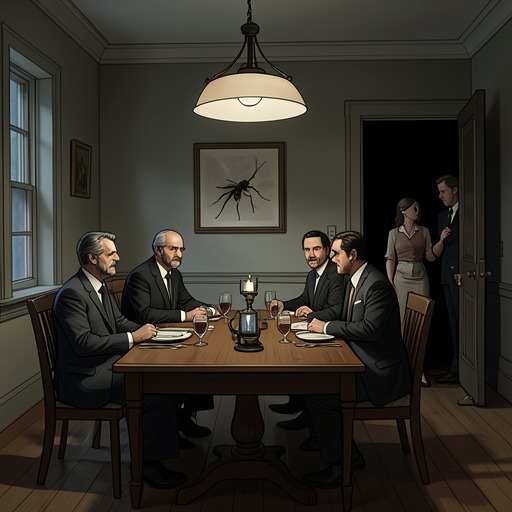
The performance takes place after the three lodgers have finished their evening meal in the shared living room. One of them, the middle lodger who functions as the authority among the three, has produced a newspaper and distributed pages to his companions; they sit back, read, and smoke. The violin begins in the kitchen, where Grete Samsa is playing, and the lodgers immediately become attentive. They stand and move on tiptoe toward the hallway door, pressing close together to listen. Their reaction is not spontaneous admiration so much as a demand for improved accommodation: the middle lodger asks whether Grete would come into the living room and play there, where it is more comfortable.
The family responds with exaggerated deference because the lodgers' rent has become important to the household. Mr. Samsa Samsa answers as though the request were a privilege, and the arrangement is made at once. Mr. Samsa brings the music stand, Mrs. Samsa brings the music, and Grete brings the violin. The parents do not even dare to sit in their own chairs. Mr. Samsa stands by the door with one hand pushed between the buttons of his uniform coat, while one of the lodgers gives Mrs. Samsa a seat and leaves it in an inconvenient corner. The performance is therefore framed by an unequal social order: Grete supplies the labor and the family manages the guests' comfort, while the lodgers occupy the room as evaluators.
The Performance and the Lodgers' Response
Grete begins to play while Mr. and Mrs. Samsa watch her hands closely from either side. The three lodgers first approach the music stand, putting their hands in their pockets and coming so close that they disturb her. They soon withdraw toward the window, however, lowering their heads and speaking to one another in half voices. Their distance, combined with their smoking, makes their judgment clear. They appear to have expected beautiful or entertaining music and to have been disappointed; they remain only out of politeness, while the family anxiously watches them.
The scene contrasts the family's emotional investment with the lodgers' detached assessment. Grete's face is turned toward the lines of music with a careful, melancholy expression, and her parents attend to the movements of her hands. The lodgers, by contrast, treat the performance as another service supplied by the household and then retreat when it fails to satisfy their expectations. Their cigarette smoke rises from their mouths and noses as they wait by the window, a visible sign of their boredom and distance. The performance thus fails as a social transaction even while it succeeds as an intimate artistic act.
Gregor's Entrance and Recognition Through Music
Gregor Samsa is drawn from his room by the violin. Although he has become covered with dust, threads, hairs, and scraps of food, and although he has stopped cleaning himself as he once did, he crawls onto the immaculate living-room floor. No one notices him at first. His family is absorbed in Grete's playing, while the lodgers examine the music and then withdraw. Gregor's movement across the threshold violates the household's established spatial order: the locked bedroom and the shared room briefly become connected by sound before they are connected by his body.
For Gregor, the music produces an experience unlike the family's recent routines of feeding, cleaning, concealment, and surveillance. He crawls farther forward with his head close to the ground, hoping to meet Grete's eyes. The playing seems to direct him toward an unknown nourishment for which he has been yearning. His response gives the episode its decisive moral reversal. The household has increasingly treated him as an embarrassing burden, yet the music allows him to recognize and articulate a depth of feeling that the others no longer see. His reaction is presented not as an argument that he is human by appearance, but as an experience of inward responsiveness that contradicts the family's external classification of him.
Gregor imagines asking Grete to bring the violin into his room, where he alone would appreciate her playing. He imagines keeping her there by her own choice, not forcing her to remain with him, and telling her that he had always intended to send her to the conservatory. He would have announced this plan the previous Christmas if his misfortune had not intervened. In the imagined conversation, Grete would weep with emotion, and Gregor would climb to her shoulder and kiss her unadorned neck. The fantasy preserves their former sibling intimacy while also revealing how completely the relationship has been displaced by concealment and practical care.
Exposure, Conflict, and the Collapse of Hospitality
The fragile connection created by the music ends when the middle lodger points at Gregor and calls Mr. Samsa's attention to him. The violin falls silent. The lodger first smiles at his companions and then looks back at Gregor, treating the exposed figure as more entertaining than the interrupted performance. Mr. Samsa rushes toward the lodgers with his arms spread, trying both to drive them back toward their room and to block their view of Gregor. His priority is not to protect Gregor from humiliation but to manage the lodgers' reaction and preserve the household's rented arrangement.
Grete, who had briefly fallen into despair when her playing was interrupted, recovers and helps restore the lodgers' room under pressure from her father. She quickly arranges the pillows and covers before the lodgers reach it. The movement from violin performance to bed-making exposes the narrow range of roles available to her: her artistic effort is interrupted, and she immediately returns to domestic service. The family cannot allow the performance to remain an independent expression of Grete's ability because the lodgers' displeasure now governs the room.
The middle lodger declares that he is giving immediate notice on his room because of the repugnant conditions in the apartment and the family. He refuses to pay for the days he has stayed and threatens to consider legal action for damages. The violin performance therefore changes the status of the lodgers from paying occupants to hostile witnesses and turns the shared living room into the site of a public breach. Music, which might have offered a form of communication, instead reveals the household's concealed crisis and destroys the family's attempt to keep Gregor's presence separate from its economic life.
Consequences for Gregor and the Family
Gregor's emergence is followed by his forced return to Gregor Samsa's room. After he has turned himself around with difficulty and crawled back, Grete hurriedly shuts the door, bolts it, and locks it. She has been waiting for him and springs forward so quickly that he does not hear her approach; as she turns the key, she says, "At last!" The word marks a final boundary. The door no longer merely separates Gregor from the family while they negotiate his condition; it becomes the instrument by which the family reasserts its restored interior order.
The contrast with earlier domestic scenes is sharp. Gregor had once locked the doors at night as a cautious habit connected with travelling and work, and the family had learned to communicate with him through closed doors. Later, Grete had entered his room to bring food and had considered removing the chest of drawers and desk so that he could crawl more freely. By the time of the performance, however, shared space has been reorganized around the lodgers, Gregor's room has become a repository for unwanted objects, and his appearance in the living room is treated as an intolerable exposure. The same architectural feature that once protected Gregor's privacy now completes his exclusion.
Inside the darkness, Gregor discovers that he can no longer move. His body aches, the apple lodged in his back is barely perceptible, and the inflammation around it is covered with white dust. He thinks of his family with emotion and love and concludes that, if possible, he must go away even more strongly than Grete. After a period of peaceful, empty reflection, he hears the clock tower strike three in the morning. As daylight begins outside the window, his head sinks down and his last breath leaves him. The violin performance does not save Gregor, but it gives his final withdrawal a specific inward cause: he has heard a form of beauty and imagined a renewed bond, only to encounter the household's decisive refusal.
Narrative Significance
Grete's violin performance condenses the work's recurring conflicts among communication breakdown, domestic confinement, economic dependence, and residual humanity. The family hears music as a service for tenants; the lodgers hear it as a commodity that can be judged and rejected; Gregor hears it as a language capable of reaching the self that ordinary speech can no longer convey. The same sound therefore produces three incompatible meanings, and the absence of shared interpretation becomes the scene's governing tragedy.
The event also reverses the presumed hierarchy between appearance and inward life. Gregor is visibly degraded and materially excluded, yet he responds to Grete's playing with the richest imaginative and relational vision in the scene. Grete, who has shown courage in caring for him, is nevertheless absorbed into the family's service economy and cannot recognize what the music awakens in him. The lodgers, who possess social authority and physical access to the living room, display the least emotional engagement with the performance. The scene's final irony is that the music confirms Gregor's continuing humanity for the reader while making his social expulsion more complete within the household.