Metamorphosis and transformation
The MetamorphosisMetamorphosis and transformation is not merely the fantastic premise of Gregor Samsa’s story but the process through which every surrounding category becomes unstable. Gregor remains mentally concerned with trains, debt, employment, breakfast, and his family even after waking with an altered body, while those around him increasingly define him through his appearance, his unintelligible voice, and the burden he imposes. The transformation therefore exposes a conflict between inner continuity and external classification: Gregor experiences himself as the same person, but the household, the workplace, and eventually the narrative’s social world withdraw that identity from him.
Bodily Change and Immediate Disorientation
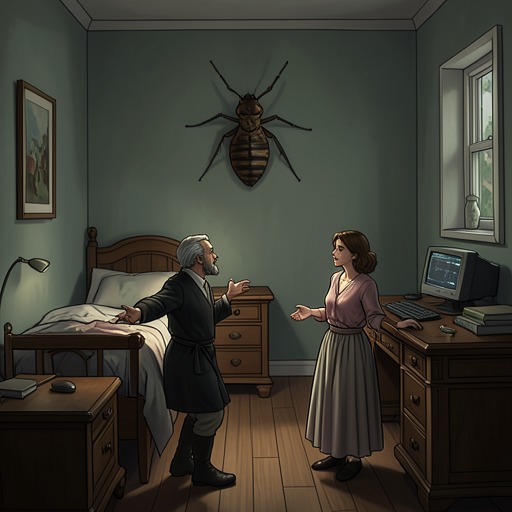
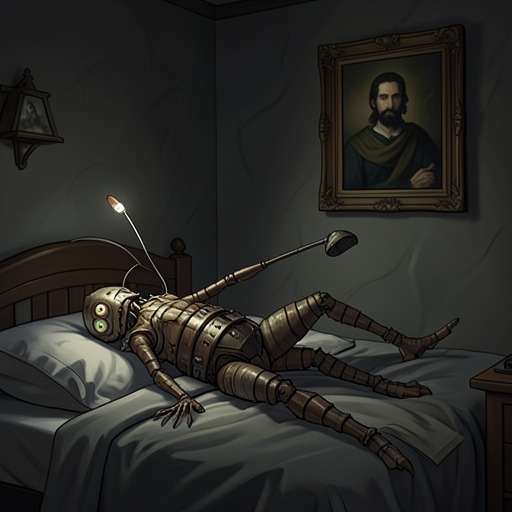
The transformation appears without an explained cause. One morning, Gregor Samsa wakes from troubled dreams and finds himself changed in his bed into “a horrible vermin.” His body has an armour-like back, a slightly domed brown belly divided into stiff sections, and many thin legs that wave helplessly. The human room remains intact around him: the familiar walls, the travelling salesman’s textile samples, and the framed picture of a woman in fur preserve the ordinary setting while making his new body seem even more impossible.
Gregor’s first response is not philosophical wonder but practical denial and physical experimentation. He looks toward the dull, rainy window, considers sleeping longer, and tries repeatedly to roll onto his right side, the position in which he is accustomed to sleeping. Each attempt fails, sending him back onto his back and eventually producing a new, mild pain. The body’s alteration is thus established through frustrated routine: a familiar gesture becomes impossible, and a habit that once confirmed his ordinary humanity now demonstrates his estrangement from it.
The same tension governs his attempt to rise. He first plans to throw off the covers, dress, eat breakfast, and decide what to do afterward. He tells himself that the strange voice may be the beginning of a serious cold, an occupational hazard for a travelling salesman, and remains convinced that sensible thought cannot occur while he lies in bed. Yet the physical details defeat this explanation. Instead of arms and hands, he has uncontrolled legs moving in different directions; his broad body slides from the chest of drawers; and when he forces himself forward, he strikes the bedpost and discovers that the lower part of his body is especially sensitive.
Work, Debt, and the Persistence of the Former Self
Gregor’s transformation initially changes neither his sense of duty nor his understanding of his place in the family. The alarm clock shows that he has missed the five o’clock train and may also miss the next one. He worries about uncollected samples, the office assistant’s report, and the anger of his employer. His fifteen years of service without a single illness make a report of sickness appear suspicious, and he imagines the employer sending a doctor from the medical insurance company to accuse his parents of having a lazy son. Even while transformed, Gregor feels physically well apart from excessive sleepiness and hunger; the crisis is interpreted through the language of attendance, suspicion, and productivity rather than through diagnosis.
His employment is inseparable from his family obligation. Gregor has undertaken to pay off his parents’ debt to his employer, estimating that five or six more years will be needed before he can make the major change he has long imagined. He also supports his parents and sister, and later explains to the Chief Clerk that commercial travelling is arduous but necessary because he cannot earn his living without travelling. The altered body therefore collides with a social identity already organized around economic dependence: Gregor is valued as a worker, debtor, and provider before he is approached as a suffering person.
This persistence of work anxiety gives the transformation its particular force. Gregor does not wake with a new set of desires or a liberated outlook; he wakes still trying to catch a train. His first instinct is to preserve the schedule that has structured his life, even though his body can no longer perform the simplest movement required to leave the bed. The fantastic change reveals how deeply labor discipline has entered his consciousness: physical catastrophe is initially treated as an interruption to be explained, managed, and overcome.
Voice, Doors, and the Collapse of Recognition
Communication breaks down before the family sees Gregor. When his mother knocks and asks whether he intended to go somewhere, Gregor answers that he is getting up, but his voice can hardly be recognized. A painful squeaking lies beneath the words, and an echo makes them unclear to the hearer, although Gregor himself believes his speech is becoming clearer. He carefully enunciates his replies to his father and Grete, hoping to remove the strangeness from his voice. The discrepancy between what he means and what others can receive becomes the first social form of the transformation.
The locked doors briefly preserve Gregor’s former identity. He congratulates himself on his travelling habit of locking every door at night, even when at home, and refuses to open the room while he dresses and attempts to regain control of his body. Behind the doors, however, concern quickly becomes institutional pressure. The Chief Clerk arrives to demand an explanation for Gregor’s absence, accusing him of causing unnecessary concern to his parents and failing in business duties. The workplace’s first interpretation of the transformed man is not illness but possible irresponsibility, suspicion, and professional failure.
Gregor still believes that opening the door will restore a shared reality. He wants the Chief Clerk and his family to see him, reasoning that if they are shocked, the responsibility will no longer be his, while if they remain calm, there will be no reason to be upset. He drags himself to the door with a chair, braces himself against it with the adhesive tips of his legs, and turns the key with his powerful jaw. The effort injures him: brown fluid runs from his mouth over the key and onto the floor. Yet the turning lock briefly encourages everyone, because it is recognizable as a human action even when performed by an altered body.
When the door opens, recognition becomes horror. The Chief Clerk retreats with his hand over his mouth; Mrs. Samsa collapses; and Mr. Samsa clenches his fists as though prepared to force Gregor back into his room before covering his face and weeping. Gregor alone remains comparatively calm. He speaks about dressing, packing his samples, reaching the station, and asking the Chief Clerk to report accurately that a temporary inability to work should not erase his past diligence. His reasoning still belongs to the world of employment and family provision, but the listeners hear only an animal voice. The door, once a private safeguard, becomes a threshold across which Gregor’s continued humanity cannot pass.
From Family Member to Managed Body
After the first confrontation, Gregor is forced back into his room. His father drives him forward until one side of his body scrapes against the white door, leaving him injured and bleeding; a final shove sends him deep into the room, and the door is slammed shut. The household has not discovered a curable illness or made an arrangement with a changed family member. It has established confinement as the practical response to a body that cannot be understood within ordinary domestic space.
That evening, Gregor wakes from a deep, coma-like sleep with a painful scar stretching across his left side and one leg dragging lifelessly. He follows the smell of food to a dish of sweetened milk with pieces of white bread, which Grete has left because milk had previously been his favorite drink. The food becomes an immediate test of continuity and difference. Gregor is hungrier than before, yet the milk disgusts him and he cannot eat it comfortably. His appetite has changed along with his body, but his family still attempts care by relying on the memory of the person he was.
The family’s quietness then redefines the apartment. Through the living-room door, Gregor watches the gaslight and remembers the earlier household habit of his father reading the evening paper aloud. He feels pride that his work had provided his parents and sister with a peaceful, comfortable home, but he also fears that this peace and wealth may now end. The open or closed doors measure his changing membership: while the family once sought him urgently behind the locked room, no one enters after he becomes visible, even though the room is no longer securely closed.
The transformed body also alters the household’s labor. Gregor’s injuries leave him with greatly reduced mobility, perhaps permanently, and crawling across his room takes long minutes. Nevertheless, the family’s former dependence on his income is gradually replaced by their own work: his father, his mother, and Grete take on occupations or prepare for better positions. The transformation thus changes not only Gregor’s physical condition but the family system built around him. He shifts from provider to dependent, and the others shift from dependents to workers.
Furniture, the Fur Picture, and Classification
The removal of Gregor’s furniture makes the transformation spatial as well as bodily. Grete and Mrs. Samsa begin clearing the room, carrying away the chest containing his fretsaw and other tools and threatening to remove the writing desk where Gregor had done homework from childhood through his business training. To the women, the activity may seem like a practical adaptation to his new mobility; to Gregor, the scraping furniture and repeated movements feel like an assault from every side. The objects preserve a material record of his human history, so their removal threatens to erase the evidence that he once occupied the room as a student and worker.
Gregor’s response is selective and revealing. When the room has been stripped of much of its contents, he rushes to the framed picture of the woman in fur, climbs onto it, and presses his hot belly against the glass. He resolves that this image, now covered by his body, will not be taken away. The picture becomes a boundary object between his former human attachments and his present animal form: he protects a distinctly human possession through distinctly nonhuman movement, while using his altered body to preserve the memory of the self that others are beginning to discard.
The scene also shows how unstable the family’s categories have become. Grete tries to protect her mother from seeing Gregor, while Mrs. Samsa recognizes him only after seeing the enormous brown patch against the wallpaper. Grete then addresses him directly for the first time since his transformation, shouting his name and treating him as a dangerous presence. Gregor attempts to help as he once would have, imagining that he might advise his sister, but he can only stand behind her and do nothing. The former brother remains present in intention, while the family responds to an animal-shaped body that no longer supports their customary relation.
Recognition, Death, and the Family’s New Future
The apple lodged in Gregor’s flesh remains for more than a month because no one dares remove it. It becomes a visible reminder of his injury and, for a time, forces even Mr. Samsa to acknowledge that Gregor remains a family member despite his revolting form. The family’s duty is described as the need to overcome revulsion and practice patience. Yet this recognition is provisional: it does not restore conversation, work, or equality, and it coexists with confinement and deterioration.
The decisive reversal comes when Grete rejects the idea that the creature is still her brother. She argues that the family must get rid of the belief that the animal is Gregor, because living with it has harmed them, driven out the tenants, and threatened to leave them without a home. Her logic converts failed recognition into a condition for survival: if Gregor were still Gregor, she reasons, he would understand that human beings cannot live with such an animal and would have left voluntarily. The family member has become, in her account, an intruder whose removal permits the family to resume its life.
Gregor’s final movement is misunderstood in the same way. He is only trying to turn around and return to his room, but the effort is so painful that he repeatedly strikes his head against the floor and alarms the others. After he manages to get inside, Grete hurriedly locks and bolts the door. Unable to move, Gregor experiences the stillness as both physical collapse and relief. The pain from the decayed apple and the inflamed area around it has weakened, and he thinks of his family with emotion and love, feeling that he must go away even more strongly than Grete does. At three in the morning, as daylight begins outside, his head sinks and his last breath leaves him.
After Gregor’s death, the transformation is retrospectively completed by the family’s language and behavior. The Charwoman discovers that his body can be pushed across the floor without resistance and announces that it is dead. Grete observes that he has become thin because he had eaten almost nothing, while Mr. Samsa gives thanks for the death and crosses himself with the women. The corpse is dried up and flat, a final material reduction of the body that had once been broad, mobile, economically productive, and capable of sustaining a family.
The family’s subsequent outing reveals the social meaning of this ending. After dismissing the Charwoman, the Samsa family leaves the apartment together for the first time in months and travels by tram into the open country. They discover that all three have good jobs with promising prospects and begin considering a smaller, cheaper, better-located home. Their attention turns toward Grete’s future as she appears to blossom into a young woman whom they may soon marry to a suitable man. The transformation has not led to a cure or reintegration; it has ended in Gregor’s death and the family’s renewed mobility, economic confidence, and future planning.
Thematic Significance
The concept joins bodily difference to social value without reducing either to a single medical explanation. Gregor’s symptoms include altered speech, pain, changed appetite, impaired mobility, injured limbs, and eventual wasting, but the story supplies no diagnosis and no successful medical intervention. The doctor is imagined as an authority who might classify absence from work, while the Chief Clerk classifies the same crisis as a business failure and the family alternates between care, fear, impatience, and expulsion. The body is therefore interpreted through competing institutions and relationships rather than understood on its own terms.
Metamorphosis and transformation also dramatizes dehumanization as a process of naming and exclusion. Gregor’s inward continuity survives the change: he worries about his parents’ debt, wants to protect his sister, remembers his work, tries to help with his mother, and dies thinking of his family with love. External recognition steadily contracts. His voice becomes an animal sound, his room becomes a space to manage, his food becomes evidence of difference, his furniture becomes negotiable, and his body becomes a corpse whose removal restores domestic order. The transformation is complete not when Gregor changes shape, but when the social world makes his former identity irrelevant.
At the same time, the narrative refuses to present the family as unchanged observers. Gregor’s metamorphosis reorganizes the entire household. His parents and Grete move from dependence on his wages toward their own employment, while Grete’s relation to him changes from attentive sisterly care to explicit rejection. The family’s improved prospects after his death expose the economic structure beneath their affection, but the story also preserves the fact that they once felt duty and patience toward him. Transformation thus works in both directions: Gregor becomes unrecognizable to the family, and the family becomes a different social unit because he can no longer perform the role that held it together.