Mr. Samsa
The MetamorphosisMr. Samsa, Gregor Samsa’s father, is both a member of the family sustained by Gregor’s labor and the household authority who ultimately enforces Gregor’s exclusion. His decisive significance lies in this reversal of dependence: before Gregor’s transformation, he appears exhausted and economically defeated; afterward, he resumes paid work, stands upright in a bank uniform, and becomes the principal force driving Gregor back into confinement. Through him, the family’s crisis becomes a visible struggle over authority, obligation, and who may still count as a person within the home.
Identity and Background
Before Gregor Samsa’s transformation, Mr. Samsa is presented through Gregor’s memory as a tired, diminished figure. When Gregor returned from business trips, his father lay in bed; in the evenings he received his son from an armchair while wearing a nightgown, and on the family’s occasional walks he could scarcely keep pace. Gregor remembered that his father’s pleasure was expressed by raising his arms and that he had to stop carefully, placing his stick down before gathering the others around him to speak. This image establishes a father whose physical and social authority has apparently declined, leaving Gregor to occupy the practical role of provider.
The family’s financial collapse five years earlier had intensified that reversal. Mr. Samsa’s business failure seemed, to Gregor, to have left nothing behind, and Gregor responded by working with exceptional energy. He rose from junior salesman to travelling representative, placed his earnings before the family, and eventually bore the costs of the household. Yet Mr. Samsa had secretly preserved some receipts and documents in a locked cash box. When he explains the family’s finances after Gregor is confined, Gregor learns that not everything has been lost. The discovery complicates Gregor’s sacrifice: his labor had been real and necessary, but the family’s situation was not quite as hopeless as he had believed.
The First Crisis and Gregor’s Expulsion
On the morning of Gregor’s transformation, Mr. Samsa is one of the family members who calls through the closed doors of Gregor Samsa’s room. His knocking is initially gentle, but his repeated summons acquire a warning depth. Gregor answers that he is ready, trying to disguise the strangeness of his voice, while Mr. Samsa eventually returns to breakfast. At this stage, concern remains entangled with expectation: Gregor is still presumed to be a worker who has failed to leave for the train.
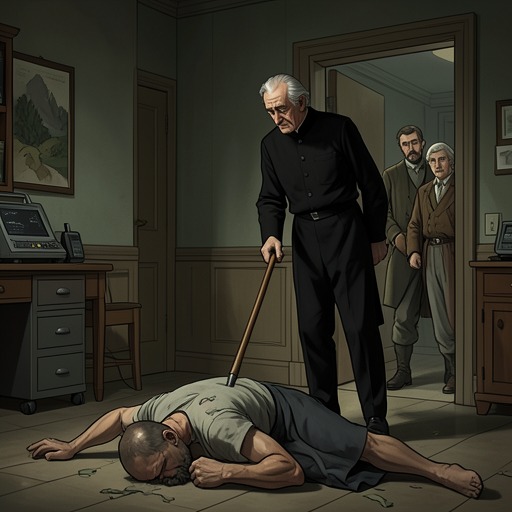
When the Chief Clerk arrives to investigate Gregor’s absence, Mr. Samsa urges him to open the door. Gregor refuses, and his refusal deepens the family’s alarm. Once Gregor opens the door and exposes his transformed body, Mr. Samsa does not interpret his appeals or recognize the intention behind his movements. The flight of the Chief Clerk turns the father’s anxiety into panic. He takes the Chief Clerk’s stick and uses it with a large newspaper to drive Gregor back toward Gregor Samsa’s room, stamping his foot and hissing like a wild man.
The expulsion is both physical and symbolic. Gregor can move forward only with difficulty, cannot reverse in a straight line, and is too broad to pass easily through the doorway. Mr. Samsa does not open the second door or allow him time to position himself; he is fixed on getting Gregor back inside as quickly as possible. Gregor’s flank scrapes against the white door, leaving brown marks, and his father finally shoves him through, sending him heavily bleeding into the room before slamming the door shut. The home’s boundary is thus re-established through force, with Mr. Samsa acting as the guardian of a domestic order that Gregor’s body has made unintelligible.
Economic Recovery and Reclaimed Authority
Gregor’s confinement forces Mr. Samsa to disclose the family’s remaining financial resources, but it also forces him to return to active labor. Later, when he comes home during the confrontation caused by Gregor’s escape from the room, Gregor is astonished by the change in his appearance. The father he had remembered as nearly incapable of standing now appears in a smart blue uniform with gold buttons, the clothing associated with employees of a banking institute. His white hair is combed close to his scalp, his eyes are fresh and alert, and his strong double chin rises above the stiff collar. The uniform makes his renewed social position visible before he performs any action.
The physical transformation of Mr. Samsa’s role is sharply contrasted with Gregor’s deterioration. Gregor, once the travelling representative who financed the household, is confined, hungry, injured, and increasingly unable to move. Mr. Samsa, once dependent and inactive, has regained the ability to work and the authority to command. Their altered bodies and positions form an ironic exchange: Gregor’s loss of human form coincides with his loss of economic power, while his father’s renewed appearance accompanies the recovery of paternal control.
The Apple Attack and Family Conflict
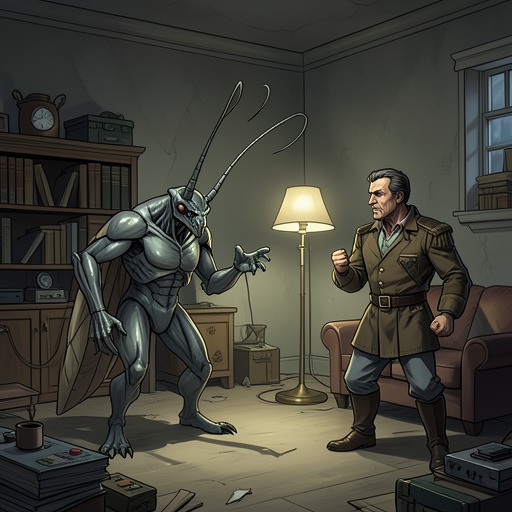
When Mr. Samsa finds Gregor outside his room, he advances with determination, lifting his feet unusually high. Gregor tries to anticipate each movement and remains on the floor because he fears that climbing the walls or ceiling would provoke his father further. The encounter proceeds slowly at first, but Gregor becomes exhausted and nearly loses consciousness. Mr. Samsa then fills his pockets with apples from the sideboard and begins throwing them without taking time to aim carefully.
One apple glances off Gregor’s back, but another strikes him squarely and lodges in his flesh. Gregor becomes unable to move, while Mrs. Samsa runs to her husband and begs him to spare their son. Mr. Samsa’s action is therefore not merely a moment of private anger; it is a violent attempt to restore control over the household, checked only when the women intervene. The apple is not removed. It remains embedded for more than a month, a visible reminder that Gregor is still a family member even in what the family finds revolting, and that the duty to endure him has not entirely disappeared.
The injury permanently reduces Gregor’s mobility. He becomes like an ancient invalid, taking long minutes to cross his room and losing the ability to crawl across the ceiling. Mr. Samsa’s violence consequently changes the practical conditions of Gregor’s existence while also producing a grudging limit on further violence. The father can treat Gregor as an enemy in the moment of panic, but the lodged apple makes that treatment impossible to forget.
Authority, Exclusion, and the Final Household Order
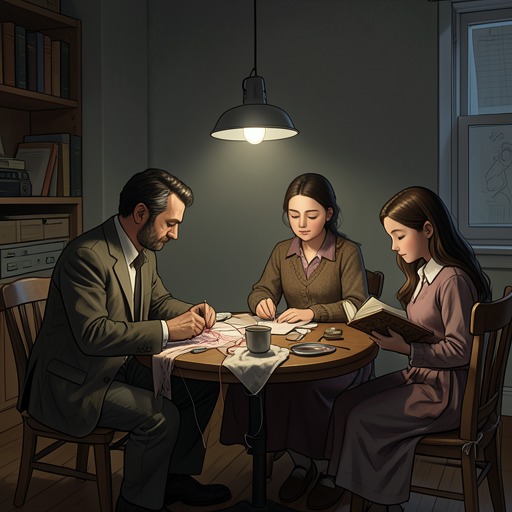
As the family’s circumstances change, Mr. Samsa’s authority becomes less openly active but no less decisive. The family members take jobs, and their evenings become quiet and laborious: Mrs. Samsa sews, Grete Samsa studies shorthand and French after taking a sales position, and Mr. Samsa sleeps in his chair. The household is no longer organized around Gregor’s income. It is instead a strained working system in which each surviving member contributes, while Gregor watches from the darkness of his room through the open living-room door.
The decisive rupture comes after the lodgers hear Grete’s violin performance and then see Gregor. Grete declares that the family cannot continue living this way and insists that the creature must be removed. Mr. Samsa silently recognizes that she is right. When he asks whether Gregor can understand them, he accepts her certainty that communication is impossible; the possibility of an arrangement between father and son collapses because Gregor’s body and silence have been reclassified as proof that he is no longer Gregor.
After Gregor dies, Mr. Samsa immediately reasserts his authority over the apartment. Appearing in uniform with Mrs. Samsa and Grete beside him, he orders the Three Lodgers to leave. He does not negotiate or explain; he points toward the door and repeats that he means exactly what he has said. The lodgers depart, and the family’s attention shifts away from them as they descend the stairs. This expulsion mirrors Gregor’s earlier forced return to his room, but the direction of power has changed: Mr. Samsa is now strong enough to remove outsiders and reclaim the home without assistance.
Change and Narrative Role
Mr. Samsa’s trajectory exposes the family system’s dependence on roles rather than stable affection. Gregor once supported the household and imagined announcing his plan to send Grete to the conservatory on Christmas Day. After Gregor’s transformation, Mr. Samsa’s preserved savings and renewed employment reduce the family’s dependence on him, while his uniform and commands make him the visible center of the reorganized household. The father’s recovery therefore accompanies Gregor’s abandonment, not because the family becomes independent through mutual understanding, but because responsibility is redistributed and Gregor is progressively excluded from the exchange of work, speech, food, and space.
His final response to the death is not extended mourning but restoration. He joins Mrs. Samsa and Grete in writing letters of excuse, then agrees that they should relax and go for a walk. On the tram, the three discuss their prospects and discover that all of them have jobs with promising futures. They consider moving to a smaller, cheaper, better-located apartment, and Mr. Samsa and Mrs. Samsa recognize that Grete has become a healthy young woman for whom a suitable marriage may soon be sought. Mr. Samsa thus ends the story as part of a family looking forward, while Gregor’s death functions as the condition under which the household can imagine a more practical home and a future centered on Grete.