Music and residual humanity
The MetamorphosisMusic and residual humanity is a central concept in Metamorphosis because music gives Gregor Samsa’s inner life its clearest surviving form. Before his transformation, his work as a travelling salesman had made him responsible for supporting the household, yet his closest remaining attachment was to Grete Samsa, a gifted and expressive violinist. After Gregor becomes unable to work, speak intelligibly, or participate in family life, music allows him to recognize desire and tenderness within himself. It also reveals the widening distance between what Gregor experiences inwardly and what the people around him are willing to see.
Music Before the Transformation
Gregor’s relationship with Grete’s music is rooted in the family’s earlier economic and emotional arrangement. After the collapse of his father’s business, Gregor worked with unusual intensity, rising from a junior salesman to a travelling representative and placing his earnings on the table for the benefit of the family. He was able to bear the costs of the household, and the family accepted his money with gratitude, although the warmth of their affection did not remain proportionate to his financial contribution.
Grete’s violin playing marked a different kind of value within that exchange. Gregor remained especially close to her because she loved music and played the violin with talent and expressiveness. He had secretly planned to send her to the conservatory the following year, despite the considerable expense, and intended to announce this plan on Christmas day. Their conversations about the conservatory had usually been treated as a beautiful but unrealizable dream, partly because their parents did not like hearing about it. Gregor’s intention nevertheless gave his labor a personal horizon: the money he earned was not only for debt, food, and household survival, but also for Grete’s artistic future.
The Violin Performance
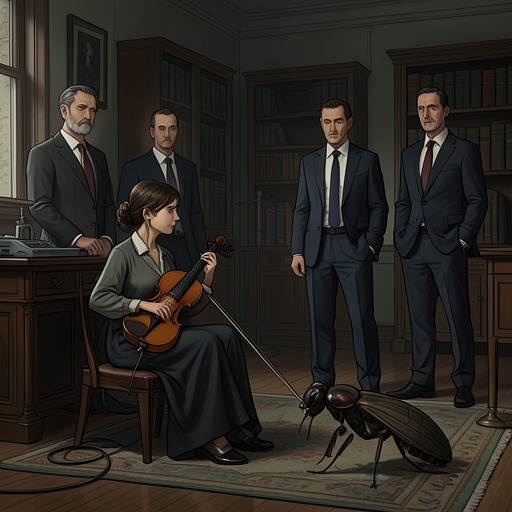
The decisive musical scene occurs after the Samsa family has taken in three lodgers to meet its financial needs. The three gentlemen finish dinner, read newspapers, and smoke while Grete plays the violin from the kitchen. They then ask whether she would play in the living room, treating the performance as a service within the rented household. The family responds with exaggerated courtesy because it has never rented out rooms before: Gregor’s father brings in the music stand, his mother brings the music, and Grete enters with the violin.
The family listens closely, but the three lodgers soon withdraw toward the window. Their behavior suggests that they expected entertaining or beautiful music and have been disappointed, even though they remain outwardly polite. The contrast makes Grete’s playing more significant for Gregor. The lodgers hear a performance that fails to satisfy their immediate expectations; Gregor hears something that reaches a need he has not been able to name.
Drawn by the music, Gregor crawls out of his room and places his head into the living room. His body is covered with dust, hairs, threads, and remains of food, and he has become too indifferent to clean himself as he once did. He nevertheless crosses onto the immaculate floor, not because he has ceased to understand shame, but because the violin has overcome his impulse to remain hidden. The music temporarily reverses the household’s spatial order: the creature confined behind a door moves toward the family, while the people who claim the living room remain unable to perceive what the performance means to him.
Music as Proof of Inner Life
Gregor’s response to the violin is the clearest challenge to the assumption that his transformed body has erased his humanity. He wonders whether he is an animal if music can captivate him, but the question is immediately answered by his conduct. He experiences the playing as a form of nourishment, a way toward something unknown for which he has been yearning. His response is not merely sensory pleasure. It involves recognition, hope, memory, and a renewed wish to act for Grete’s sake.
He imagines bringing Grete into his room with her violin, where he could listen more attentively than anyone else. He wants to tell her that he had always intended to send her to the conservatory and that he would have announced the plan at Christmas if the misfortune had not intervened. In this imagined conversation, he sees Grete moved to tears, while he climbs to her shoulder and kisses her neck. The fantasy combines his old protective affection with a new awareness that Grete has begun working and no longer wears a necklace or collar when she goes out. Music therefore restores not Gregor’s former social identity, but his capacity to form a meaningful relation under radically changed conditions.
The scene also shows that Gregor’s residual humanity is active rather than passive. He does not simply remember that he once loved music. He makes a decision based on what he hears, advances toward Grete, and imagines reorganizing the family’s future around her artistic gift. His old economic role and his new bodily condition meet in the same impulse: he still wants to protect another person’s possibility, even though he can no longer earn the money required to do so.
The Collapse of Recognition
The violin’s power does not produce mutual recognition. The middle lodger notices Gregor first and points him out to Gregor’s father. The music stops, and Gregor’s father rushes toward the lodgers, attempting both to drive Gregor away and to block their view of him. The lodgers are not primarily horrified; they are interested, annoyed, and eager for explanations, treating Gregor’s appearance as an unexpected disturbance in their rental arrangement. Their response places social and economic judgment above Grete’s performance and above Gregor’s inward experience.
Grete’s reaction is also revealing. When her playing is interrupted, she first collapses into despair, then places the violin on her mother’s lap and runs to make the lodgers’ beds under pressure from her father. The instrument, which had momentarily opened a space for expression, is quickly absorbed back into domestic service. Grete’s musical ability is real, but the household’s financial hardship has turned her into a sales worker and a provider of practical labor. Music survives as a human possibility, yet the family’s economic structure continually subordinates it.
Gregor’s movement toward the violin thus becomes a final attempt at communication. He cannot speak in a form the family can receive, and his appearance prevents the others from interpreting his advance as an expression of care. The music briefly makes his inner humanity legible to himself; its interruption makes that humanity socially invisible again. The episode ends not with reconciliation but with the exposure of a gap between inward value and outward status.
Family Labor and the Residue of Humanity
Music cannot be separated from the labor crisis surrounding it. Gregor had once imagined leaving his exhausting career after paying off his parents’ debt to his employer, a process he estimated would take another five or six years. His work was governed by early trains, irregular food, constant travel, business supervision, and the threat of dismissal. The chief clerk’s visit makes clear that Gregor is valued through attendance, turnover, and obedience, while the family’s survival depends on the continuation of his income.
After Gregor’s transformation, the family gradually enters the labor market itself. His father returns to work, his mother sews fancy underwear for a fashion shop, and Grete takes a sales job while studying shorthand and French to improve her future position. The household dismisses its maid, employs the Charwoman for heavy work, sells family jewelry, and remains trapped in an apartment that is too large for its reduced circumstances. The family’s need to earn money leaves little time for Gregor beyond what is absolutely necessary. As his usefulness declines, the care once associated with family membership becomes hurried, uncomfortable, and increasingly resentful.
That change is visible in the treatment of food as well as music. Grete begins pushing food into Gregor’s room with her foot before rushing to work and sweeping it away later, often without caring whether he has eaten. Gregor sometimes plans to enter the pantry to take what he believes he is entitled to, even when he is not hungry. His appetite and the family’s meals become signs of a broken exchange: he remains within the household but no longer participates in its shared consumption or reciprocal obligations.
The violin scene resists that reduction of persons to economic functions, but only briefly. Grete’s playing recalls her artistic identity, Gregor’s protective purpose, and a form of affection not measured by income. Yet the performance is interrupted by the lodgers’ demands and by the family’s fear of losing rent. Music reveals the humanity that economic dependence has obscured; it does not undo the material conditions that make that obscuring possible.
Significance and Aftermath
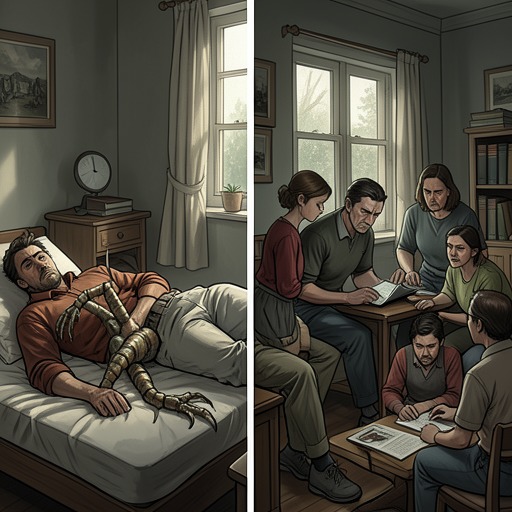
Music becomes the last medium through which Gregor recognizes himself as capable of attachment and through which the narrative invites readers to recognize him beyond the category of a horrible vermin. His physical decline, the apple lodged in his flesh for more than a month, and his reduced mobility have made him appear increasingly like an invalid or an object requiring management. Even so, the family’s duty to treat him as a member has not entirely disappeared. The violin performance gives that residual membership its most intense expression, because Gregor responds not with hunger or fear but with an understanding of Grete’s unrealized artistic life.
The scene is also tragic because Grete’s music cannot become the shared human language Gregor hopes for. The family treats it as part of hospitality, the lodgers judge it as entertainment, and Grete must return almost immediately to practical work. Gregor alone hears its full significance, but his transformed body makes his interpretation impossible to communicate. Music therefore stands between speech and silence: it reaches the deepest surviving part of Gregor while remaining powerless to restore him to social exchange.
After Gregor dies, the family leaves the apartment together for the first time in months and discusses its prospects. All three remaining members have jobs with promising futures, and they begin planning a smaller, cheaper, more practical home. Their attention turns toward Grete’s growth into a young woman and toward finding a suitable husband for her. Against that renewed domestic future, Gregor’s response to the violin remains a final counter-image: before his death, he was still capable of hearing beauty, imagining Grete’s education, and wanting her to choose closeness freely. Music does not save him, but it preserves the evidence that his humanity outlasts the social recognition of it.