Picture of the Woman in Furs
The MetamorphosisPicture of the Woman in Furs is a framed image in Gregor Samsa's room and one of the few objects that Gregor has personally selected and preserved. At first it appears as part of the room's ordinary human order, but during Gregor's transformation it becomes a boundary marker between the person he understands himself to be and the creature his family can no longer recognize. When the room is stripped of its furniture, Gregor clings to the picture as if defending the last visible proof that his inner life has not been erased.
Appearance and Place in Gregor's Room
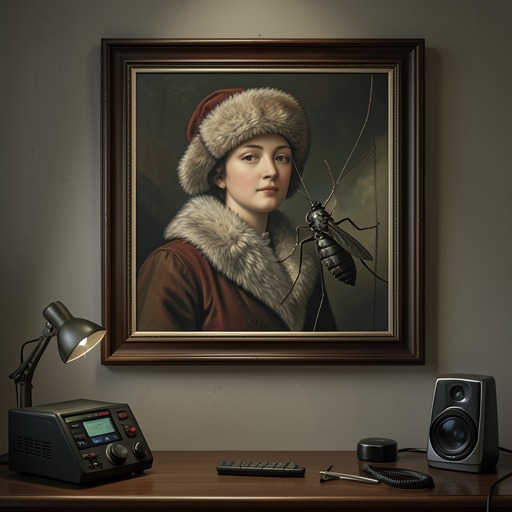
The picture is an image Gregor Samsa cut from an illustrated magazine and placed in a nice gilded frame. It shows a woman wearing a fur hat and fur boa, seated upright and raising a heavy fur muff toward the viewer so that it covers her lower arm. The image hangs above the table where Gregor's textile samples are spread out, linking it to the modest but distinctly human world of his work, habits, and private taste. His room is described as a proper human room, though somewhat too small, and the picture helps establish that setting before the transformation makes the room seem newly strange.
The image also stands among details that locate Gregor within a social and economic identity. The textile samples identify him as a travelling salesman, while the framed picture records an act of selection and arrangement that belongs to Gregor rather than to his employer or family. Even before anyone sees his transformed body, the object silently presents him as someone with preferences, attachments, and a private visual world. Its decorative frame gives the magazine clipping a permanence that the original printed page would not have possessed.
The Picture During the Transformation
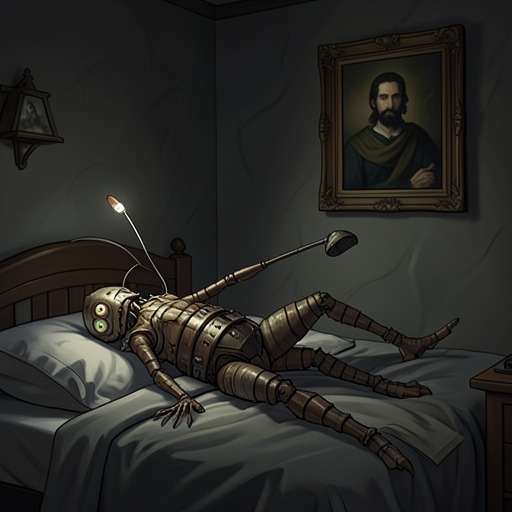
When Gregor wakes transformed into a horrible vermin, the picture remains exactly where it was, while his body has become unfamiliar to him. He lies on an armour-like back, sees a brown, divided belly, and struggles with many thin legs that wave helplessly. Against this physical disintegration, the room's familiar walls and the picture offer continuity. Gregor's first thoughts remain organized around ordinary human concerns: getting up, dressing, eating breakfast, catching a train, and explaining his absence from work. The picture belongs to that same threatened continuity, a material reminder of the life that his body no longer visibly confirms.
The contrast grows sharper when Gregor's voice becomes an animal-like squeak and the Chief Clerk concludes that he is no longer speaking with a human voice. Gregor himself still believes that his words are clear and hopes that the doctor and locksmith will solve the immediate crisis. When he opens the bedroom door, the family and the Chief Clerk respond not to an interior person but to a shocking visible body. The framed image, however, does not change its meaning for Gregor: it remains part of the human room from which he is increasingly excluded.
Removal of Gregor's Furniture
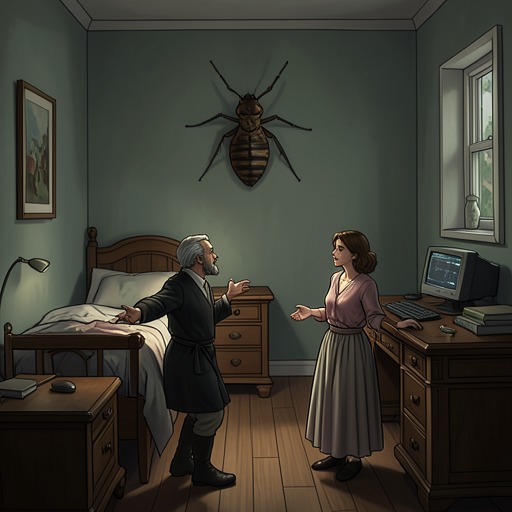
The picture becomes central when Grete Samsa decides that the furniture should be removed to make it easier for Gregor to crawl along the walls and ceiling. Gregor has discovered that he can move across vertical surfaces and hang from the ceiling; the small swing of his body there gives him relief and even a kind of happiness. Grete interprets these traces of adhesive from his feet as evidence that the room should be redesigned around his transformed mobility. Her practical care therefore begins to alter the room that once represented Gregor's human life.
Grete and Mrs. Samsa first struggle to move the chest of drawers. The removal seems, at first, to concern only space, but Gregor experiences the scraping furniture, the women's movements, and their calls to one another as an assault from every side. The chest contains his fretsaw and other tools, while the writing desk bears the worn place where he did homework as a business trainee, at high school, and even at infant school. These objects preserve a continuous biography. Removing them would not merely give him more room to crawl; it would erase the material stages through which his human identity had been formed.
The Picture of the Woman in Furs becomes the decisive object in this conflict because it is the one possession Gregor actively chooses to save. As Grete and Mrs. Samsa pause beside the desk, he crawls out, changes direction repeatedly because he cannot decide what to protect first, and then notices the picture on the wall after everything else has been stripped away. He climbs onto it and presses his body against its glass. The glass holds him firmly and feels good against his hot belly, while the picture is now wholly covered by Gregor himself. He reasons that no one will take it away while he is covering it, turning his body into both shield and barrier.
Family Recognition and the Object's Boundary
Grete sees Gregor on the wall but remains outwardly calm, urging her mother back into the living room. Her response suggests that she wants to secure her mother before forcing Gregor down from the picture. Mrs. Samsa then sees the enormous brown patch against the wallpaper and collapses in terror before she understands what she is looking at. Grete shouts Gregor's name directly for the first time since his transformation and treats his presence as the immediate cause of their mother's crisis. The picture thus becomes the surface on which incompatible classifications meet: Gregor experiences it as a beloved possession, while his family sees a disturbing mass of animal flesh attached to the wall.
Gregor tries to help when the medicine bottle breaks and a splinter cuts his face, but Grete shuts him out with their mother. His attempt to act as he once might have acted—as a family member able to advise and assist—has no practical effect because his body makes him unable to participate in ordinary care. The picture remains behind as the object he has defended, but the defense cannot restore communication or prevent the room from becoming a site of fear. Its preservation therefore carries an irony: Gregor can protect the image, yet he cannot protect his place within the family.
Significance
The picture's significance lies in its material ambiguity. It is a mass-produced magazine image, but Gregor has made it personal by cutting it out, framing it, and placing it in his room. It is decorative, yet it becomes functional when he uses his body to keep it from being removed. It depicts a woman dressed in furs, while Gregor, himself now covered in a hard, animal-like body, presses against the glass. That visual parallel does not make the two figures identical; instead, it exposes how unstable the boundary between a valued image of humanity and a rejected animal body has become.
The object also reveals how identity in the Samsa family is maintained through things as much as through speech. Gregor's voice can no longer be understood, the Chief Clerk calls it the voice of an animal, and later Grete insists that the family must stop thinking of the creature as Gregor. Against those verbal judgments, the picture preserves a concrete trace of Gregor's former self and of his capacity to desire something for himself. The room's furniture, doors, food, and eventually Gregor's corpse all participate in the family's attempt to classify and control him; the picture is the one object he claims in resistance.
That resistance is limited and ultimately tragic. Gregor cannot keep the room unchanged, cannot make his family accept his intentions, and cannot convert the picture into a means of communication. Yet his decision to cover it shows that his transformed body has not emptied him of memory, attachment, or judgment. At the moment when others increasingly reduce him to a pest, a monster, or an obstacle to domestic life, the picture allows the narrative to show a contrary fact without explaining it away: Gregor remains a subject because he can still recognize, value, and defend a chosen object.