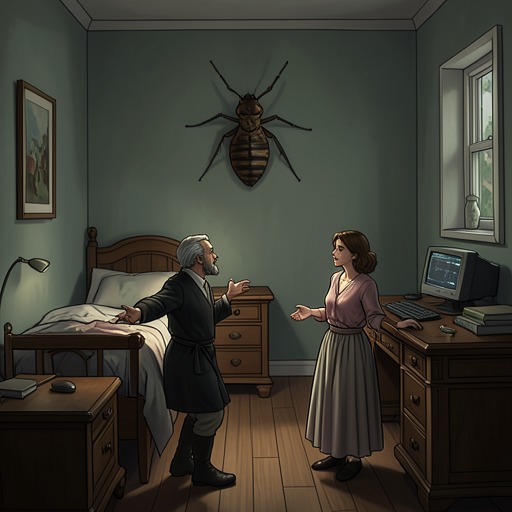
Removal of Gregor's furniture
The MetamorphosisRemoval of Gregor's furniture marks the moment when Gregor's room becomes the battlefield between his altered body and his continuing human identity. After Gregor Samsa's transformation, he learns to crawl up walls and hang from the ceiling, finding movement easier when the room offers open space. Grete Samsa therefore decides to remove the furniture that obstructs him, but the operation also threatens to strip away the objects that connect him to his former life.
Causes and Domestic Context
Gregor's room has become a confined enclosure. His food no longer gives him pleasure, the few square meters of floor leave little room for movement, and he avoids the window during the day so that his parents will not see him there. Crawling on the walls and ceiling becomes his principal diversion; the adhesive traces left by his feet reveal this new bodily capacity to Grete. From her perspective, the chest of drawers and desk are now useless obstacles, and because she has become the family's spokesman about Gregor's condition, she treats their removal as a reasonable form of assistance. The family nevertheless approaches the task through fear and secrecy. Grete cannot ask her father for help, the maid refuses involvement and wants the kitchen kept locked, and so Grete brings in Mrs. Samsa while Mr. Samsa is away. During the first fourteen days, Gregor's parents have not entered the room at all; they wait outside while Grete cleans and ask her what Gregor has eaten, how he has behaved, and whether there has been any improvement. The furniture removal therefore occurs within a care system already organized around indirect reports, closed doors, and the parents' inability to face Gregor directly.
The Dispute Over the Room
Grete begins by planning to move the chest of drawers and the desk, especially the pieces that impede Gregor's crawling. Mrs. Samsa, however, questions whether emptying the room will help. After the women labor for fifteen minutes or more with the chest of drawers, she argues that it is too heavy to finish before Mr. Samsa returns and that leaving it in the middle of the room would make the obstruction worse. More importantly, the bare walls distress her: Gregor has lived among this furniture for a long time, and an empty room might make him feel abandoned. Mrs. Samsa's objection reaches beyond decoration. She fears that removing everything will declare that the family has given up hope of Gregor's recovery and is abandoning him to his altered condition. Her wish is to preserve the room exactly as it was, so that if Gregor returns to them he will find his surroundings unchanged and might more easily forget the intervening period. The room thus carries a future-oriented promise: its familiar contents preserve the possibility that the human Gregor has not vanished completely. Grete rejects this interpretation and insists on removing all the furniture except the couch. Her judgment is based on direct observation of Gregor's new movements, but it also shows how quickly she has begun to speak for him rather than with him. She treats bodily adaptation as proof that the human arrangement of the room should be dismantled, while Mrs. Samsa treats the same room as a material link to Gregor's former self. The disagreement is not simply between sentiment and practicality; it is a conflict over which version of Gregor the family will recognize.
Gregor's Resistance and the Picture
Gregor initially tries to tell himself that nothing extraordinary is happening, only that several pieces of furniture are being moved. The scraping of objects, the women's repeated movements, and their calls to one another soon make that reassurance impossible. The chest containing his fretsaw and other tools has already been removed, and the writing desk is threatened next. The desk is especially charged with memory: its worn place on the floor recalls Gregor's years of homework, business training, high school, and even infant school. As the room is cleared, his biography is being cleared with it. Gregor then leaves his hiding place and searches for something to save. After changing direction four times, he sees the framed picture of the woman in furs on the wall, the only remaining object among the stripped surfaces. He climbs onto it and presses his body against the glass, which holds him firmly and feels good against his hot belly. By covering the picture with himself, he makes it impossible for anyone to remove it. The gesture is both physical defense and symbolic attachment: the transformed body claims the image associated with the human room, refusing to surrender every visible trace of the person he was. Grete sees Gregor on the wall but tries to keep Mrs. Samsa from looking. When Mrs. Samsa nevertheless sees the enormous brown patch against the wallpaper, she screams and collapses onto the couch. Grete addresses Gregor directly for the first time since his transformation, shouting his name and shaking her fist. In the confusion, Gregor attempts to help by following Grete toward the bottles of smelling salts, but he startles her, a bottle breaks, and a splinter cuts his face while caustic medicine spills over him. His effort to act as he once would have acted toward his family produces only further danger, reinforcing the gap between his intention and how others perceive his body.
Consequences for Family Boundaries
Mrs. Samsa's fainting brings Mr. Samsa home, and Grete's hurried explanation leads him to believe that Gregor has caused a serious disturbance. Gregor presses himself against his bedroom door to show that he means no harm and will return inside voluntarily. His father, however, does not recognize this intention. The domestic disagreement over furniture therefore opens into a more violent struggle over access and exclusion: Gregor's room is no longer merely his private space but the boundary to which he is repeatedly driven back. The episode also clarifies why the room cannot be treated as neutral storage. Earlier, Gregor's locked door had protected him from immediate scrutiny while he tried to rise, dress, eat breakfast, and preserve the routines of a travelling salesman. After the furniture is removed, the room becomes increasingly like a cave, a space optimized for crawling but emptied of the objects that confirm a human past. Gregor realizes that such an arrangement would allow him to forget that past more quickly. Mrs. Samsa's voice interrupts that danger, reminding him that the furniture's difficulty is also a restraint against total mental and social disappearance.
Thematic Significance and Aftermath
Removal of Gregor's furniture exposes the unstable boundary between care and erasure. Grete's labor is not presented as simple cruelty: she observes Gregor's physical needs, takes on work his parents cannot perform, and tries to make movement possible. Yet the practical solution carries an irreversible meaning. A room without the desk, tools, and other familiar objects no longer supports the claim that Gregor remains a human family member temporarily afflicted; it begins to classify him solely by his animal body. The scene's most important object is consequently not the furniture that disappears but the picture that Gregor preserves. The image of the woman in furs, already cut from a magazine and placed in a gilded frame, becomes the last defended possession in a room being converted into an enclosure. Gregor's body covers it, but that protection also makes his identity visually inseparable from the monstrous form the family fears. The result is a Gothic domestic image of confinement: the familiar bedroom is emptied from within, the door separates Gregor from those he loves, and the remaining human artifact survives only beneath the body that others no longer know how to recognize. Later, Gregor's injuries and declining mobility make the cleared space less a liberation than a preparation for permanent isolation. His father comes to regard him as a family member who must be tolerated, yet Grete eventually argues that the family must stop believing that the animal is Gregor. In that later rejection, the logic implicit in the furniture removal becomes explicit: once the room's human furnishings have been judged unnecessary, the family can more easily imagine that the human occupant has already disappeared. The event therefore anticipates Gregor's final exclusion and death by turning material surroundings into evidence in the family's changing classification of him.