Samsa family apartment
The MetamorphosisThe Samsa family apartment is both the principal setting of Gregor Samsa’s transformation and a material record of the family’s changing structure. At first it is a familiar home whose rooms preserve ordinary domestic life; after Gregor becomes a horrible vermin, it turns into a controlled enclosure organized around his locked bedroom. As the family loses its former dependence on Gregor, the apartment is progressively reorganized around work, strangers, storage, and finally the removal of the transformed family member from shared consideration.
Definition and Domestic Setting
The apartment initially appears as a stable, recognizably human household. Gregor Samsa wakes in his own room, which remains a proper human room between four familiar walls, though it is somewhat too small. The room contains the practical traces of his occupation as a travelling salesman, including textile samples spread across a table, as well as a framed picture of a woman in a fur hat and fur boa. These details establish the apartment as the intimate center of a life otherwise governed by travel, trains, employers, and commercial obligations.
The apartment also embodies the quiet comfort Gregor believes he has purchased for his parents and sister. Through the crack of his bedroom door, he remembers his father reading the evening paper aloud in the living room and takes pride in having provided the family with peace, wealth, and comfort in a pleasant home. That pride is inseparable from anxiety: once Gregor can no longer work, he fears that the household’s calm and security may come to a frightening end. The apartment therefore begins as both refuge and economic achievement, but its apparent security rests heavily on one person’s labor.
Doors, Rooms, and Enforced Separation
The apartment’s doors become its clearest instruments of separation. Before the crisis, Gregor’s habit of locking every door at night, even when he was at home, seems like a traveller’s caution. On the morning of his transformation, however, the locked bedroom prevents his mother, father, sister, and the Chief Clerk from seeing him. The family gathers outside the door, calling to him from different sides, while Gregor remains physically present but socially inaccessible. His attempt to reassure them through the door fails because his voice has become a painful, barely intelligible squeak.
The apartment’s circulation is consequently controlled by access, visibility, and sound. Gregor hears his family moving outside, receives their questions without being able to answer effectively, and remains preoccupied with opening the door even though he cannot yet control his changed body. When the door is eventually opened, his appearance exposes the crisis to the household and to the workplace represented by the Chief Clerk. Thereafter, the bedroom is not simply a private room but a zone of confinement, approached cautiously, entered under special conditions, and repeatedly closed against him.
The family’s relation to the room changes as Gregor’s condition develops. For the first fourteen days, his parents cannot bring themselves to enter, waiting outside while Grete Samsa cleans and reports what she has seen. Grete becomes the principal intermediary between the imprisoned Gregor and the rest of the apartment. Even when Mrs. Samsa longs to visit her son, she must initially be restrained by her husband and daughter. Domestic care thus takes the form of surveillance conducted across a threshold: Grete reports what Gregor has eaten, how he has behaved, and whether there is any improvement, while the parents remain outside.
The Apartment as a Family Economic System
The apartment’s household arrangements are reshaped by the family’s financial history. After the collapse of Mr. Samsa’s business five years earlier, Gregor worked with exceptional intensity, rising from junior salesman to travelling representative and placing his earnings on the table for the benefit of the astonished family. He was able to bear the costs of the whole household, and the apartment’s comfort was sustained by that income. His transformation therefore removes not only a family member’s labor but the economic mechanism that has organized domestic life.
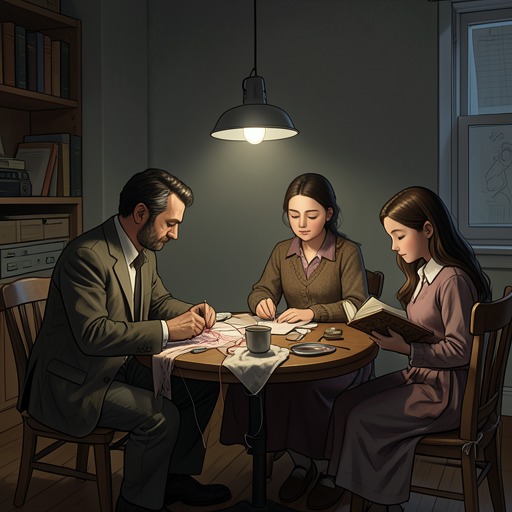
The first day of the crisis reveals that the family is not entirely without resources. Mr. Samsa has retained money and documents in a small cash box from the failed business, although Gregor had believed that nothing remained. This reserve does not restore the former order. Instead, the apartment becomes a place where each member must assume new economic duties. The household dismisses the maid; Mrs. Samsa undertakes extensive sewing for strangers as well as domestic work; Grete takes a sales position and studies shorthand and French in the evenings; and Mr. Samsa brings breakfast to bank employees. Family life becomes a tightly managed combination of paid labor, unpaid care, exhaustion, and restricted consumption.
The material signs of decline accumulate inside the apartment. Family jewelry is sold, meals become smaller, and the family has little time to give Gregor more attention than is absolutely necessary. The apartment is now too large for their circumstances, but moving seems impossible, partly because of the difficulty of transferring Gregor and partly because the family feels overwhelmed by a misfortune they regard as unprecedented. The space that once displayed Gregor’s success becomes an economic burden, even as the family continues performing the labor expected of poor people.
Storage, Lodgers, and the Reclassification of Gregor
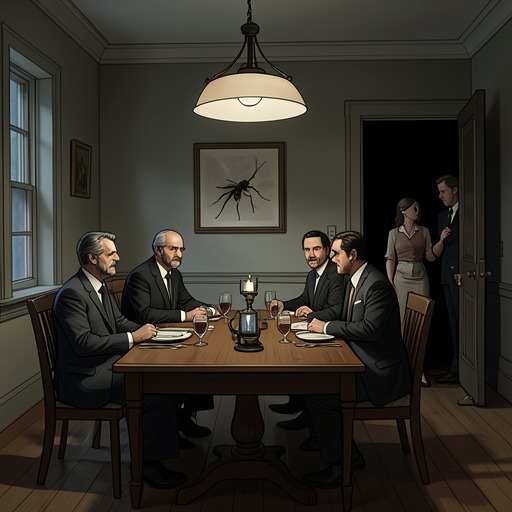
As the apartment’s economic pressure increases, one room is rented to The Three Lodgers. The lodgers bring much of their own furniture and equipment and demand rigorous tidiness throughout the household, especially in the kitchen. Their presence changes the function of Gregor’s room. Objects that cannot be sold and that the family does not wish to discard are placed there, along with kitchen dustbins and other unwanted items. The room becomes a repository for the household’s surplus, and Gregor is gradually treated as part of the clutter that has accumulated around him.
Gregor initially moves the objects because the room is his only remaining area in which to crawl. Later, despite the sadness and exhaustion caused by the effort, he derives some satisfaction from rearranging the junk. This altered use of the room marks a decisive spatial reversal. The human occupant who once financed the apartment is confined among discarded possessions, while paying strangers acquire authority over the apartment’s order. The room’s contents make Gregor increasingly resemble an object to be stored rather than a person to be accommodated.
The family’s conflict with Gregor becomes explicit after the lodgers are driven out by the violin incident. Grete declares that the household cannot continue as it is and refuses to call the transformed creature her brother. She argues that the family has done everything humanly possible to care for it and that they must get rid of it. In her reasoning, the apartment’s inhabitants are reduced to threatened occupants who may be forced onto the streets, while Gregor is imagined as an animal trying to take over the entire flat. The domestic boundary has therefore been inverted: Gregor remains inside the family home, yet the family experiences him as the force that has expelled them from ordinary life.
Death, Release, and the Apartment’s Recovery
Gregor’s bedroom is the site of his final withdrawal. After Grete’s rejection, she urgently shuts, bolts, and locks the door behind him. In the darkness, Gregor discovers that he can no longer move. His pain is weakening, the decayed apple in his back has become difficult to feel, and he thinks of his family with emotion and love. At three in the morning, as light begins to enter through the window, his head sinks and his last breath leaves him.
The apartment receives his death as a practical discovery rather than a shared vigil. The Charwoman finds him still and, after testing his body with a broom, announces that he is dead. Mr. Samsa immediately decides that she will be dismissed, but the family’s attention soon turns from the corpse to the restoration of domestic calm. The three Samsas embrace, finish letters excusing themselves from work, and leave the apartment together for the first time in months.
Their outing shows how quickly the apartment’s future is reimagined once Gregor is gone. In the open country, the family discovers that all three now have jobs with good prospects. They discuss moving to a smaller, cheaper, and more practical apartment in a better location. The household that had been immobilized by Gregor’s presence can once again plan, travel, and evaluate its prospects. Even Grete’s physical vitality becomes part of this new future: her parents recognize that she is blossoming into a young woman and begin imagining a suitable marriage for her.
Narrative Significance
The Samsa family apartment gives visible form to the story’s central transformation. It is not a neutral backdrop but a system of rooms, thresholds, furniture, food, work, and strangers through which family membership is continually reassessed. Gregor’s bedroom first protects him from workplace scrutiny, then confines him, then stores the household’s unwanted objects, and finally contains his death. The living room, by contrast, remains the place of family meals, rented accommodation, music, argument, and renewed plans.
The apartment also exposes the conditional character of domestic belonging. Gregor’s place in the household is secure while his labor supports it and while his body can be understood as human. Once he cannot work, speak normally, eat the expected food, or participate through an open door, care becomes increasingly procedural and exclusion becomes easier to justify. The family does not simply abandon a home; it reorganizes the home until Gregor’s presence is treated as incompatible with its future. His death appears to end the crisis because the apartment can once again function as a household oriented toward work, mobility, and marriage, but that recovery also reveals how thoroughly the former family order depended on his disappearance.