The Charwoman
The MetamorphosisThe Charwoman is the elderly domestic worker who enters the Samsa family’s life after Gregor Samsa’s transformation has exhausted the household’s money, labor, and emotional resources. She is not a member of the family and does not share its fearful attachment to Gregor; instead, her robust practicality turns him into a problem of cleaning, movement, and disposal. Through her, the story presents a stark alternative to the family’s oscillation between pity, shame, obligation, and disgust: she sees Gregor’s body, addresses it without ceremony, and finally identifies his death as a completed household task.
Identity and Position
The Charwoman replaces the former maid after the family’s budget contracts. The household has already dismissed the maid, taken on additional sewing, banking, and sales work, and sold some of its jewelry. The new worker is described as an enormous, thick-boned woman with white hair, physically suited to the heaviest labor. Her employment therefore reflects the Samsa family’s economic decline as much as its domestic needs: she is hired for strength and efficiency when ordinary household service has become too expensive.
Her role also reveals the changing structure of the Samsa family apartment. Mrs. Samsa takes responsibility for much of the remaining domestic work, while the Charwoman handles the hardest tasks. The family has rented one room to The Three Lodgers, whose demand for tidiness extends beyond their own room to the entire apartment. Gregor Samsa’s room consequently becomes a storage space for superfluous furniture, dustbins, and objects that cannot be sold or discarded. The Charwoman is part of this redistribution of labor and space. She does not restore the apartment to its former order; she works within a household whose disorder has been displaced onto Gregor’s confinement.
Attitude Toward Gregor Samsa
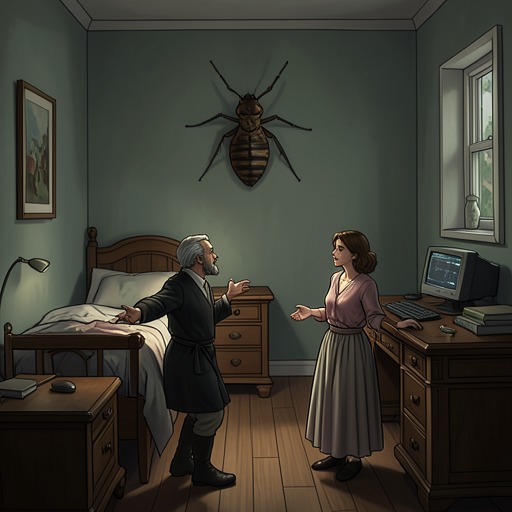
Unlike Grete Samsa, who initially approaches Gregor with anxious care, the Charwoman is not repelled by him. Her first direct encounter with him occurs when she opens the door by chance and finds herself face to face with him. Gregor is startled and rushes to and fro, but she merely stands in amazement with her hands crossed in front of her. Her reaction is neither familial shock nor sustained compassion. She registers the strange body, then incorporates it into the practical routine of the apartment.
From that point, she looks briefly into Gregor Samsa’s room every morning and evening. Her visits are not motivated by a serious attempt to understand him. The narration emphasizes that she does so without real curiosity, and her casual address reduces him to an object of coarse familiarity. She calls him “come on then, you old dung-beetle!” and “look at the old dung-beetle there!” These are the only words associated with her direct treatment of him, and they replace his former name and family identity with an animal label. Yet the label does not carry the same frightened moral rejection that later appears in Grete Samsa’s demand to stop calling the creature Gregor. For the Charwoman, it is an offhand description used by someone who feels no need to protect the household from the sight of him.
Gregor Samsa does not answer her. He remains still, refusing to acknowledge her words as meaningful communication. Their exchange is thus a compressed form of the story’s communication breakdown: she speaks freely because she assumes no reciprocal understanding is possible, while he understands enough to feel insulted but cannot make his human status intelligible. When he finally moves toward her in resentment, slowly and infirmly, she does not retreat. She lifts a chair and holds it ready, intending to bring it down on his back if he comes closer. When he turns away, she calmly returns the chair to its corner and asks whether he is not coming closer. Her confidence comes from physical readiness rather than emotional insight; she neither interprets his movement as a plea nor treats it as a revelation of his former self.
Domestic Labor and the Changed Apartment
The Charwoman’s work belongs to the final stage of the family’s economic and emotional deterioration. The household has too little money to maintain its former arrangements, and every person who remains has been drawn into work. Mr. Samsa has returned to employment after five years without work; Mrs. Samsa washes clothes for strangers while doing the household sewing; Grete Samsa works behind a desk; and The Charwoman takes on the heaviest cleaning. This structure makes her an emblem of labor replacing intimacy. Gregor’s family once organized its life around his earnings, but after his transformation the apartment survives by distributing burdens among bodies that are increasingly tired and constrained.
Her cleaning practices also show how Gregor has been removed from ordinary domestic membership. Objects that have no place elsewhere are thrown into his room, and the dustbins from the kitchen are stored there because she is always in a hurry. Anything she cannot use immediately is left where it lands. The room ceases to be a private human space and becomes a repository for household waste. The Charwoman does not create this transformation alone, but her hurried disposal of objects makes the family’s reclassification of Gregor materially visible: his room is treated as the place where unwanted things may remain.
The family’s earlier care has already become uneven and resentful by the time she arrives. Grete Samsa, exhausted by work and by her previous responsibility for Gregor, becomes possessive about cleaning his room; when Mrs. Samsa cleans it thoroughly with several bucketfuls of water, Grete reacts with tears and anger. Against this tense conflict over who must care for Gregor, the Charwoman represents a more openly functional arrangement. She is assigned the labor but does not pretend that it is an act of affection. Her lack of repulsion makes her more effective as a worker, while her lack of attachment makes her incapable of serving as a bridge between Gregor and the family.
Discovery of Gregor Samsa’s Death
The Charwoman discovers Gregor Samsa’s body early in the morning. Her habitual arrival is itself noisy: the family has repeatedly asked her not to slam the doors, but her strength and haste make the doors announce her presence and prevent the apartment from sleeping peacefully. She enters Gregor’s room for her usual brief inspection and initially misreads his stillness as deliberate behavior, imagining that he is playing the martyr.
Because she happens to be carrying the long broom, she first tries to tickle him from the doorway. When that produces no response, she pokes him, and only when she can shove him across the floor without resistance does she understand that he is dead. The sequence is deliberately physical and unsentimental. Death is recognized not through mourning, ritual, or a family member’s intimate perception, but through the failure of a body to resist a broom. Once she understands what has happened, she opens the bedroom doors and calls into the darkness that Gregor is dead, “stone dead!” Her announcement is loud enough to summon the household and convert a private death into an immediate domestic fact.
The family’s response sharply contrasts with hers. Mr. Samsa and Mrs. Samsa rise in shock, Grete Samsa is already dressed and pale, and Mr. Samsa gives thanks to God. Grete observes that Gregor has become thin because he has eaten almost nothing, while the Charwoman’s earlier shove has already established the body’s complete passivity. The Charwoman does not remain to interpret the death or participate in grief. She has supplied the decisive information, and the family must now decide what to do with the consequences.
Final Function and Narrative Significance
After Gregor Samsa’s death, the Charwoman tells the family that they need not worry about removing “that thing in there” because the matter has already been dealt with. She tries to explain further, but Mr. Samsa stops her with an outstretched hand. Her eagerness to describe the disposal is treated as an intrusion into the fragile peace the family has just recovered. Mr. Samsa immediately says that she will be dismissed that night, and neither Mrs. Samsa nor Grete Samsa answers because her presence has disturbed their newly regained calm.
Her dismissal completes a pattern in which the family accepts practical services while rejecting the language and manner attached to them. The Charwoman has been useful because she could clean, tolerate Gregor’s presence, and remove his body without hesitation; she becomes unwelcome once her bluntness threatens the family’s preferred silence. Nevertheless, she is the person who performs the final act of recognition. The family may call Gregor a son, a brother, or a burden, but she determines that the body is dead and announces that its removal is settled.
The Charwoman therefore occupies a crucial threshold between care and disposal. She is less sentimental than the family, but not necessarily more cruel in her conduct: she does not demand Gregor’s exclusion, does not argue that he has ceased to be Gregor, and does not participate in Grete’s explicit rejection. Her vocabulary is coarse, her treatment is physical, and her curiosity is minimal, yet her presence strips away the family’s unstable emotional explanations. By the time she names the corpse and reports that the problem has been handled, Gregor’s death is no longer an ambiguous family crisis. It has become an ordinary fact of domestic labor, and the apartment can begin to reorganize itself around the living.