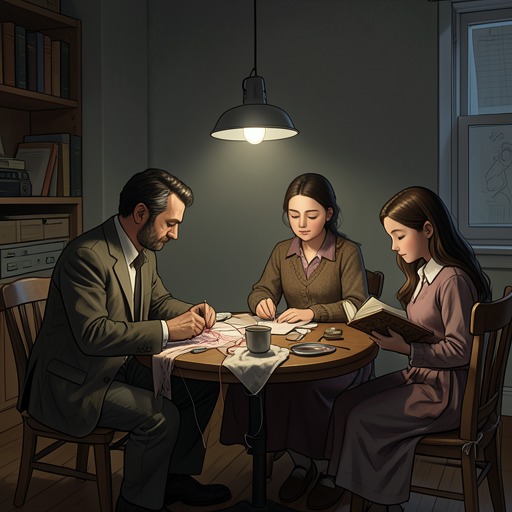
The Samsa family's post-Gregor outing
The MetamorphosisThe Samsa family's post-Gregor outing is the closing movement of the family's crisis and the clearest sign that Gregor Samsa's death has released the household from the obligations that had organized its life around him. After the three lodgers are dismissed, Mr. Samsa, Mrs. Samsa, and Grete leave the apartment together, travel by tram into the open country, and begin discussing work, housing, and Grete's future. Their movement from the closed apartment into warm daylight gives the ending an unmistakable sense of relief, but that relief is inseparable from the fact that the family can imagine its prospects only after Gregor has ceased to be part of them.
Immediate Background
The outing follows a sequence in which Gregor Samsa has been progressively reclassified within his own household. He begins as the family's principal provider: after Mr. Samsa's business collapses, Gregor works with exceptional intensity, rises from junior salesman to travelling representative, and places his earnings before his astonished family. He supports the household for years, while secretly planning to send Grete Samsa to a conservatory. The transformation destroys that economic arrangement. His parents initially remain outside Gregor Samsa's room, while Grete assumes the practical work of entering, cleaning, and reporting on his condition. Even this care changes into exhaustion and rejection as the family members return to paid work and Gregor Samsa becomes a burden rather than a provider.
The family attempts to replace lost income by taking in the three lodgers, but the arrangement makes the apartment feel less like a home and more like a controlled economic space. Gregor Samsa's appearance remains concealed until the lodgers hear Grete's violin and discover him. Grete then declares that the family must get rid of the creature and insists that they can no longer treat it as Gregor Samsa. Her judgment turns the household's previous uncertainty into a decision to exclude him completely. By the time Gregor Samsa withdraws to his room and dies, the family has already begun to imagine survival as a life organized without him.
Dismissal of the Lodgers
The first practical act after Gregor Samsa's death is not mourning but the removal of the three lodgers. Mr. Samsa appears in his uniform with Mrs. Samsa and Grete beside him, and, while keeping the two women close, orders the middle lodger to leave the home immediately. The lodger's brief uncertainty and attempted appeal to permission collapse before Mr. Samsa's directness. The three men collect their hats and sticks, bow, and depart down the many flights of stairs.
This reversal is significant because the lodgers had seemed to possess the authority associated with rent, respectability, and financial necessity. Mr. Samsa had tolerated their presence while the household needed their money; after Gregor Samsa's death, he can expel them without negotiation. The family follows the men onto the landing, but its attention quickly fades as the lodgers descend. When a butcher's boy passes them carrying a tray on his head, the family returns to the apartment, as though ordinary commercial life has already replaced the household's immediate emergency.
From Crisis to Coordinated Action
The family decides to use the day for rest and a walk, acknowledging that all three members have earned a break and urgently need one. Before leaving, they write letters of excuse: Mr. Samsa addresses his employers, Mrs. Samsa writes to her contractor, and Grete writes to her principal. The scene translates grief into administrative procedure. Their missed obligations must be explained, but the fact that each of them now has an external workplace also confirms that the family is no longer economically dependent on Gregor Samsa alone.
The charwoman interrupts this brief recovery by announcing that the body in Gregor Samsa's room has already been dealt with. Mr. Samsa refuses to hear the details and announces that she will be dismissed that evening. His response restores control over the apartment, including control over the manner in which Gregor Samsa's death may be discussed. When the two women stand by the window with their arms around each other, Mr. Samsa calls them back and asks them to forget the old matter and attend to him. They immediately obey, kissing and embracing him before completing their letters. The household's emotional alignment has shifted toward the surviving family members and away from the dead Gregor Samsa.
The Tram Ride and New Prospects
The three survivors leave the apartment together, something they have not done for months, and take the tram to the open country outside the town. The tram is filled with warm sunshine and is otherwise empty, a sharp contrast with the dark, crowded, and burdened interior of the apartment. Seated comfortably, they discuss their prospects and discover that those prospects are better than they had previously examined. All three hold jobs described as good and promising, although the family had not until this moment asked one another about their work.
Their discussion also produces a concrete housing plan. The family now sees moving as the most immediate improvement: the next apartment should be smaller and cheaper, better located, and more practical than the one chosen by Gregor Samsa. The proposed move is therefore not merely financial. It imagines a new domestic structure in which space will no longer be organized around Gregor Samsa's room, his confinement, or the need to conceal him from visitors. The family can reduce its physical surroundings because it has also reduced the obligations those surroundings once contained.
Grete's Future and the Ending's Ambivalence
During the journey, Grete becomes increasingly lively. Her cheeks had grown pale under the strain of recent events, but as her parents consider her condition they recognize that she is blossoming into a well-built and beautiful young woman. Their shared glance produces a new plan: it will soon be time to find a good man for her. When the family reaches its destination, Grete is the first to rise and stretch her young body, an action that visually completes the movement from enclosure toward a future imagined through health, marriage, and renewed social possibility.
The outing thus ends with a genuine restoration of family function, but its optimism is morally unsettled. Gregor Samsa once devoted his labor to the household, converted his success into money, and hoped to make Grete's musical education possible; now the family speaks of its own prosperity and Grete's marriage only after his death. The outing is a release from economic dependence and domestic paralysis, yet it also exposes how completely Gregor Samsa's value had been tied to what he could provide. The warm tram, the open country, and Grete's awakening vitality form a final tableau of survival, while the absent figure at its center makes that survival feel like both recovery and erasure.