The Samsas dismiss the lodgers
The MetamorphosisThe Samsas dismiss the lodgers in the immediate aftermath of Gregor Samsa’s death, and the act functions as more than a household dispute. By expelling the three paying occupants from the Samsa family apartment, Mr. Samsa reclaims domestic authority, rejects their claim to breakfast and accommodation, and closes the commercial arrangement that had made the family’s home dependent on outsiders. The dismissal also reveals how quickly the family’s attention shifts from Gregor’s body to the restoration of order, privacy, and future prospects.
Background and Household Dependence
The lodgers belong to the period after Gregor Samsa’s transformation, when the family must reorganize its finances and labor. Before the transformation, Gregor had worked as a travelling salesman and supported the household while trying to repay his parents’ debt. His father had retained some money from the collapse of his business five years earlier, but Gregor had believed that nothing remained and had responded by working with exceptional intensity. His income had paid the family’s expenses, yet this arrangement had also made the household dependent on the continued productivity of one person.
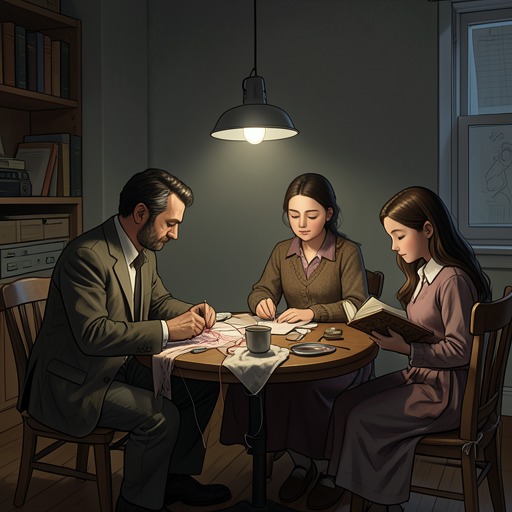
After Gregor is confined to his room, that old economic structure breaks down. The family’s work and care are redistributed: Grete Samsa begins to take on more responsibility, Mrs. Samsa works at sewing fancy underwear for a fashion shop, and Mr. Samsa adopts the visible discipline of employment in his uniform. The lodgers therefore enter an apartment already reshaped by financial pressure and domestic exhaustion. Their presence turns the home into a rented space in which the family must accommodate strangers, regulate its behavior, and tolerate the loss of privacy in order to survive.
The family’s relationship to Gregor also changes across this period. At first, his parents remain unable to enter Gregor Samsa’s room, while Grete manages the practical work of tidying and bringing food. Gregor continues to regard himself as responsible for the family and takes pride in having once provided their peaceful, comfortable life. Yet his body deteriorates after the apple lodged in his flesh, and the injury becomes a visible reminder that he is both a suffering family member and an increasingly excluded presence. The open door through which he watches the family at dinner gives him a diminished form of participation, but it also makes clear that he now exists at the edge of the household’s shared life.
What Happens
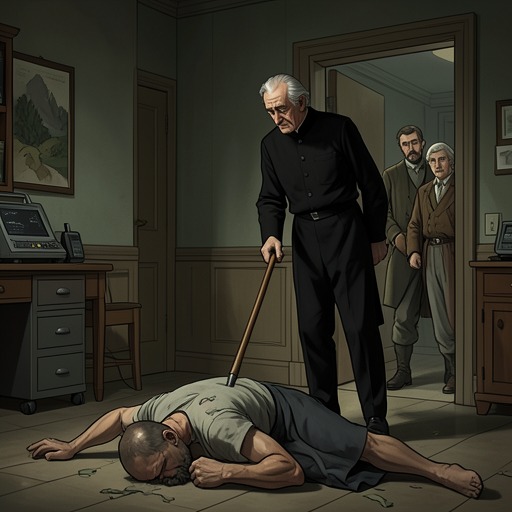
The dismissal occurs after the three gentlemen have seen Gregor’s corpse. They emerge from their room expecting breakfast, only to discover that the meal has been forgotten. The middle lodger asks the Charwoman irritably where it is, and she silently directs the men into Gregor Samsa’s room. In the newly bright room, the three stand around the corpse with their hands in the pockets of their worn coats. Their first concern is not the death itself but the interruption of the routine for which they are paying.
Mr. Samsa then appears from the bedroom in his uniform, with Mrs. Samsa on one arm and Grete Samsa on the other. The family has been crying, and Grete repeatedly presses her face against her father’s arm. The arrangement presents the family as a unit confronting the lodgers: the father stands as its spokesman, while the mother and daughter remain physically attached to him. Without allowing the women to leave his side, Mr. Samsa orders the lodgers to leave his home immediately.
The middle lodger responds with apparent disbelief and a sweet smile, while his two companions rub their hands together in anticipation of a quarrel. Their posture suggests that conflict might strengthen their position, but Mr. Samsa refuses to negotiate. The middle lodger eventually agrees to go, though he looks up as if seeking permission for his decision. Mr. Samsa answers only with widened eyes and several brief nods. The exchange reverses the apartment’s recent hierarchy: the lodger, previously entitled to demand service, now waits for recognition from the man who has decided to end his tenancy.
The three men leave in formation. They take their hats from the stand, collect their sticks, bow without speaking, and depart. Mr. Samsa and the two women follow them onto the landing and watch their slow descent down the many stairs. The lodgers repeatedly disappear around one floor and reappear below, but the family’s interest in them fades as they descend. When a butcher’s boy carrying a tray on his head passes on the stairs, the Samsas withdraw from the landing and return to the apartment, as though the ordinary movement of the building has already displaced the expelled men.
Immediate Consequences
The expulsion ends the lodgers’ claim on the family’s domestic resources. Their forgotten breakfast, their demand for explanation, and their expectation of a potentially profitable quarrel are all refused. Mr. Samsa’s command therefore restores a boundary that financial hardship had weakened: the apartment is no longer required to function primarily as a service environment for strangers. The family can again determine who enters, who eats, and who has the right to occupy its rooms.
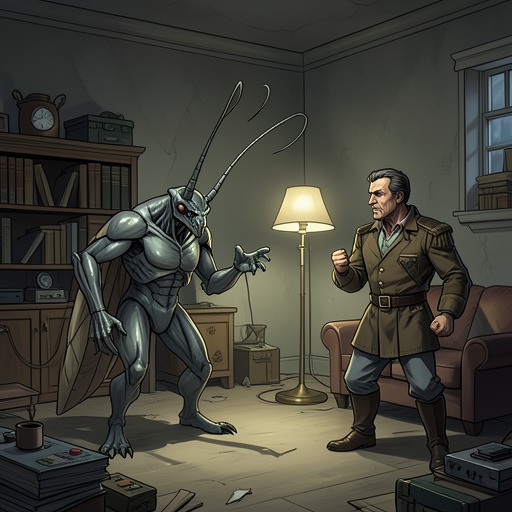
The act also follows Grete’s decisive rejection of Gregor. In front of the lodgers, she declares that the family cannot continue living with the creature and insists that they must get rid of it. She argues that they have done everything humanly possible to care for it and that they have harmed themselves by continuing to believe it is Gregor. Her claim turns Gregor from a brother into an obstacle to the family’s survival. When she says that the animal has driven out the tenants and threatens to force the family into the street, the lodgers become part of the practical crisis surrounding Gregor’s presence.
Gregor’s death removes the immediate object of that crisis, and the lodgers’ expulsion follows almost without pause. The sequence links the two removals: Gregor is eliminated from the household as a living member, and the lodgers are eliminated as external occupants. In both cases, the family responds to a destabilizing presence by closing ranks and recovering control over the apartment. The difference is that Mr. Samsa can command the lodgers openly, whereas Gregor has been confined, managed, and finally left alone until his body is discovered.
Restoration of Family Order
After the lodgers leave, the family writes letters of excuse for the day: Mr. Samsa writes to his employers, Mrs. Samsa to her contractor, and Grete to her principal. This detail shows that the family’s renewed unity does not mean a return to economic dependence on Gregor. All three are now connected to work outside the old arrangement in which Gregor alone carried the household. Their letters briefly suspend those obligations so that they can recover from the morning’s events.
The Charwoman interrupts them with news that the thing in Gregor’s room has already been dealt with. Mr. Samsa decides that she will be dismissed that evening, but neither Mrs. Samsa nor Grete answers him. The family instead gathers by the window, arms around one another, until Mr. Samsa calls them back and asks them to give him attention. They immediately kiss and embrace him, then finish their letters. The scene makes the dismissal of the lodgers part of a larger restoration of authority: the father expels the outsiders, dismisses the servant who speaks too freely about Gregor, and reunites the remaining family around himself.
The family then leaves the apartment together for the first time in months and takes the tram into the open country outside the town. The warm sunshine and empty tram contrast with the closed rooms, corridors, doors, and stale routines that have defined Gregor’s confinement. Their conversation about work reveals that all three now have jobs that are good and promising. They also consider moving to a smaller, cheaper, better-located, and more practical flat. The apartment that Gregor once selected and financed has become associated with burden and disorder; the family’s imagined future requires a different space.
Significance
The Samsas dismiss the lodgers at the point when the family’s dependence on Gregor has been replaced by a more collective and socially acceptable economic structure. Gregor had once been valued because his labor paid for the household, but after his transformation he is confined behind a door and described by Grete as a monster. The lodgers, meanwhile, are treated as useful only so long as they pay and obey the household’s conditions. Once they become witnesses to the family’s crisis, their economic usefulness no longer outweighs the need to remove them.
The event exposes the family system’s changing alliances. Grete, who initially cared for Gregor and reported on his food and condition to parents too frightened to enter his room, eventually joins her father in defining him as an impossible burden. Mrs. Samsa remains emotionally attached to her son, but she is physically sheltered by Mr. Samsa during the confrontation. The father’s authority, weakened by the family’s earlier financial collapse and by Gregor’s role as provider, is restored through uniformed work, command, and the power to expel. The lodgers’ removal thus marks the household’s movement from dependence, through crisis, toward a new hierarchy.
The final consequence is a troubling form of renewal. The family’s relief is genuine: it can leave the apartment, assess its prospects, and imagine a cheaper home. Yet that freedom is achieved after Gregor has been reduced first to a hidden body and then to a corpse. The expulsion of the lodgers completes the same process of simplification that Gregor’s death begins. The apartment becomes less crowded, the family becomes more mobile, and Grete’s parents begin to see her as a beautiful young woman whose future may include marriage. The household recovers its prospects by removing everyone who no longer fits its emerging picture of usefulness, intimacy, and normal life.