The Three Lodgers
The MetamorphosisThe Three Lodgers are three bearded gentlemen who rent a room in the Samsa family apartment during the later phase of Gregor Samsa’s confinement. They are not individualized by personal names; instead, they function as a collective presence, marked by shared habits, identical social authority, and a hierarchy led by the middle lodger. Their tenancy gives the family income and imposes a new standard of order, but their discovery of Gregor Samsa transforms them from paying guests into the immediate cause of the family’s decisive break with him.
Arrival and Household Authority
The Three Lodgers enter the Samsa household because the family’s financial position has changed. Before Gregor Samsa’s transformation, his earnings had supported his parents and Grete Samsa, allowing them to live in comfort and to rely on his labor. After his confinement, that arrangement collapses. Mr. Samsa reveals that some money had survived the failure of his business five years earlier, but the family nevertheless has to reorganize its resources, and the members of the household take on work of their own. Renting a room to The Three Lodgers becomes part of this economic adjustment.
Their presence changes the apartment’s internal order. All three have full beards and are described as unusually insistent on tidiness, not only in their own room but throughout the shared premises, especially the kitchen. They bring most of their own furnishings and equipment, making many of the family’s possessions superfluous. Objects that cannot be sold or discarded are transferred into Gregor Samsa’s room, along with kitchen dustbins and other unwanted material. His room therefore becomes both a place of confinement and a storage area created by the lodgers’ demands for cleanliness elsewhere.
The lodgers’ standards also intensify the family’s labor. The apartment must be kept presentable for men who are paying for accommodation, while Gregor Samsa’s room becomes increasingly neglected and crowded. The contrast is stark: the tenants’ comfort receives organized attention, whereas Gregor Samsa is left among accumulated objects, food scraps, dust, threads, and hair. The household’s priorities are expressed spatially, through the distribution of cleanliness, privacy, and usable space.
Conduct as Tenants
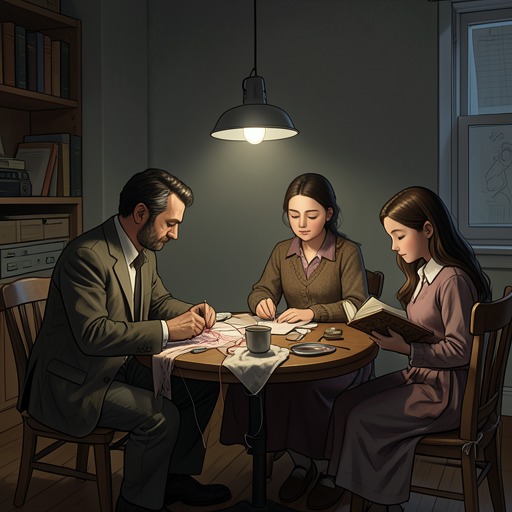
The Three Lodgers sometimes eat their evening meal in the shared living room, at the same table where Gregor Samsa had formerly eaten with Mr. Samsa and Mrs. Samsa. Their meal is treated as a formal domestic performance. Mrs. Samsa brings a dish of meat, Grete Samsa brings a dish piled with potatoes, and the three men examine the food before eating. The middle lodger cuts a piece of meat while it is still in the dish to determine whether it has been sufficiently cooked or ought to be sent back to the kitchen. Only after he approves does the anxious attention of Mrs. Samsa and Grete Samsa ease.
The family itself eats in the kitchen, while Mr. Samsa enters the living room in his uniform, bows with his cap in his hand, and makes a circuit of the table. The lodgers stand together and mumble a response. This ritual places Mr. Samsa in the position of a servant or subordinate host within his own home. Their authority is not based on affection or kinship but on the rent they pay and the household’s dependence on it.
The Three Lodgers eat in near-perfect silence. From Gregor Samsa’s room, the sound of their chewing teeth becomes conspicuous, and he interprets it as a cruel demonstration that eating requires teeth and that his own toothless jaws cannot perform the same human function. Their ordinary meal thus becomes, for him, an image of exclusion. Food is available in the apartment, but the tenants receive carefully prepared nourishment in the common room while Gregor Samsa is nearly unable to eat and is dying in isolation.
The Violin Incident
The lodgers’ most important appearance follows Grete Samsa’s violin playing. They have finished their meal, and the middle lodger has distributed a newspaper among the three men. When the violin begins in the kitchen, they become attentive, stand up, and move on tiptoe toward the doorway. The middle lodger asks whether Grete Samsa would play for them in the living room, describing it as a more comfortable setting. Mr. Samsa eagerly accepts on her behalf, displaying an exaggerated courtesy toward tenants whose approval the family cannot afford to lose.
The family stages the performance with formal submissiveness. Mr. Samsa brings the music stand, Mrs. Samsa brings the music, and Grete Samsa brings the violin. Neither parent dares sit in a chair of their own at first. The lodgers occupy the living room as judges and patrons, while the Samsas arrange themselves around their comfort. The scene turns Grete Samsa’s music into a service offered to paying guests rather than an expression of her own development.
The playing nonetheless reaches Gregor Samsa. He crawls forward from his room, despite the dust and food remains covering his body, because the music seems to point toward a form of nourishment that ordinary food can no longer provide. He imagines bringing Grete Samsa and her violin into his room and telling her about his former plan to send her to the conservatory. His response establishes a sharp contrast between the lodgers’ shallow interest in the performance and Gregor Samsa’s intimate understanding of Grete Samsa’s musical potential.
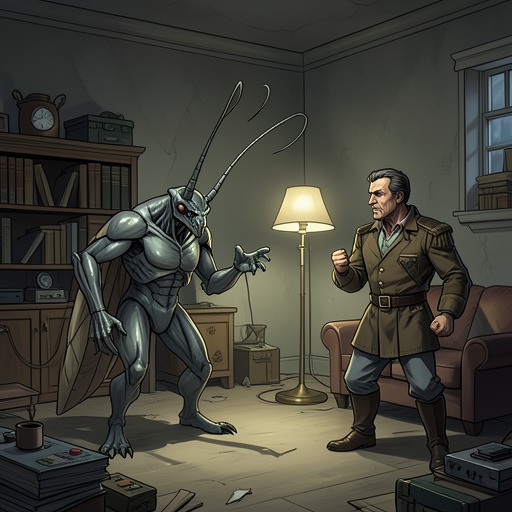
The middle lodger is the first to point directly at Gregor Samsa. The violin stops. The middle man initially treats the sight as entertainment, exchanging a smile with his companions, but the discovery soon becomes a complaint about the conditions of the apartment. Mr. Samsa tries to shield Gregor Samsa and drive the three men back toward their room, yet his frantic behavior itself makes the domestic crisis visible. The lodgers demand an explanation and retreat only slowly, pulling at their beards and raising their arms in agitation.
Withdrawal and Consequences
The middle lodger becomes the spokesman for all three. He declares that the repugnant conditions in the apartment and the family justify immediate notice on his room. He says that he will pay nothing for the days he has lived there and may even seek damages, claiming that the grounds for such an action would be easy to establish. His two companions immediately join him in giving notice. The three men therefore convert their discomfort into economic and legal pressure, making the family’s dependence on their rent unmistakable.
Their departure is not merely a practical inconvenience. Grete Samsa uses the failed tenancy to argue that the family must get rid of Gregor Samsa. In her view, the lodgers’ withdrawal proves that Gregor Samsa’s continued presence threatens the household’s survival. She insists that the family has done everything humanly possible to care for him and that they can no longer continue to treat the creature in the room as their brother. The Three Lodgers thus become the external pressure that helps turn private exhaustion into an explicit demand for exclusion.
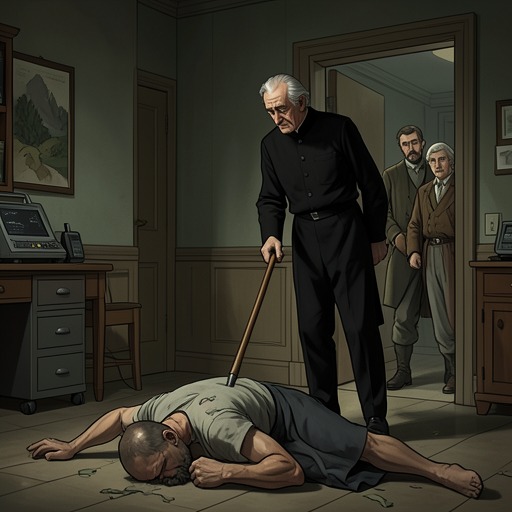
After Gregor Samsa’s death, The Three Lodgers emerge looking for the breakfasts that have been forgotten. The cleaner silently directs them toward Gregor Samsa’s room, where they stand around his corpse with their hands in the pockets of their worn coats. Their posture is detached and observational; even at the moment when the family’s crisis has reached its end, they remain concerned with the services owed to tenants.
Mr. Samsa then appears in uniform with Mrs. Samsa and Grete Samsa beside him and orders The Three Lodgers to leave the home immediately. The middle lodger reacts with apparent surprise and a sweet smile, while his companions rub their hands together in anticipation of a quarrel. Mr. Samsa does not negotiate. The three men eventually collect their hats and sticks, bow without speaking, and leave the premises. Their dismissal reverses the earlier power arrangement: the family no longer needs to placate them, and Mr. Samsa can recover the authority that their tenancy had displaced.
Narrative Function and Significance
The Three Lodgers embody the economic logic that governs the Samsa household after Gregor Samsa can no longer work. They are admitted into the family’s private space because rent is necessary, accommodated through excessive courtesy because their approval matters, and expelled only after Gregor Samsa’s death has removed the condition that made their presence useful. Their relation to the family is contractual rather than emotional, and their quick movement from guests to complainants exposes the fragility of hospitality founded on financial dependence.
They also sharpen the story’s contrast between appearance and human recognition. The lodgers demand order, clean rooms, properly prepared food, and acceptable social conditions, but they show little interest in the suffering within the apartment. Grete Samsa’s violin receives their attention only as a possible entertainment, whereas Gregor Samsa hears it as a revelation of his sister’s inner life. Their judgment of the household is based on visible disorder and tenant rights, not on the concealed history of labor, debt, care, and family obligation that produced the scene.
Finally, The Three Lodgers help mark the transition from Gregor Samsa’s tolerated confinement to his complete social erasure. Their departure is followed by Grete Samsa’s insistence that the creature is no longer her brother, and after Gregor Samsa’s death the family’s first collective outing becomes possible. In this structure, the lodgers are both beneficiaries and agents of the household’s transformation: they occupy the space Gregor Samsa once helped finance, expose the family’s dependence on external income, and leave once the family has decided that Gregor Samsa’s existence is incompatible with its renewed prospects.