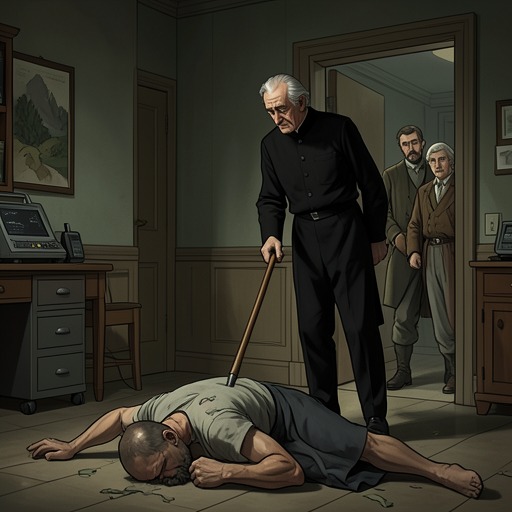
The apple attack
The MetamorphosisThe apple attack is the central eruption of violence between Mr. Samsa and Gregor Samsa. After Gregor’s transformation has already made communication, work, and ordinary family life impossible, Mr. Samsa responds to his son’s appearance not by listening or investigating but by driving him back into Gregor Samsa’s room. The attack converts domestic fear into bodily punishment: an apple becomes both a weapon and a visible sign that Gregor, still recognized intermittently as a family member, has nevertheless been treated as an intruder within the Samsa family apartment.
Causes and Immediate Circumstances
The attack follows Gregor’s escape from his room after Grete Samsa has tried to keep him contained. His mother, startled by his appearance, faints, and Grete leaves Gregor shut out while she brings her mother medicine. When Mr. Samsa returns, Grete’s incomplete explanation leads him to assume that something seriously wrong has occurred and that Gregor is responsible. Gregor understands that his father has misread the situation, but he cannot explain himself in a form his family can understand. He therefore presses himself against the door of Gregor Samsa’s room, intending to show that he means no harm and will return without being forced.
Mr. Samsa is not prepared to recognize this intention. He enters in a smart blue uniform with gold buttons, his body and bearing sharply changed from the tired, dependent father Gregor had known before the transformation. The uniform presents him as newly disciplined and authoritative, while his lifted feet, clenched determination, and enormous boots make his approach seem like an official expulsion. Gregor runs ahead of him across the room, stopping and starting whenever his father moves, but he remains on the floor because he fears that climbing onto the walls or ceiling would appear deliberately provocative. The encounter is therefore shaped by a profound asymmetry: Gregor tries to communicate submission through movement, while Mr. Samsa reads his presence as a threat requiring force.
Course of the Attack
At first the pursuit is slow and uncertain. Gregor circles the room with his father, whose intentions seem not fully formed even to himself, but Gregor’s body cannot sustain the effort. For every step Mr. Samsa takes, Gregor must make countless movements. He becomes short of breath, his thoughts slow, and his capacity to invent another means of escape disappears. Just as he is nearly exhausted, Mr. Samsa begins throwing apples from the bowl on the sideboard.
The first apple glances off Gregor Samsa’s back without causing harm. The next strikes him squarely and lodges in his flesh. Gregor tries to drag himself away, but the pain fixes him to the spot and overwhelms his senses. The scene ends with his room door being pulled open, Grete screaming, and Mrs. Samsa rushing toward her husband in a blouse after Grete has removed some of her clothing to help her breathe. Mrs. Samsa throws her arms around Mr. Samsa and begs him to spare Gregor’s life. Her gesture places the family’s fear and Gregor’s vulnerability in the same frame: the mother seeks protection from the father even as she asks him not to destroy their son.
The attack completes a pattern already established when Mr. Samsa forced Gregor back into his room earlier that day. Then, his father had used a stick, hissing at him and driving him through a doorway too narrow for his altered body. Gregor’s flank was scraped against the white door, leaving brown flecks, and a final shove sent him bleeding into the room before the door was slammed shut. The apple attack intensifies that earlier expulsion. The stick and doorway injured Gregor while restoring a physical boundary; the apple penetrates and remains inside him, turning the boundary between family and intruder into a wound carried within his body.
Injury and Lasting Consequences
No one removes the apple. It remains lodged in Gregor’s flesh for more than a month, a visible reminder of the assault and a continuing source of bodily deterioration. The injury permanently reduces his mobility. He becomes like an ancient invalid, needing long minutes to crawl across his room and no longer able to move across the ceiling. The transformed body that had initially been helpless but adaptable is now additionally crippled by violence from the person who should have been responsible for his safety.
The wound also produces an unstable recognition. Mr. Samsa’s treatment of Gregor has shown that he can regard him as an enemy, yet the apple’s presence reminds even Mr. Samsa that Gregor remains a family member despite his revolting form. The household is thus caught between revulsion and obligation. Care does not undo the attack; instead, the family’s duty to be patient coexists with the unhealed evidence that Gregor has been physically expelled from domestic life. The body is tolerated, but not restored to full membership in the household.
Gregor’s reduced mobility changes how he participates in family life. Because he can no longer move freely, the living-room door being left open each evening becomes a major consolation. From the darkness of his room, he watches the family around the dinner table and listens to their conversation. The open door offers a limited form of inclusion, but it also makes clear how far his position has fallen: he is permitted to observe rather than to join. His access to family life is now visual and auditory, not social or reciprocal.
Family Reorganization After the Violence
The attack coincides with a wider transfer of roles within the Samsa family. Gregor had once worked as a travelling salesman, endured exhausting travel and irregular food, and planned to repay his parents’ debt before leaving his job. His earnings had supported the household, and he had secretly intended to send Grete to the conservatory. After his confinement, the family’s finances force each able member into work. Mr. Samsa returns to employment in a bank uniform; Mrs. Samsa sews fancy underwear for a fashion shop despite her asthma; and Grete takes a sales job while studying shorthand and French for a better position.
This economic reorganization sharpens the meaning of the attack. Mr. Samsa is no longer merely the weakened father Gregor once helped; he has recovered an outward authority connected to paid work, uniform, and command. Gregor, by contrast, has lost the labor that gave him value in the family and is now treated as a costly, dangerous presence. The apple does not simply express personal anger. It enforces a new domestic arrangement in which the former provider becomes dependent and the former dependent household members become workers, guardians, and eventually judges of whether he may remain.
Grete’s later rejection of Gregor shows how the violence has been absorbed into the family’s understanding of him. She argues that the family must stop believing that the animal is Gregor and insists that they must get rid of it. In her reasoning, a human brother would have recognized that human beings could not live with such an animal and would have left voluntarily. The apple attack anticipates this logic by making expulsion physical before it becomes explicit in speech. Gregor’s body is first driven away, then named as a problem, and finally treated as something whose removal is necessary for the family to continue.
Narrative and Thematic Significance
The apple attack is the turning point at which the transformed Gregor’s suffering becomes irreversible. Before it, he still struggles to open doors, explain his absence from work, preserve his family’s security, and remain useful to those he loves. After it, his mobility declines, his participation becomes observational, and the family’s tolerance takes the form of confinement rather than relationship. The apple is therefore both an event and a continuing condition: a single thrown object governs the remaining course of Gregor’s life.
The episode also exposes the fragility of the distinction between family care and social exclusion. Mr. Samsa attacks Gregor as though he were an intruder, yet the family later treats the lodged apple as evidence that Gregor cannot simply be reduced to an enemy. Their response is not a return to intimacy but a suspended state in which Gregor is kept alive, hidden, and increasingly separated from common life. The family acknowledges his kinship only after violence has made his vulnerability undeniable.
Gregor’s death eventually reveals the full consequence of this logic. By then he is completely dried up and flat, and Grete observes that he had eaten almost nothing for a long time. When the family learns that he is dead, Mr. Samsa gives thanks, and the household rapidly turns toward relief, work, improved prospects, and the possibility of moving to a smaller, cheaper flat. The family’s later outing into the open country confirms that Gregor’s death restores movement and future planning to the others. The apple attack is the wound through which this restoration begins: it does not kill Gregor immediately, but it makes his exclusion bodily, permanent, and ultimately compatible with the family’s return to ordinary life.