The lodgers' violin incident
The MetamorphosisThe lodgers' violin incident is the turning point at which music briefly reconnects Gregor Samsa with his family and then accelerates his exclusion from it. During a meal arranged for The Three Lodgers, Grete Samsa plays the violin in the kitchen; Gregor, moved by the performance and by his long-standing hope for his sister's musical future, crawls into the living room. The Three Lodgers respond with irritation and menace rather than appreciation, withdraw their payments and announce their departure, while Grete uses the resulting crisis to declare that the family must get rid of Gregor. The scene therefore joins artistic recognition, economic dependence, communication failure, and family repudiation in one irreversible sequence.
Domestic and Economic Background
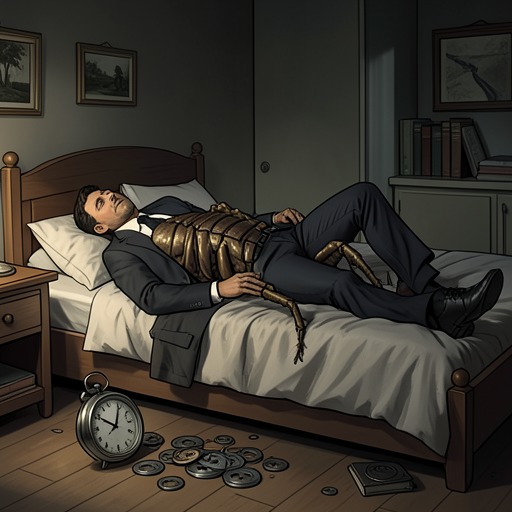
The incident occurs after the Samsa family apartment has been reorganized around financial necessity. Gregor's transformation has deprived the household of its former principal wage earner, while the family has begun placing unwanted furniture, kitchen refuse, and other clutter in Gregor Samsa's room after renting part of the apartment to The Three Lodgers. The lodgers are bearded, exacting men who demand tidiness throughout the flat, especially in the kitchen, and whose presence turns the home into a controlled lodging establishment. Gregor's room becomes both his prison and a storage space for objects that the family cannot sell or discard, making his physical exclusion coincide with his reduced economic value.
The household's financial history intensifies the stakes. Mr. Samsa had believed that almost nothing remained from the collapse of his business five years earlier, but he later reveals that he had preserved some money in a cash box. Gregor had responded to the family's earlier desperation by working with exceptional intensity, rising from junior salesman to travelling representative and placing his earnings at home. He had supported the whole family and had privately planned to send Grete Samsa to the conservatory, an ambition he intended to announce on Christmas Day. By the time of the violin incident, however, the family survives through its own labor and through rent from The Three Lodgers, so the domestic space is governed by income, cleanliness, and the tenants' approval rather than by Gregor's former sacrifices.
The Performance and Gregor's Emergence
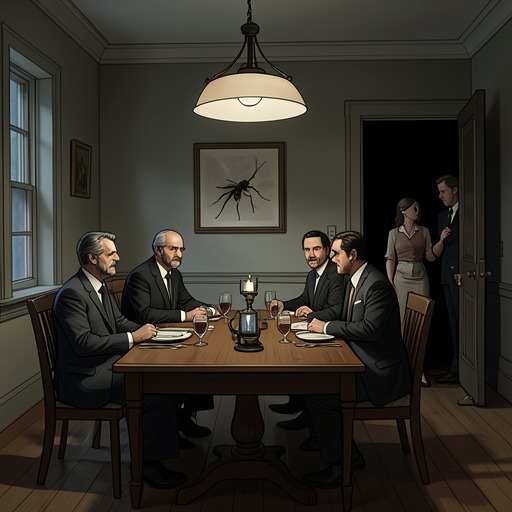
The Three Lodgers finish their meal and read newspapers while smoking. When the violin begins in the kitchen, they become attentive enough to approach the hallway door, but their interest is uncertain and acquisitive. The middle lodger, who acts as the group's authority, asks whether Grete would play inside the living room, where he considers it more comfortable. Mr. Samsa eagerly agrees, and the family stages the performance with exaggerated courtesy: Mr. Samsa brings the music stand, Mrs. Samsa carries the music, and Grete brings the violin. Because the family has never rented rooms before, the parents do not even sit in their own chairs with ease; the tenants' presence has reordered the household's manners as thoroughly as it has reordered its rooms.
Grete plays while her parents watch closely, but The Three Lodgers soon retreat toward the window, speaking quietly and blowing cigarette smoke upward. Their behavior suggests that they expected entertainment and are disappointed by what they hear. Gregor, by contrast, is captivated. He crawls forward from the darkness of Gregor Samsa's room, even though dust, food remnants, threads, and hairs cling to his body and he has become indifferent to concealing himself. The immaculate floor of the living room marks a boundary he once would have respected, but the music draws him across it.
Gregor's response reveals that his inner relation to art has survived the transformation more fully than his social identity has. He wonders whether he can really be an animal if music can move him so deeply, and he imagines that the playing offers the nourishment he has been seeking. He wants Grete to bring the violin into his room, where he would tell her of his plan to send her to the conservatory. His imagined conversation recovers the brother who once worked for her future, even as his approach presents that brother to the household as a frightening body. The performance thus creates a sharp contrast between Gregor's inward humanity and the external language through which others classify him.
The Lodgers' Departure
The middle lodger notices Gregor and addresses Mr. Samsa, pointing at him without offering any further attention to the violin. Grete's playing stops. Mr. Samsa first tries to calm The Three Lodgers and to block their view of Gregor, treating the tenants' satisfaction as the immediate priority. The men ask for explanations and move toward their room, while Grete briefly restores the beds under pressure from her father. The family attempts to preserve its commercial arrangement even after the hidden inhabitant of the flat has become impossible to conceal.
The middle lodger then declares that the repugnant conditions in the flat and within the family justify immediate notice. He refuses to pay for the days he has occupied the room and threatens to consider legal action for damages. His two companions immediately join him in giving notice, and the door is slammed. Their departure is more than a practical loss of rent: it demonstrates that the family's precarious economic order cannot accommodate Gregor's continued presence. The man who once financed the household has become, in the tenants' eyes and in the family's crisis management, a liability capable of destroying its remaining income.
Gregor remains motionless after the failure of his attempt to reach Grete. Hunger and disappointment leave him too weak to move, and he expects the others to turn against him. The violin falls from Mrs. Samsa's trembling hands, making the silence after the performance physical and public. A scene that began with the possibility of shared attention ends with Gregor isolated on the floor, unable to convert his response to music into communication with anyone around him.
Grete's Rejection and the Immediate Aftermath
Grete now speaks with a decisiveness that marks a transformation in the family hierarchy. She tells Mr. Samsa and Mrs. Samsa that they cannot continue living this way and refuses to call the creature her brother. In her view, the family has done everything humanly possible to care for it, but the lodgers' departure proves that the arrangement has become intolerable. Her argument depends on a final test of identity: if the creature were truly Gregor, she reasons, he would understand that human beings cannot live with such an animal and would leave of his own accord.
This rejection converts uncertainty into a verdict. Earlier, Gregor's family had still spoken and acted as though the transformed body contained a suffering family member, even while they feared, concealed, and confined him. Mr. Samsa had been reminded by the apple lodged in Gregor's flesh that the revolting creature was nevertheless a member of the family and that revulsion had to be endured. Grete's speech withdraws that fragile recognition. Gregor is no longer treated as a damaged relative whose condition demands patience, but as an occupying animal whose removal is necessary for the family's survival.
Gregor does not intend to frighten Grete. He is merely trying to turn around and return to his room, a movement made painful by his injuries and by the loss of mobility caused by the apple attack. His repeated striking of his head against the floor is misread as a new threat. The family reacts to his attempt at retreat as proof of danger, illustrating the communication breakdown that governs the entire incident: an act of consideration cannot be received as consideration because Gregor can no longer make his intentions legible in human language.
Consequences and Narrative Significance
After Grete's rejection, Gregor manages to return to Gregor Samsa's room, where the door is hurriedly shut, bolted, and locked. He discovers that he can no longer move, but the pain in his body has begun to weaken, and he can scarcely feel the decayed apple or the inflamed flesh around it. Thinking of his family with emotion and love, he concludes that he must go away even more strongly than Grete has demanded. His final withdrawal is therefore both imposed and inwardly accepted: he is excluded by the family, yet he also relinquishes the struggle to remain within its life.
At three in the morning, as daylight begins outside, Gregor's head sinks and his last breath leaves him. The cleaner discovers the body the next morning and announces that he is dead. Mr. Samsa responds with relief and gives thanks to God; the women cross themselves. Grete observes how thin and dried up Gregor has become, linking his death directly to his prolonged inability to eat. The scene confirms that the violin incident was not an isolated quarrel but the final social and emotional stage of Gregor's physical deterioration.
Gregor's death immediately restores the family's practical mobility. The Samsas dismiss the cleaner, finish their letters, leave the apartment together for the first time in months, and take the tram into the countryside. They discover that all three now hold jobs with promising prospects and begin discussing a smaller, cheaper, better-located flat. As Grete stretches and appears to her parents as a beautiful young woman, Mr. Samsa and Mrs. Samsa silently begin imagining a suitable husband for her. The family’s renewed future is inseparable from Gregor's disappearance, making the incident the episode in which music, tenancy, and family duty converge into the final expulsion of the former provider.