Allen
The Minds of Billy MilliganIdentity and Presentation
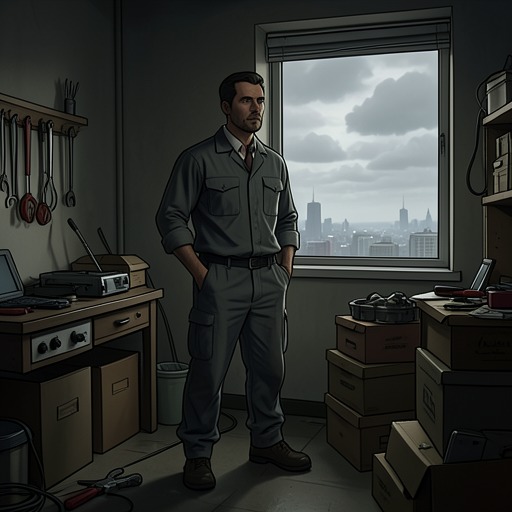
Allen is identified as the fourth personality in the group’s profile and nicknamed the con man. He is agnostic, and his stated outlook is to make the best of earthly life. The book presents him as a social operator rather than a purely abstract schemer: he is the personality who most often deals with outsiders and says that he is the one who usually speaks with Judy Stevenson and Gary Schweickart. In an early introduction, he identifies himself directly as Allen; later, observers see a striking change from Danny’s shy, boyish manner to a relaxed, outgoing person who speaks earnestly and fluently.
The profile gives Allen several concrete markers. He is the same height as William Stanley Milligan but weighs 165 pounds; his hair is parted on the right, and he is the only personality who is right-handed. He alone smokes cigarettes. He plays drums and piano, paints mostly portraits, and loves baseball. Those details make him legible across changes of scene: a smoke ring, a cigarette, a portrait, or a conversation with an outsider can all signal his particular combination of performance and competence.
The Group’s Intermediary
Allen’s facility with people makes him useful in situations where another personality might struggle. He is described as someone who can talk his way out of a tight situation, and his regular contact with outsiders makes him a practical representative of the group. When an interviewer’s questions concern David’s thoughts and visions, the later account identifies Allen as the speaker, rather than William Stanley Milligan. The distinction matters: Allen can describe or convey another personality’s experience without being that personality.
His role is not simply to conceal the group. The explanation of the group’s shared consciousness describes many people in a dark room and a bright spot on the floor: whoever steps into the light holds consciousness and is perceived by the outside world, while the others continue their own activities. The person in the spot must not reveal the others; their existence is treated as a family secret. Allen’s outward confidence therefore operates within a system that depends on secrecy. He is skilled at managing the public encounter, but that skill also helps preserve the boundary between the visible person and the many unseen ones.
The book shows the fragility of that boundary as well as Allen’s competence. After waking one morning, he sees money in a drawer and becomes worried because he cannot reach Tommy, Ragen, Arthur, or anyone else to explain what happened. The money is a concrete trace of activity that Allen does not remember. His usual control of conversation and circumstance cannot fill the gap: the personality who is adept at explaining events to others is, in this instance, unable to account for his own surroundings.
Art, Work, and Practical Resourcefulness
Painting is both an enduring interest and a source of material opportunity. At a flower shop in Lancaster, Ohio, Allen persuades the owner to display his paintings in the window and to pay him a commission if one sells. His portraits provide a route into the arrangement, while the work itself becomes shared labor: Timothy, who loves flowers, does most of the shop work; Adalana sometimes appears to arrange flowers; and Tommy, encouraged by the prospect of earning money from art, produces landscapes. Those landscapes sell faster than Allen’s portraits or Danny’s still lifes. The episode shows Allen using persuasion to open a door, while the group’s different interests and abilities determine what happens once it is open.
Allen’s artistic and musical abilities also become part of treatment. During work toward fusion, Allen and Tommy are chosen to be fused first because they are considered the most alike. Their work with Dr. George Harding follows hours of argument and analysis and further internal discussion with Arthur and Ragen. Yet their shared interests do not erase their differences. Allen loves baseball, while Tommy fears playing because, after making mistakes at second base when he was younger, he was beaten. Dr. George Harding suggests that Nick Cicco, Allen, and the others help Tommy by discussing the fear and encouraging him to play; art therapy, including oil painting, is to continue. The proposed fusion is therefore not merely a joining of similar talents: it requires the group to confront an experience Allen does not share.
A later observation makes the limits of fusion audible. On June 14, in the music building, Tommy plays the drums, an instrument previously played only by Allen. In the fused state, the playing is not as good as Allen’s had been alone. The skill has crossed a boundary, but the result does not simply reproduce Allen’s individual ability. Music records both the connection between the personalities and the loss of distinction involved in combining them.
Allen also applies his persuasive and artistic abilities to work beyond the flower shop. In prison, when a parole hearing is postponed for two months, he worries about how to secure release. He hears through the prison grapevine that bribing the clerk who files applications in the central office is the only sure route. He then trades sketches, drawn in pencil and charcoal, to inmates and guards for goods that can be stockpiled and exchanged. He also writes to Marlene asking her to bring oranges injected with high-proof vodka: one is intended for Ragen, and the rest for sale. The episode joins his artistic skill to bargaining and contraband commerce, showing resourcefulness under pressure without presenting the scheme as an uncomplicated success.
Negotiation, Loyalty, and Conflict
Allen’s public fluency also makes him a participant in decisions about who can safely represent the group. Before an interview with Daniel Keyes, William Stanley Milligan is excited and frightened at the prospect of speaking with an author whose book has been made into a film. Arthur judges that he cannot handle the interview and decides Allen must take the spot. Allen asks why he has been chosen, then meets the writer in Dr. David Caul’s office, settles on a leather settee, lights a cigarette, and begins the conversation. The scene makes the assignment practical, but not effortless: Allen’s suitability does not mean he has volunteered for the burden.
The book project itself becomes a subject of internal deliberation. Allen, Arthur, and William Stanley Milligan take turns reading the novel Daniel Keyes has sent. Afterward, William Stanley Milligan tells Arthur that Keyes is the person who should write the book. Allen’s role in the meeting and the reading places him within the group’s exchange with the author, even as the eventual judgment is attributed to William Stanley Milligan.
Allen’s relationships are not limited to professional or transactional exchange. The profile describes a close relationship with William Stanley Milligan’s mother. In a later encounter involving a proposed will, the writer senses that Allen is explaining why he wants to leave everything to his sister, Kathy Milligan. Allen recalls that a school bully once threatened to hit him and that Kathy gave the bully her last twenty-five cents to stop him. The remembered sum gives the bond its particular shape: his wish to provide for his sister is tied to an earlier act of protection that he has never forgotten.
His dealings with Marlene likewise combine practical reliance and emotional vulnerability. During the prison period, he asks her for help with the oranges intended for trading. Later, reflecting on their relationship, he describes having been in love and gullible, feeling broken and cold, then deciding that he must move on rather than judge all women by what Marlene did. He explicitly distinguishes her from William Stanley Milligan’s father, Chalmer Milligan, refusing to make one person stand for an entire group. The statement marks an effort to hold hurt and restraint together instead of turning disappointment into a universal accusation.
Risk, Responsibility, and the Limits of Control
Allen’s ability to plan does not guarantee that he understands every action taken in the group’s name. In one encounter, he looks up at the young woman driving and notices the gun in his pocket and the roll of money; his reaction is immediate alarm. The evidence establishes the weapon, the money, and his recognition of them, but not a full account of how they came to be there. That abrupt discovery echoes the earlier morning when he finds unexplained money in a drawer. In both instances, objects confront him with a history he cannot fully retrieve.
In another episode, Danny is questioned and asked to give a voluntary statement. As the questions continue, Danny hears Allen’s voice telling him exactly what to answer. When asked to sign, Danny laboriously writes the name William Stanley Milligan. Allen is thus present as an internal guide during an encounter in which Danny’s difficulty is visible to the people questioning him. The episode contrasts Allen’s quick verbal direction with Danny’s effortful act of signing, and shows how a personality’s capacity can be deployed through another rather than through the body currently at the spot.
Allen also anticipates external consequences. While Danny and Tommy paint a mural at Kathy Milligan’s home, Allen worries about an approaching court hearing in Lancaster. He hopes that, if he wins, Dr. Cornelia Wilbur can help him; if the judge rules against him, he fears being confined to hospitals and prisons for the rest of his life. He is alarmed by state hospital bills exceeding one hundred dollars a day and believes the state wants his money and wants him broke. The scene places his bargaining instincts against a system whose decisions and expenses he cannot control. His concern is not merely for immediate release but for the possibility that institutional confinement will consume both his future and his resources.
Art Under Institutional Restrictions
Allen’s art remains important in the later institutional chapters, even when the conditions for making it narrow. While at the Dayton Forensic Center, he spends much of his time working on a painting for the cover of the book. He intends to send the editor several sketches from which to choose, but one morning discovers that one of the children has scribbled over the sketches with orange crayon while he was asleep. On the morning of the deadline, he works furiously and completes the desired oil painting in time. The ruined sketches do not end the project; the final image instead becomes evidence of work carried through interruption and a fixed deadline.
Allen’s descriptions of institutions sharpen the contrast between creative work and confinement. In his notes, he calls Lima State Hospital for the Criminally Insane a “chamber of horrors” and describes the Dayton Forensic Center as an “ultra-clean germ-tank jail.” The superintendent, Allen Vogel, is sympathetic and permits painting in oils, and Allen and Tommy order art supplies. Security staff overrule that permission because linseed oil is considered dangerous, and the supplies are removed. The sequence gives Allen’s frustration a specific material form: permission is granted, supplies arrive by order, and then the means of painting are taken away.
The book also places Allen within a longer process of treatment rather than presenting him only as a prisoner or negotiator. Dr. David Caul tells William Stanley Milligan that the trial is over, that he has been found not guilty, and that progress depends on working with Billy and bringing himself together. That framing makes the internal work of fusion central to the group’s future. Allen’s participation in the first attempted fusion, his continuing creative practice, and his repeated assumption of the public spot all show why he matters to that process: he is both an individual with recognizable skills and one of the people whose capacities must be understood in relation to the whole.
Character and Narrative Significance
Allen’s defining contrast is between command and uncertainty. He can talk to outsiders, negotiate a display arrangement, trade drawings, coach Danny through questioning, and finish a painting against a deadline. Yet unexplained money, a gun, and the limits of institutional permission expose how little any one personality can command across the group’s shifts and circumstances. His adaptability is a resource, not omnipotence.
His artistic work makes that distinction especially clear. Portraits begin as a personal interest, become a way to secure commissions and trade goods, enter the therapeutic effort toward fusion, and finally meet the restrictions of a high-security institution. His music follows a parallel path: a solitary skill becomes part of Tommy’s fused performance, where the shared result is recognizably related to Allen but not equivalent to what Allen could do alone. Through these changes, Allen’s story gives concrete form to the book’s recurring question of what can be shared, transferred, or lost when distinct personalities attempt to become one.
Allen is therefore more than the group’s smooth talker. His close family bond, his workmanlike ingenuity, his vulnerability to memory gaps, and his persistence in painting complicate the label of con man. He is a mediator who makes the group’s hidden life workable in public, but the same public competence cannot erase the divisions he inhabits or guarantee the freedom he seeks.