Arthur
The Minds of Billy MilliganArthur is the Englishman: a rational, self-educated personality who discovers the other people sharing Billy Milligan’s mind and body, then builds a system for managing their access to consciousness. A student of science and medicine, a conservative who identifies as a capitalist, and an avowed atheist, he becomes the group’s chief organizer. His authority rests on observation and rules rather than force, though the need to preserve order repeatedly brings him into conflict with other personalities and with the limits of his own control.
Identity and Introduction
Arthur is described as the second personality, also numbered twenty-two, and as a rational, emotionless Englishman who speaks with a British accent and wears glasses. Self-taught in physics and chemistry, he studies medical books and reads and writes Arabic fluently. His intellectual interests extend beyond the practical: during his imprisonment he reads about Arabic and Egyptian culture, hoping to understand the language and the pyramids. A later account also says that he speaks Swahili. The profile’s portrait of a methodical scholar sits alongside an intensely political outlook: Arthur considers himself a capitalist, is staunchly conservative, and rejects belief in God.
His presence is marked not only by what he says but by changes in posture and expression. During an interview he moves his chair to the far end of the room, increasing the distance between himself and the other person; his gaze turns inward, his jaw tightens, and his body shifts into a guarded, fighter-like crouch. At another transition, his eyes go blank and flutter before he reappears sitting back, fingertips joined in a pyramid and expression haughty. The gestures make the change of personality visible, while his controlled diction and British manner distinguish him from the other voices associated with the same body.
Discovering the Inner Group
Arthur’s discovery begins with the problem of missing time. After sensing another presence while preparing to sleep, he stays awake and demands to know who is there. The stranger answers with a question of his own; Arthur identifies himself and begins the process of finding out who else shares the mind and body. He later explains that, after recognizing the gaps in his own experience, he watched other people closely, brooded over the differences, and asked questions both inwardly and aloud. By deduction, and over many years, he established contact with the others.
After meeting Tommy, Arthur continues investigating, learning how the others behave and what they do. He eventually counts twenty-three personalities, including himself and the person outsiders call Billy or Bill. This is not simply a list: it gives Arthur the knowledge on which his authority depends. He studies each personality before deciding how that person might fit into the group, and approaches Ragen only after observing his speed, anger, and Slavic accent. Arthur regards Ragen as dangerous but potentially necessary in a crisis; rather than challenge him at once, he waits until he believes the time is right. His first instinct is therefore both analytical and political: understand the source of a threat before deciding how to govern it.
When a clinician introduces Arthur to Billy, Billy reacts with astonishment and asks why he had never known of him. The exchange makes the asymmetry between them plain. Arthur has spent years learning about the group, while Billy has not even known Arthur existed. In treatment, Arthur responds formally to Dr. David Caul, saying that he appreciates the recommendation of Dr. Cornelia Wilbur and will cooperate fully. His composure gives the clinicians a point of contact, but it does not erase the fact that Billy’s awareness of his own inner life is still incomplete.
Rules, Consciousness, and Shared Authority
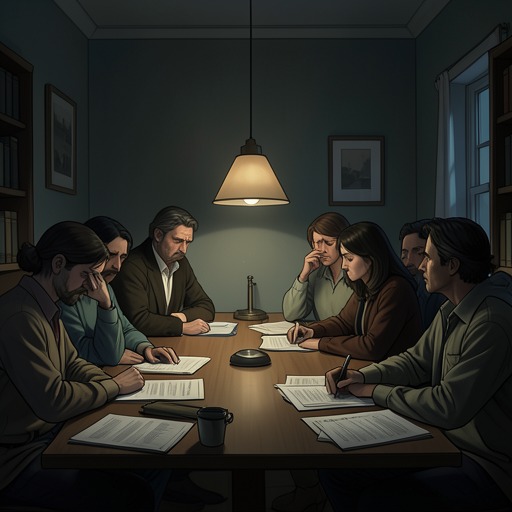
Arthur describes consciousness through the image of a dark room with a bright spot on the floor. Whoever steps into the light appears in the outside world and holds consciousness; the others may study, sleep, talk, or pursue their interests within the mind. The person in the spot must avoid revealing the group’s existence. Arthur presents this secrecy as a family obligation, but the image also clarifies the practical basis of his power: he decides who may enter the place from which other people can see and hear them.
He develops that authority into a governing arrangement. In relative safety, Arthur expects to control who takes the spot; in dangerous surroundings, Ragen is to take over. He proposes that they share responsibility and jointly decide who may hold consciousness, while ensuring that Billy is not allowed to take it under any circumstances. Arthur reaches the other personalities one by one to explain what is expected of them, including responsibilities attached to being out in the world. The system is presented as a safeguard against chaos, but it also makes Arthur an internal gatekeeper, able to exclude as well as protect.
The rules grow from Arthur’s observations at Zanesville Youth Camp, where he watches the behavior of those he allows onto the spot. He concludes that self-control is essential to survival in society and that, without rules, disorder could endanger everyone. The camp’s threat of being sent back to zone one or two, he reasons, had restrained unruly boys; some comparable structure is needed when the group acts on its own. Arthur’s governance is therefore not abstract. It is built from observed behavior, reinforced by consequences, and intended to carry a disciplinary system from the camp into the wider world.
Conflict, Judgment, and Consequences
Arthur’s reasoned outlook can turn sharply critical when he encounters Ragen’s politics. Watching Ragen follow another car, Arthur is fascinated by his actions but scornful of his belief in communism. He sees a contradiction between Ragen’s revolutionary claims and his involvement in bank robberies and narcotics trafficking, and argues inwardly that the Soviet Union is a dictatorship while capitalism offers freedom of conscience and opportunity. The episode shows Arthur applying the same habit of analysis to ideology that he applies to personality: he tests what a person says against what that person does. It also exposes the limits of his neutrality. His reasoning is disciplined, but his political judgments are emphatic and shaped by his own convictions.
His authority is tested in confinement. While Allen sends written protests to Warden Dallman about protective isolation, arguing that it must be voluntary and threatening legal action, Arthur recommends a change of tactics: silence toward both inmates and guards. He expects that silence to make the authorities worry. The account also describes the children refusing food, placing the collective protest beside Arthur’s strategic advice. In this instance, he does not lead through open confrontation; he tries to make withdrawal itself exert pressure.
As release from Lebanon prison approaches, the internal question of who should govern becomes more explicit. Allen argues that he should have greater influence over who takes the spot because he must deal with people and talk the group out of situations. Arthur recognizes the difficulty of persuading Ragen to relinquish the domination he has held for two years and suspects that Ragen intends to continue ruling. This exchange reveals that Arthur’s formal division of responsibility does not settle the contest for power. He can devise a structure, but he cannot guarantee that its strongest participant will accept it.
Arthur’s capacity to restrain others remains visible in a locked-room episode. When Ragen gets up to break down the door, Arthur freezes him; when Tommy begins checking whether the door can be unlocked, Arthur pulls him away from the spot. Around them, the personalities respond in markedly different ways: Samuel wails, Philip curses, David feels pain, Christene weeps, Allen calls for his lawyer, and others rage, joke, or fantasize. The scene places Arthur’s control against a surge of divergent reactions. His interventions curb particular actions, though the account does not present them as resolving the group’s distress.
Later Development and Narrative Significance
Arthur’s knowledge continues to shape how he interprets new personalities. He tells Billy that he believes Kevin and Philip are products of Billy’s mind. At the hospital, after attendants harass and beat patients, Kevin and Ragen are described as the only personalities who stand up to them. Arthur responds by removing Kevin from the undesirables list. The change matters because it shows that his judgments are not necessarily permanent: conduct that demonstrates resistance on behalf of the group can revise a person’s status under his rules.
The portrait also records a more exploratory side to Arthur’s discipline. During imprisonment he reads books about Arabic and makes small cardboard pyramids while thinking about Egyptian tombs and the physical questions they raise. David smashes the models. The episode makes Arthur’s intellectual curiosity concrete: books and hand-built shapes become tools for investigating a question, even in the constrained setting of prison. It also shows that his projects remain vulnerable to the actions of others, just as his political plans and internal rules do.
Late in the account, Tommy tells a visitor that Arthur has given up hope of treatment and cure and has decided to commit suicide. This report establishes Arthur’s decision, not its completion. It stands in stark contrast to the organizer who had spent years turning missing time into a problem he could investigate and a group he could govern. Arthur’s role in the narrative is defined by that double movement: he makes the inner world legible and imposes order on it, yet his system cannot settle every struggle or preserve his own hope. His intellectual control is both the means by which the group learns to survive and a measure of how heavily its survival has come to rest on him.