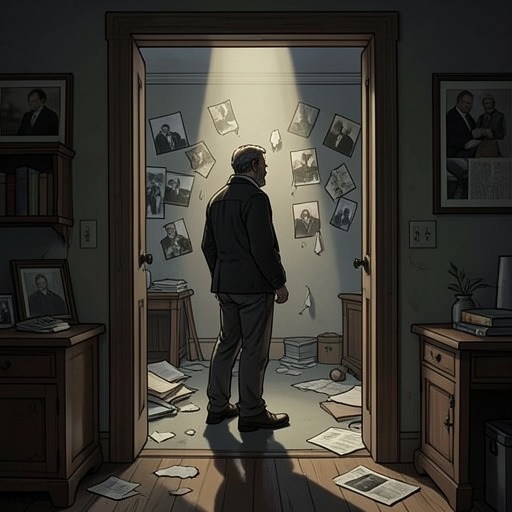
Billy's Final Fusion with The Teacher
The Minds of Billy MilliganBilly Milligan’s final fusion with The Teacher begins when Billy learns that the divided personalities he has known about only by report are parts of a whole whose unseen center is himself. After Arthur and Ragen agree that Billy must be told he is The Teacher, Dr. David Caul shows him recorded evidence of the others. The disclosure turns belief into direct recognition; Billy then experiences the personalities coming together and emerges with their shared memories. The episode joins a therapeutic revelation to a startling change in identity, while leaving open how long the new integration will last.
The Decision to Tell Billy
At a therapy session, Ragen reports that he and Arthur have argued at length about whether Billy should learn the truth. Arthur had feared that the shock would be more than Billy could bear, perhaps driving him insane. Their judgment changes: if Billy is to recover, they conclude, he has to know that he is The Teacher. Their decision is not presented as casual disclosure. It follows a worsening internal crisis, including conflict between Arthur and Ragen and rebellion among the personalities Arthur had tried to suppress.
Caul welcomes the change in their position. He believes Billy needs to see the others and understand that the intelligence, skills, and knowledge distributed among them belong to a deeper identity: The Teacher, who had acquired those capacities and passed them on. Caul therefore treats the revelation as a necessary step in therapy, not simply an explanation of the personalities. He asks to speak to Billy and tells him that Arthur and Ragen have agreed he should be informed.
The Recording Makes the Inner Life Visible
Billy nods, showing both excitement and fear. Caul puts a tape cartridge into a recorder, adjusts the sound, and watches his patient’s reaction. On the monitor, Billy sees himself with his knees jiggling. Noticing that his legs continue to move in the room, he presses his hands against both knees to stop them. When he sees an image of his lips moving silently, he raises a hand to his mouth, eyes wide. His gestures register a difficult new kind of evidence: what had been described to him as an inner experience is now visible outside him, on a screen.
Then Ragen appears, looking like Billy, and speaks from the recording rather than as a voice inside Billy’s head. The recorded Ragen addresses Caul and talks about the twenty-four names on the list and the undesirables. Billy listens as Ragen describes The Teacher, the figure who taught everyone what they knew. Until this moment, Billy has accepted on faith the doctors’ account that he is a multiple personality, but has not felt that it is true. He has known voices and lost time; he has not understood how those experiences fit together. Seeing and hearing the evidence gives him, for the first time, a comprehension that mere explanation had not produced.
Recognition and the Experience of Fusion
The decisive statement in Ragen’s account is that The Teacher is Billy whole, although Billy does not know it. Caul watches Billy go limp. Sweating and looking weak, Billy leaves the medical microwave room, climbs the stairs to the third floor, passes people who greet him without responding, and crosses the nearly empty AIT lobby. Trembling, he sinks into an easy chair. The change is at once an intellectual shock and a physical crisis: he has to take in that the capacities he had understood as belonging to separate personalities are his own.
Billy tries to reconstruct the relation between the core personality and the others. The core Billy was the child who was born and had the birth certificate; later, he had broken into many parts. Yet Billy now understands that behind those divisions had been an unnamed presence: The Teacher. He sees that this presence had created the other personalities, both children and monsters, and consequently bears responsibility for their crimes. The revelation does not simply offer a reassuring account of hidden ability. It also draws Billy into the burden of the other personalities’ acts.
As he closes his eyes, warmth rises from his legs through his body and into his arms, shoulders, and head. He feels himself vibrating and pulsing, then sees the bright white spot associated with the focus of consciousness. He understands that all of them must take the spot together. The personalities move into it and, in his experience, flow, slide, and interlock. He emerges on the other side. The passage renders fusion not as a discussion or a decision but as a bodily and spatial event, following the recording that made the divided self perceptible from outside.
Shared Memory and a New Encounter
Afterward, Billy looks at his clasped hands and understands why he had not been completely fused before: the others had not yet been revealed to him. Now he remembers their actions, thoughts, and experiences, from early childhood to the present. His recovered history includes not only the successful personalities but also the undesirables whom Arthur had tried to control and conceal. Absurdities, tragedies, and previously undisclosed crimes enter the same field of memory. The scope of the change is therefore wider than recognition of a name: Billy can now know the lives that had been divided among the personalities.
He also realizes that telling the writer what he remembers will make the other twenty-three personalities know it too. Once their amnesia is gone, they cannot remain as they were. That prospect saddens him, as though something has been lost, and his thought of how long the change will last keeps the scene from presenting integration as a settled guarantee. Fusion brings shared knowledge, but the consequences of that knowledge are still unfolding.
Caul approaches through the lobby. At first he thinks the person sitting outside the TV room is Billy; when the patient stands and turns, Caul recognizes that this is neither Billy as he knew him nor any of the personalities he has met before. He reads the open gaze and ease of the stance as signs that something has happened, and risks naming what he sees: The Teacher. The Teacher confirms it and tells Caul that the doctor has stripped away his defenses. Caul answers that it was time. Their brief exchange marks a change in the therapeutic relationship: Caul is no longer only receiving reports about an inner group but speaking directly with the integrated figure those reports described.
Asked how far back he can remember, The Teacher claims total recall. He remembers Billy being brought back to a Florida hospital at one month old, near death from an obstruction in his throat; he recalls Billy’s biological father, Johnny Morrison, a Jewish comedian and master of ceremonies who died by suicide; and he remembers Billy’s first imaginary playmate. These memories make the new identity legible through specific points in Billy’s life, extending its reach to infancy and family history. Caul welcomes The Teacher and acknowledges that there is much still to learn. The fusion thus ends not with every question resolved, but with a new witness able to remember the whole story.