Brian Foley
The Minds of Billy MilliganBrian Foley is introduced as the connection who can bring Kevin into full-time drug dealing, but the meeting that follows reveals a more specific role: he recruits Ragen as armed protection for narcotics deliveries around Columbus. Foley’s importance lies in the quick reversal of their first encounter. A man who appears to control the meeting through bodyguards and an ambush instead recognizes that Ragen is the more dangerous and useful person in the group.
Identity and Introduction
Gordy Kane directs Kevin to Blacklick Woods, near Reynoldsburg, and tells him that Foley wants to assess him alone. Kevin arrives early and waits near a culvert. Almost half an hour later, a Mercedes appears with two men outside it and someone still watching from the back. Kevin sees the guards, notices the situation feels wrong, and wonders whether to leave. The scene initially presents Foley as a hidden authority: he is not the first man to approach Kevin, and his identity is disclosed through the bodyguards’ instructions.
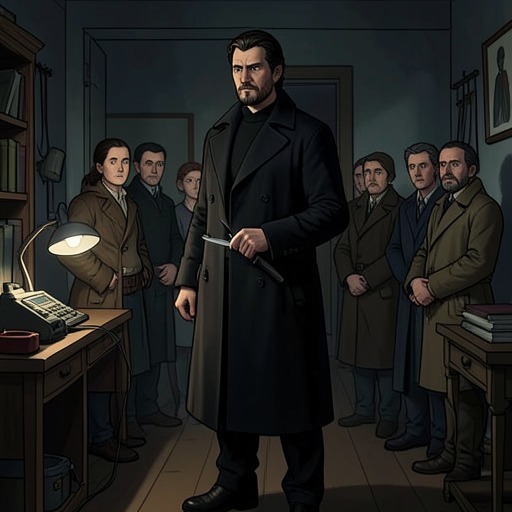
Foley is revealed in the back seat of the Mercedes, leaning against the door. He looks about eighteen, with shoulder-length blond hair, a camel-hair coat, and a matching muffler knotted at his throat. His youthful appearance contrasts with the organized and threatening circumstances of the meeting. The evidence offers no broader biography, but it makes his position legible through the men around him, the controlled encounter, and his command of a shipping operation.
The Reversal at Blacklick Woods
As Kevin gets out of his car and turns toward Foley, the tall guard spins him around and braces him against the vehicle. The guard holds an automatic to his head while the bearded man begins to frisk him. At that point Kevin disappears and Ragen takes control. Rather than submit to the search, Ragen catches the bearded man’s hand, turns him, and throws him toward the armed guard. He then wrests away the gun and uses the guard as a shield while covering Foley.
The encounter changes Foley’s assessment of the visitor. Ragen empties both clips, spins the guns, catches them by their barrels, and returns them to their owners before walking toward Foley. The demonstration is both a display of control and a refusal to be treated as a helpless recruit. Foley orders the guards to put away their guns and wait by Ragen’s car, then invites Ragen into the Mercedes to talk privately. The attempted intimidation has become a negotiation on Ragen’s terms: Foley has seen the ability he wants, while Ragen has shown that the bodyguards cannot simply dictate the meeting.
Recruitment and Terms of Employment
Foley tests Ragen’s competence in a smaller, controlled demonstration. He points out a beer can across the road; before Foley finishes describing its location, Ragen fires through the open window and hits it, then shoots it twice more as it bounces away. Foley responds by saying he can use a man with Ragen’s speed, intelligence, strength, and skill with a gun. He needs someone to ride shotgun because his drivers require protection.
Ragen says he needs money and is willing to do the job. When Foley asks whether he objects to breaking the law, the conversation makes clear that this is not legitimate commercial security. Foley describes a shipping business, but the later account identifies Ragen’s work as guarding deliveries of narcotics. Ragen also rejects the name Milligan, saying that people call him Billy and that he dislikes being called Milligan. Foley accepts the preferred name, while indicating that he assumes it is not Ragen’s real one. The exchange shows Foley adapting readily to the identity presented to him; the book, by contrast, has already shown the reader the shift from Kevin to Ragen.
Foley’s arrangements are designed to limit what the guard knows. He asks for a number where he can reach Ragen and says that, a day or two before each delivery, Ragen will sleep at Foley’s premises, where there are many rooms. Ragen will not learn what is being shipped or where it is going until he is already on the road with the driver. Foley explicitly presents this compartmentalization as a way to reduce the chance of a leak. The arrangement gives Ragen access to paid work while keeping him outside the operation’s planning and information network.
The Operation and Foley’s Narrative Role
In the weeks that follow, Ragen rides shotgun on narcotics deliveries to dealers and customers in and around Columbus. He encounters marijuana and cocaine being shipped to prominent people whose names he recognizes from the newspapers. The work therefore extends Foley’s operation beyond a single roadside meeting: Foley has enough deliveries to employ Ragen repeatedly, and the cargo reaches customers whose public standing contrasts with the concealed criminal business. Ragen also guards a shipment of M-1s for a group of Black men in West Virginia, a separate delivery that leaves him wondering what they want the weapons for. The account does not establish Foley’s involvement in every shipment beyond Ragen’s work for him, so the deliveries do not provide grounds to assign Foley additional motives or activities.
Foley is drawn through action rather than extended access to his private life. He makes an assessment, gives an order that ends the armed standoff, tests a prospective employee, and lays out practical rules for protecting deliveries. The contrast between his youthful appearance and the disciplined secrecy of his business sharpens that portrait. His recruitment also exposes the difference between the identity that brings Kevin to the meeting and the personality who answers its danger: Foley believes he is hiring a capable gunman, while the reader has seen Ragen seize control and make that capability unmistakable. The available account leaves Foley in the role of employer and criminal connection; it does not describe his later fate.