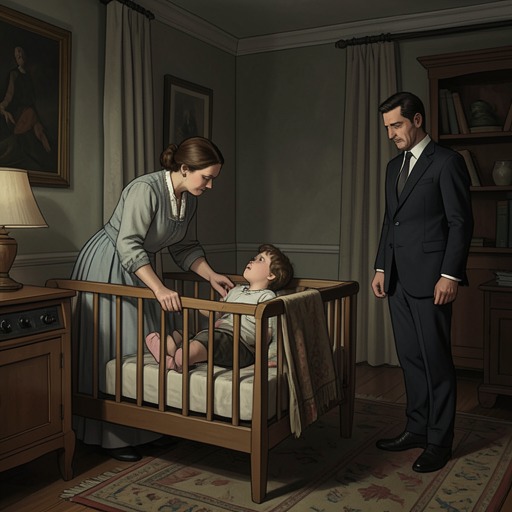
Chalmer Milligan
The Minds of Billy MilliganChalmer Milligan enters the account first as a new husband and adoptive father, then as the central figure in conflicting accounts of the family’s past. William Stanley Milligan and other relatives described physical and sexual abuse in childhood; Chalmer denied the allegations in public statements. The book distinguishes those claims from the documentary and testimonial sources through which they are presented, rather than treating the disputed history as uncontested.
Family Role and Public Account
On October 27, 1963, Chalmer married Dorothy Moore. In a later sworn statement, he said that he adopted William and William’s brother and sister shortly after the marriage. The family’s early visit to his father’s farm in Bremen, Ohio, offered the children a view of the place where Chalmer expected them to work on weekends. William, then hoping to please his new stepfather, remembered the farm and planned to draw it as a present. The contrast between that hopeful beginning and the later allegations gives the farm a lasting significance in the family history.
William’s account, as recorded in clinical material and presented in court, placed abuse by Chalmer on a farm when William was eight or nine, over the course of about a year. The account also included a fear that Chalmer might kill him and conceal what had happened. In a separate account of family life, Dorothy said that Chalmer beat her, often after drinking, and that he generally shut the children in their bedroom while doing so. She also described him as jealous of William and said he beat him as punishment. These claims were supported in the book by court materials and accounts from relatives and neighbors; they remain allegations attributed to those sources, not an admission by Chalmer.
Chalmer rejected the accusations in statements to newspapers and magazines and in a sworn statement published by the Columbus Dispatch. He said the claims were false and objected that the psychiatrists and psychologists who prepared material for the court had not interviewed him. In the book’s preface, the author likewise records that Chalmer declined an offer to give his account. The difference between Chalmer’s public complaint that no one had spoken with him and the author’s report of that declined offer remains part of the record, sharpening the divide between his denial and the accounts assembled from William, Dorothy, and other family members.
Repeated Family Violence and Its Consequences
The account presents the family’s conflict as recurring rather than confined to William Stanley Milligan’s childhood recollections. In January 1971, after William began part-time work delivering groceries, he used some of his first pay to buy a steak for Chalmer, hoping a gesture of care might improve their relationship. Instead, he came home to find Dorothy Moore injured and the kitchen door damaged. Jim Milligan and Kathy Milligan described what Chalmer had done; William remained silent, put the steak on the table, and withdrew to his room. The failed attempt at reconciliation sharpened his sense of the family’s accumulated pain.
In the narrative that follows, William’s despair gives way to Ragen’s anger. Ragen regarded Chalmer as a continuing danger because of what he had done to William, Danny, and Dorothy, and formed a plan to kill him. He took a steak knife from the kitchen and waited in his room, but fell asleep before acting. The next morning, Dorothy found the knife while making the bed. The episode marks a consequential boundary in the family history: the violence attributed to Chalmer had become not only a source of fear and dissociation but also the stated cause of a threatened retaliatory act, which did not take place.
Chalmer’s authority over the children also appeared in ordinary demands for labor. When William was sixteen, Chalmer ordered him to go to the farm to help cut grass, insisting that work was required if he was to eat. Tommy witnessed the exchange as Chalmer loaded a yellow tractor-mower onto a truck. The scene links the farm, introduced earlier as a place of family work and hope, with a later pattern of coercive authority; it also shows that the family’s conflict persisted in everyday arrangements, not only in the recollections later presented in court.
Disclosure, Treatment, and Public Dispute
The allegations also emerged in clinical encounters, where William Stanley Milligan’s fear of discussing the past appeared alongside the division of experience among his inner personalities. During a medical examination, a proposed procedure made him visibly anxious; after seeming to confer internally, he explained that the examination touched a traumatic area associated with abuse by Chalmer on the farm. He distinguished Billy and David from himself and identified Chalmer as their stepfather, while also saying that the mother in the family history was Billy’s mother, not his own. The episode shows how the family history entered the medical record not as a single, detached recollection, but through a disclosure shaped by fear and by Milligan’s fragmented sense of identity.
In conversation with Dr. George Harding, Arthur described how mention of Chalmer had touched a memory and brought Billy’s fear to the surface. Arthur said that the fear was shared, that it had been enough to put Billy to sleep, and that he could not control the change. He also explained that his awareness of Billy’s thoughts was partial and that Billy could not clearly hear him. The exchange links the reported abuse not only to past events but to the internal limits on who could speak, remember, or take control in the present.
The family testimony carried that history into the courtroom in a different form. As Judy Stevenson read Dorothy Moore’s deposition, William appeared pale and covered his eyes; he asked for a tissue, and people nearby passed one to him. Dorothy’s account described violence in the household and said she had not understood the severity of the abuse of William until the later allegations came to light. After her divorce from Chalmer, she told Tommy that Chalmer had also hurt her and that she had remained because she needed a home for the children. Her explanation adds a difficult distinction to the family record: the testimony portrayed her as both a target of violence and a parent who had not fully recognized what was being done to her son.
Fear, Retaliation, and the Limits of the Record
When doctors and lawyers first questioned William Stanley Milligan after he recalled going to a school roof, he warned that Chalmer would kill him if he spoke about what had happened. The fear recurs in the account as more than a retrospective allegation: it shaped whether William could discuss his past and who could speak for him. The book presents this fear through clinical and courtroom records, while maintaining the distinction between the abuse described by William and his relatives and Chalmer’s public denials.
The threat attributed to Chalmer also reverberates through the inner group as a source of imagined retaliation. April became preoccupied with killing him and devised a plan to make him suffer; she then urged Ragen to shoot him. This episode is separate from Ragen’s earlier plan to attack Chalmer after Dorothy was hurt: it shows another personality taking up the same grievance and attempting to enlist Ragen. The narrative establishes April’s intention and her appeal, but does not establish that this later plan was carried out. Together, these episodes place Chalmer at the center of a family history in which alleged violence, persistent fear, and retaliatory impulses recur, while the disputed claims about his conduct remain contested.