Columbus Police Department
The Minds of Billy MilliganThe Columbus Police Department is presented as a city investigative agency central to the inquiry into Polly Newton’s abduction and to the broader investigation of attacks associated with the campus rape series. Through Detective Nikki Miller and the Sexual Assault Squad, the department gathered victim testimony, pursued physical evidence, and coordinated with the Ohio State University Police Department. The account emphasizes both the practical work of investigation and the limits imposed by jurisdiction: Newton’s abduction began on campus, while the assault took place elsewhere.
Role and investigative setting
The department’s activity is anchored at the Central Police Station in downtown Columbus. On Wednesday, October 26, Detective Nikki Miller reported for the second shift at three o’clock after a two-week vacation. She was assigned to the Sexual Assault Squad, and a first-shift detective told her that she would be handling a case involving Polly Newton, a twenty-one-year-old Ohio State student. Miller had not followed the coverage of the campus rape series or seen the suspect composites while away, so colleagues briefed her before she began the investigation.
The book also records the Columbus Police Department as one of the agencies whose staff cooperated with the author’s research. That acknowledgement places the department within a wider network of institutional participants that included the Athens Mental Health Center, Harding Hospital, the Ohio State University Police Department, prosecutors, and other local police departments. The department is therefore present both in the events being recounted and in the research process through which those events were reconstructed.
The investigation of Polly Newton
Newton told investigators that she had been abducted behind her apartment near the university campus after parking her boyfriend’s blue Corvette. She was forced to drive to an isolated rural area and later back to Columbus, where the assailant made her cash two checks. He then brought her back toward the campus area. Miller’s account records these events as Newton described them, rather than treating the practical choices she was made to carry out as evidence of consent.
Miller and her partner, Officer A. J. Bessell, went to University Hospital to interview Newton. The department’s report identified similarities between Newton’s case and two rape-abductions being handled by the Ohio State University Police Department. Newton also described the man’s claims about himself, including that he was a Weathermen member and a businessman who drove a Maserati. After receiving hospital care, she agreed to help officers locate the rural scene, although darkness and confusion prevented them from completing the search that evening.
Investigators examined Newton’s car and recovered three partial fingerprints with enough ridge detail for comparison with possible future suspects. Miller and Bessell then took Newton to the Detective Bureau, where she worked with the department artist on a composite drawing and reviewed photographs of white male sex offenders. The search covered three trays of mug shots, a hundred photographs in each, without producing an identification. After seven hours with police, Newton was exhausted and stopped for the night.
The search resumed the next morning. At 10:15, officers from the Assault Squad’s morning shift took Newton to Delaware County. In daylight she was able to guide them to the assault scene, where they found 9-millimeter casings near a pond. Newton told an officer that the man had fired his gun at beer bottles he had thrown into the water. When Miller returned to duty, she seated Newton in a small room opposite the reception desk and brought in another tray of photographs, continuing the identification effort.
Jurisdiction and interagency work
The case did not fall entirely within one department’s jurisdiction. Miller’s report connected Newton’s account to two cases being handled by the Ohio State University Police Department. In a related jurisdictional discussion, investigators identified kidnapping as the offense committed on campus and therefore within university-police jurisdiction, while the rape had occurred elsewhere. This division helps explain why the city department’s investigation developed in coordination with university officers rather than as an isolated inquiry.
The narrative shows that coordination involved more than exchanging general descriptions. Newton’s account, the composite, the mug-shot reviews, the car fingerprints, and the evidence found at the rural scene each offered a different possible route toward identifying or corroborating the suspect. No single item in the account resolves the case on its own; the investigation accumulates details across interviews, locations, and agencies.
Threat assessment and response
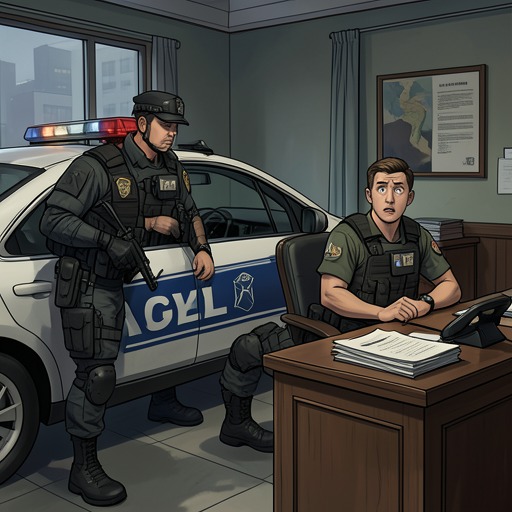
As evidence connected William Stanley Milligan to the investigation, detectives planned an approach to his apartment. Miller called for a SWAT team, and officers met in the Assault Squad office to plan how to enter. They did not know how many people were inside. Two victims had reported that the suspect described himself as a terrorist and a hit man, and Newton had reported that he fired a gun in her presence. The team therefore treated the possibility that he was armed as a serious operational risk.
The proposed approach was a disguised delivery: an officer would carry a dummy Domino’s pizza box and try to look inside when the door opened. The account establishes that the officers agreed on this plan; it does not, in this passage, describe its execution. That distinction matters. The department’s response is shown at the point of preparation, where officers weighed uncertainty about the occupants and the reported weapon against the need to approach the apartment.
Victim testimony and the department’s narrative role
The police investigation depends on testimony from people who experienced the assaults, and the narrative preserves concrete stages of their participation: Newton described what had happened, returned to help locate the rural site, reviewed hundreds of photographs, and accompanied officers again in daylight. Her exhaustion interrupted the first identification session, but did not end the effort. The sequence makes clear that investigation required time and repeated cooperation from the victim, not merely a report filed after the event.
The account also distinguishes police evidence gathering from later disputes over how the assaults should be characterized. In discussions about trial strategy, Arthur claimed that the women had cooperated; Judy and Gary rejected that account and understood it as Adalana’s perception of events. That disagreement is not a finding by the Columbus Police Department. It instead underscores why the department’s documented investigative actions—interviews, physical evidence collection, and efforts to locate scenes—must be kept distinct from competing interpretations of the victims’ experiences.