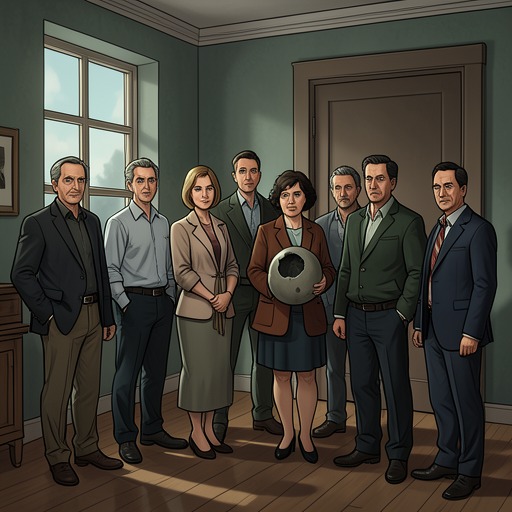
Donna Egar
The Minds of Billy MilliganDonna Egar is a member of the Wakefield Cottage staff who becomes important to Billy Milligan not through a formal clinical role, but through acts of attention and advocacy. She witnesses a public display of his personalities that leaves staff divided, hears his fear that fusion may diminish the others, and is present when he gives up a concealed razor blade and says that he wants to live. On the day he leaves the hospital, she challenges the decision to handcuff him. Her part in the narrative is concentrated in these moments, where care means both listening to Billy and defending his dignity in front of others.
Place in Billy’s Treatment
Donna appears among the Wakefield Cottage staff during a period when Billy’s treatment and the staff’s response to it remain unsettled. At a crowded presentation, Dr. George shows videotapes of sessions with Billy’s different personalities. Nearly a hundred people attend, far more than staff had expected. Afterward, Dr. Wilbur interviews Billy and several of the personalities, and the staff’s reaction is sharply divided: some complain that he has again been made to feel special and placed in the spotlight. Donna, Rosalie Drake, and Nick Cicco are angry that Billy has been put on display.
The scene gives Donna’s concern a specific setting. The videotapes make treatment material visible to an audience well beyond the people directly involved, while the interview puts Billy himself before that audience. Donna’s response places her with colleagues who object not to the existence of treatment, but to the way Billy has been exposed and singled out. Her stance offers a counterpoint to the spectacle of the crowded room: she is attentive to what the public presentation may mean for the person being presented.
Listening to His Fear of Fusion
Donna also hears Billy express uncertainty about fusion, the treatment process then under way. He worries that the other personalities might die or lose their particular strengths and talents. Donna reports this concern, preserving the fact that Billy’s hesitation is tied not simply to the process being unfamiliar, but to what he fears it could take away. Allen’s reassurance, as reported in the same exchange, is that they are working on it.
This is a significant kind of attention in a treatment setting where Billy’s accounts of different personalities are contested. Staff have been instructed at one point to remind him that his name is Billy when he refers to himself as another personality, and the treatment record reflects institutional efforts to make him accept responsibility for actions he denies. Donna’s reported conversation with him has a different emphasis: rather than reducing his concern to a denial or a disruption, she conveys his specific anxiety about the consequences of fusion. The contrast helps define her function in the narrative as a staff member who carries his words to others without claiming to resolve the clinical questions herself.
The Razor Blade and the Choice to Live
Later, in his room, Billy reaches beneath his bed and takes out a razor blade that Tommy had taped to a slat nearly seven months earlier. He hands it to Donna. His words are direct: “Here,” he said, handing it to her. “I don’t need this anymore. I want to live.” Donna has tears in her eyes and hugs him.
The blade’s concealment gives the exchange its gravity: it has remained hidden under the bed for months, and Billy’s decision to hand it over marks a change from keeping it within reach to entrusting it to another person. Donna is the person who receives it, and her embrace follows his declaration rather than replacing it. The scene does not make her the cause of his decision; the account presents Billy as choosing to live and Donna as responding to that choice with visible emotion. Her presence makes the decision both personal and witnessed.
That distinction matters to her characterization. In the earlier presentation scene, she objects to Billy being made an object of attention. Here, she is with him in his room at a moment when he chooses to disclose something dangerous and relinquish it. The relationship conveyed by these scenes rests on recognition: Donna treats what Billy tells her as worthy of serious attention, whether it concerns his fear of fusion or his decision to surrender the blade.
Departure and Advocacy
On October 6, the day Billy is to be taken away, Donna joins Rosalie Drake in walking with him to the administration building. A sheriff’s deputy waits there and produces handcuffs. Rosalie steps in front of Billy to question whether they are necessary; Donna also protests, pointing out that he had previously been brought to the hospital accompanied by two women and objecting to the deputy’s decision to handcuff him now. The deputy says that the law requires it and apologizes.
Billy holds out his wrists. When the handcuffs close, he winces, then climbs into the transport wagon. Donna and Rosalie walk beside it as it moves along the curving road toward the stone bridge. They wave goodbye, return to the unit, and cry. Donna’s protest cannot prevent the transfer or the restraints, but it makes clear that she does not treat their use as an impersonal detail. Her objection places concern for Billy’s dignity alongside the legal procedure governing his departure.
The account’s final image of Donna is therefore not a clinical intervention but a gesture of accompaniment: she walks with Billy, protests the handcuffs, and remains beside Rosalie after the wagon has taken him away. Together with the blade scene, this departure completes the limited but consequential arc shown for her. Donna is not presented as controlling Billy’s treatment or his future; she is shown responding at the points where his vulnerability becomes immediate, first by receiving what he has kept hidden, and later by standing with him as he leaves.