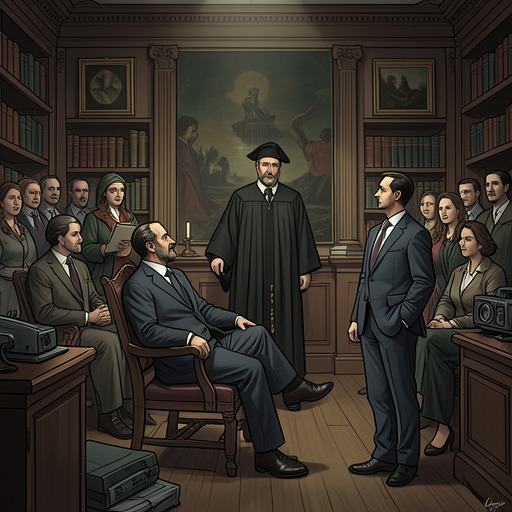
Dr. David Caul
The Minds of Billy MilliganDr. David Caul, medical director of the Athens Mental Health Center, becomes central to Billy Milligan’s story when the question of treatment shifts from diagnosis to where and how it can take place. He agrees to receive Billy only on the understanding that he can use the hospital’s most therapeutic open setting. In Athens, he works to stabilize Billy, recognize the distinct personalities without mistaking treatment for punishment, and restore privileges as trust develops. That clinical approach brings Billy greater freedom, but also places Caul at the center of a dispute over public safety, institutional authority, and what treatment should mean for someone found not guilty by reason of insanity.
Recommendation and the Athens Plan
As the trial approached, the defense needed an alternative to Lima State Hospital where Billy could receive suitable treatment for multiple personality. Harding Hospital was considered too expensive for a long-term placement. Dr. Cornelia Wilbur recommended Caul, a physician less than seventy-five miles from Columbus who had treated several people with multiple personalities and was known for his experience in the field.
The defense wanted to establish whether Athens would actually accept Billy before the court settled on a destination. Judy Stevenson contacted Caul, who said he would consult the hospital superintendent and state mental-health authorities. He agreed to attend the December 1 meeting in Columbus and said he would consider taking Billy as a patient. There, the participants discussed the planned trial and the placement that might follow an insanity verdict. The defense described Caul’s experience and the recommendations he had received from recognized specialists. Asked directly whether he would accept Billy, Caul agreed, but made his condition explicit: he would need to treat him in the same open, therapeutic manner he used with other patients. If that could not be allowed, he did not want Billy sent to Athens.
The condition defined Caul’s role from the outset. He was not simply offering a bed at a state facility; he was arguing that the setting and terms of care were part of the treatment itself. After Judge Jay Flowers found Billy not guilty by reason of insanity on counts two through ten, Billy was transferred to Athens. Caul’s distinction between patient and criminal became tangible in the receiving office: when a police officer brought Billy in handcuffed, Caul demanded that the cuffs be removed. Billy was calling himself Danny, and Caul recognized that the stress of the transfer had brought about a change in personality. Knowing from Dr. George Harding that the earlier fusion had been fragile, Caul understood that a trial and its aftermath could trigger unfusion. His immediate task, as the book presents it, was to gain Danny’s confidence rather than treat the change as defiance.
Treatment and the Work of Trust
Caul’s approach combined attention to Billy’s switching with practical methods for managing distress. He provided general therapy intended to strengthen Billy’s control of the consciousness, used hypnotherapy, and taught autosuggestion techniques to help reduce tension. Weekly group-therapy sessions with two other patients with multiple personalities gave Billy a chance to observe the condition in other people as well as understand it in himself. Billy switched less often, and Caul judged that he was improving.
His work also depended on the meaning attached to the hospital’s freedom. In an early visit, Caul reassured Billy that the court had found him not guilty and that, in the hospital, he was not to be treated as a criminal. He framed recovery as work Billy would have to undertake: accepting treatment, working with Billy’s own identity, and trying to bring himself together. The reassurance did not erase the past or promise an easy recovery. It set a different expectation for the present, one in which the patient’s actions and progress mattered more than a permanent criminal label.
Caul later extended Billy’s privileges in stages. At first Billy could leave the building with an attendant; then he could sign out for short walks on the hospital grounds. During those walks, he tested pollution levels at points along the Hocking River, made plans to take physics, biology, and art classes at Ohio University, and began charting his moods. When Billy asked to go into town for ordinary errands, Caul initially required two hospital employees to accompany him, then reduced the supervision to one after those trips went well. Billy encountered students who recognized him from news coverage and waved. Their response mattered to him as evidence that public recognition did not invariably mean rejection.
Billy then asked for permission to go into town alone. He argued that he had learned to trust the people around him and wanted Caul to show that the trust went both ways; other patients, including some with more severe illnesses, had that privilege. Caul agreed that Billy was ready. Before authorizing the change, he consulted the superintendent and law-enforcement officials. The resulting arrangement required the hospital to notify Athens police and the Adult Parole Authority in Lancaster whenever Billy left the grounds unattended or returned. Billy agreed to follow the rules. For Caul, liberty was neither an abstract reward nor an unlimited release: it was a clinical step, paired with explicit conditions and monitoring.
Recognition and the Question of Integration
Caul’s clinical attention included taking seriously the personalities as they appeared, rather than assuming a single, stable presentation. When a new list of twenty-four names was brought to him, including the previously unfamiliar name The Teacher, he arranged to have a session with Billy and Dave Malawista videotaped. The list made clear that the picture of Billy’s inner life was still incomplete. Caul did not treat the document as a settled explanation; it prompted further observation.
When The Teacher appeared, Caul recognized that the person before him was neither Billy nor one of the personalities he had already encountered. Rather than ask for an explanation, he showed that he had noticed the change and greeted The Teacher as someone he had expected to meet. The Teacher responded that Caul had stripped away his defenses; Caul denied that he had caused the emergence and understood it as something whose time had come. The exchange gives their work a different emphasis from simple symptom control: Caul’s attentive recognition creates room for a new disclosure, but he does not claim authorship of it.
This encounter also fits the broader pattern of Caul’s method. He observes changes, adjusts his response to the person present, and seeks a therapeutic relationship strong enough to accommodate uncertainty. His interest in videotaping a session reflects the need to record what was happening, while the new list of names demonstrates why one apparent period of fusion could not be treated as proof that the work was complete. Caul’s task remained ongoing even when Billy appeared more integrated or capable of greater independence.
Institutional Conflict and Restricted Care
The expansion of Billy’s freedom provoked public and institutional resistance. After newspaper reports revealed that he had been permitted unsupervised leave, Athens hospital superintendent Sue Foster said the publicity and Billy’s reaction to it had compromised his treatment. A public rebuke followed from Mike Stinziano, who objected to blaming the press for reporting the facts. Caul’s choices were consequently judged not only as clinical decisions but as matters of public administration and political scrutiny.
Pressure also arose inside the hospital. Staff on the Admissions and Intensive Treatment ward, upset by the publicity and Billy’s response to it, demanded changes to his plan and threatened to strike. Some felt Caul spent too much time with Billy. They wanted the staff team to assume day-to-day management, leaving Caul responsible for medical and therapeutic concerns. Caul reluctantly agreed, in part to prevent Billy from being sent to Lima State Hospital. The revised plan sharply narrowed daily life: Billy was not to keep glass or sharp objects in his room, could receive no general privileges without the morning treatment team’s prior agreement, and was subject to restrictions on telephone calls, visitors, spending, painting materials, and advice to other patients. Privileges would return in stages only after compliance. The contrast with Caul’s earlier graduated trust was stark: care remained in Athens, but its terms increasingly resembled institutional control.
After the controversy over furloughs resumed, the Ohio Ethics Commission began an investigation into alleged improper conduct, including the claim that Billy had received special privileges because Caul was secretly writing a book about him. Caul filed an affidavit on July 17, 1979, describing the events as upheavals beyond what he considered appropriate or consistent with logic, reason, and law. He maintained that his clinical decision about Billy’s treatment had support from professionals knowledgeable about the subject. The evidence establishes the professional and personal stakes of the dispute, but does not provide the investigation’s final finding.
Transfers and the Limits of His Work
Billy’s continued hospitalization did not resolve the legal threat attached to his earlier convictions. After a March 1, 1979 review hearing, he was recommitted to Athens for six more months. The book explains that discharge could expose him to return to prison as a parole violator, with a further sentence also possible over the roadside-rest assaults. This made Caul’s prospect of recovery inseparable from the question of what would happen once the hospital no longer held Billy.
On October 4, after a later legal proceeding, Billy was handcuffed and shackled and transferred 180 miles to Lima State Hospital. He had time to say goodbye only to Caul. The abrupt departure stands against the gradual, negotiated movement toward independence that Caul had overseen in Athens. It also marks the limit of his authority: his clinical plan could be altered by staff conflict and displaced by court and state decisions.
Billy was later moved to the Dayton Forensic Center. The account says that he hoped a future review would return him to Athens because Caul could treat him, help him fuse again, and bring back The Teacher. It also describes deterioration: Billy sometimes did not know who he was, communication among the personalities diminished, and periods of partial fusion left him without a name. In that later account, Caul represents a treatment relationship Billy believed could help restore coherence, but the evidence does not show that he was able to resume treatment at Athens. His significance lies in both the care he offered and the institutional forces that repeatedly constrained it: he made open treatment a condition of accepting Billy, then tried to make trust and measured freedom part of recovery, even as those principles came under sustained pressure.