Fusion
The Minds of Billy MilliganFusion is the coming together of Billy Milligan’s alternate personalities into a single individual, a change that made otherwise inaccessible memories available and altered the course of his treatment and the telling of his story. The book presents it both as a deeply consequential experience for Milligan and as the means by which his fragmented past could be recalled and arranged into a narrative.
Definition and Meaning
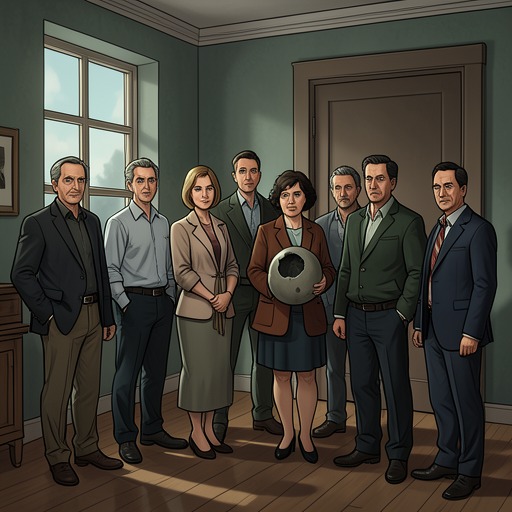
In the book’s account, fusion does not mean simply declining to acknowledge the alternate personalities. The Teacher is identified as the sum of all twenty-three alter egos fused into one. This description makes fusion an incorporation of the personalities into a larger individual, rather than an account of one personality being selected while the others are ignored. The Teacher is described as having learned from all of them and as brilliant, sensitive, and humorous. His self-description, “I am Billy all in one piece,” gives the process its clearest formulation: the resulting identity is presented as Billy in a more complete form.
The Teacher also calls the other personalities “the androids I made.” The phrase sits beside the description of him as their sum, emphasizing the unusual relationship between the fused individual and the distinct personalities whose experiences contribute to him. The book does not reduce those experiences to a list of symptoms: it identifies their thoughts, actions, relationships, tragic experiences, and comic adventures as parts of what the fused Milligan can recall.
The First Complete Fusion
The first complete fusion occurred after the narrator had found Billy hesitant and nervous during a visit in his hospital room. Billy’s knees jiggled, his voice sometimes quavered around painful memories, and long stretches of his past were blanked out by amnesia. Although he could speak generally about what he vaguely remembered, attempts to draw out details had failed. The sudden emergence of a fused Milligan therefore changed not only Billy’s presentation but also what could be learned about his life.
The fused Milligan had clear, almost total recall of the personalities from their creation onward. That recall encompassed what they had thought and done, the relationships they had formed, and their experiences, both tragic and comic. The contrast is central to the meaning of the event in the book: before the fusion, the narrator encountered a man who could not supply many particulars; afterward, the fused individual could provide access to a much broader account. The source describes this as the first time Billy fused completely, not as proof that the condition was permanent or that every difficulty had thereby ended.
Treatment and Recognition
Fusion also became a proposed goal in the clinical setting. After discussing the case with Dr. Cornelia Wilbur, Dr. George considered asking the court for at least another ninety days and trying to fuse Milligan so that he could help his attorneys and stand trial. In that context, fusion was linked to a practical legal objective: making it possible for Milligan to participate in his defense. The proposal does not establish that fusion alone resolved the question of his ability to stand trial; it records the treatment aim being discussed.
The clinicians’ revised approach followed recognition that ignoring the alternate personalities had not brought them together. Dr. George told the staff that the effort to ignore the multiple personalities had instead caused them to go underground. He stressed that responsibility and accountability still mattered, while warning against repressing the personalities. He also argued that any hope of achieving fusion required recognizing and dealing with all the personalities as individuals. The sequence distinguishes fusion from suppression: in the account, the proposed route toward a unified state depended on acknowledging the distinct personalities, not pretending they did not exist.
Narrative Consequences
The first complete fusion made the book’s reconstruction of Milligan’s past possible. The narrator states that the material came from the fused Milligan, the other personalities, and sixty-two people whose paths crossed his. Scenes and dialogue were recreated from Milligan’s recollections, while therapy sessions were taken directly from videotapes. Fusion therefore supplied an unusually extensive source of personal recollection, but it was not presented as the book’s only source of information.
That material still had to be organized into chronology. Because Milligan had frequently lost time from early childhood, he rarely attended to clocks or calendars and was sometimes embarrassed to admit that he did not know the day or month. The narrator used documents—including bills, receipts, insurance reports, school and employment records, and correspondence dated by postmarks—to place events in time. Fusion opened access to memories; documentary records helped establish when events had occurred. Together, these details show why fusion matters to the book beyond its clinical and personal significance: it made a fuller account narratable, while leaving the work of verifying and arranging that account essential.