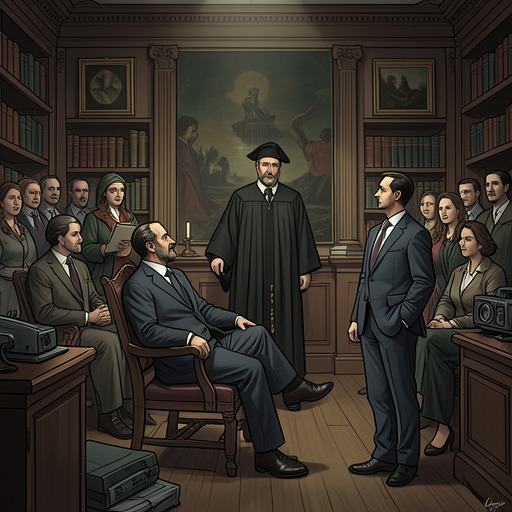
Gary Schweickart
The Minds of Billy MilliganGary Schweickart is the supervising attorney who moves from expecting to disprove Billy Milligan’s account of multiple personalities to building a defense around it. His change is not merely a shift in opinion: it redirects the case toward psychiatric observation, a plea of not guilty by reason of insanity, and a stipulated-evidence trial. The work gives Billy an advocate, but Schweickart’s eventual departure makes visible the private cost of a defense that has taken over his professional and family life.
Identity and first response
When word reached the public defender’s office that the police had booked the Campus Rapist and transferred him to the Franklin County Jail, Schweickart was trying to light his pipe. The supervising attorney was thirty-three, tall and bearded, and holding the office while another staff attorney warned that reporters would be watching and the police might pressure the accused. Schweickart initially had no one else available to send for first-aid counseling. The call placed the case before him as an urgent legal and human problem, before he had any reason to accept the explanation that would come to define it.
Judy Stevenson later returned from the jail and told Schweickart about her meetings with Billy and Dorothy Turner. He looked at her as though the account were impossible. Even while acknowledging that Billy was mentally disturbed and that he supported Judy, he doubted the proposed defense could work. His skepticism was practical as well as evidentiary: the claim seemed likely to be rejected by the prosecutor and judge. For Schweickart, belief would have to follow encounter rather than precede it.
From doubt to conviction
Schweickart expected his meeting with Billy to last the usual fifteen or thirty minutes. He went in prepared to expose what he believed might be a fraud. Instead, the interview lasted five hours. In the room he encountered Ragen, who identified the place as a prison and sprang up defensively when the door opened, settling only after he saw that the newcomer was an attorney checking whether the room was occupied. The abrupt shift from alertness to calm formed part of the encounter Schweickart had to reckon with.
Leaving with Judy in the cold night, Schweickart found himself considering whether records of Arthur or Ragen might exist in England or Yugoslavia. He did not accept reincarnation or possession as explanations; what stayed with him was the sense that he had met different people in the same conference room. He described himself as intellectually and emotionally shocked, and said that he believed. The lawyer who had expected to debunk the claim now faced the harder task of making others—especially the prosecutor and the judge—take it seriously.
Treatment and defense strategy
Schweickart’s role extended beyond the courtroom. When Billy’s observation and treatment at Harding Hospital was extended by at least three months, he and Judy visited to pass along the news, giving the treatment team more time to pursue fusion. The clinical process remained uncertain: Billy worried that fusion might weaken or erase the other personalities’ talents, and a fused state in which Tommy played drums was visibly less accomplished than Allen had been on his own. The extension therefore meant time for treatment, not a guaranteed or uncomplicated resolution.
As the prospect of trial approached, Schweickart and Judy returned to the hospital on August 28. They told Billy that Dr. George Harding’s report to the judge was due in about three weeks; if Dr. Harding considered Billy fused and competent, Judge Flowers could set a trial date. Arthur then raised the defense strategy. He was willing to accept punishment for the three robberies but refused to plead guilty to rape, although four of the ten indictment counts included rape. The proposed division exposed the difficulty of translating the inner group’s distinctions into a single legal plea.
The following day, a letter on yellow legal paper announced that William S. Milligan no longer wanted Schweickart and Judy as his attorneys and would conduct his own defense. Further dismissal letters arrived, but the attorneys did not act on them; after four more letters were misfiled and unanswered, Arthur stopped trying to fire them. Schweickart’s continued representation thus depended partly on the lawyers’ decision not to treat each written dismissal as final. When Judy asked whether an insanity plea could succeed, Schweickart assessed the case conditionally: if the psychiatrists who had examined Billy testified that he met Ohio’s legal definition of insanity at the time of the crimes, he believed the defense had a reasonable chance. He recognized the novelty of seeking that verdict in a major-crime case, but was prepared to make Billy the first.
The case in and around court
On October 3, Schweickart drove his station wagon to Harding Hospital to collect some of Billy’s paintings. Judy was on vacation in Italy and would miss the competency hearing, though she expected to return for the trial. As he and Billy walked and talked, Schweickart prepared him for transfer to the Franklin County Jail and for the possibility that the defense might lose. The paintings included a portrait of Adalana, as well as religious subjects and a landscape; the hospital report and these works would soon become part of the case’s public visibility after the report was leaked.
Schweickart also made a consequential procedural choice. Leaving the courtroom after a dispute over whether a change in law could apply, he told the prosecutors that he intended to waive a jury trial and ask Judge Flowers to hear the case. At the eventual proceeding, he stated that both sides agreed there was no need to call witnesses or put Billy on the stand: the facts would be read into the record as stipulations. The defense did not contest the charges or deny that Billy had committed the crimes, except for the first count of sexual assault; it pleaded not guilty by reason of insanity. The approach focused the trial on criminal responsibility rather than requiring Billy to testify or forcing the parties to relitigate every underlying fact.
Cost and significance
Schweickart’s defense helped carry the case through a period of observation, treatment, competency proceedings, and trial. Billy was ultimately found not guilty, and later Dr. David Caul reminded him that the court had found him not guilty and that the hospital regarded his future progress as a new life. Schweickart, however, was already confronting the end of his own role. When he left the Athens Mental Health Center, he knew Billy was in other hands and looked back on fourteen months of work that had been all-demanding and all-consuming.
The strain reached well beyond working hours. The case contributed to the breakup of Schweickart’s marriage to Jo Anne, while late-night calls blamed him for successfully defending a rapist. One of his children was attacked at school because of his father’s role in the defense. He also worried that his other clients had received less time and effort because Billy’s case had taken priority. Judy’s observation that their homes and families had paid the price captures a burden Schweickart shared: the defense demanded not only legal judgment but sustained attention that had to come from somewhere. His arc therefore joins two kinds of consequence—the public achievement of mounting an unprecedented defense and the less visible damage done by the work required to mount it.