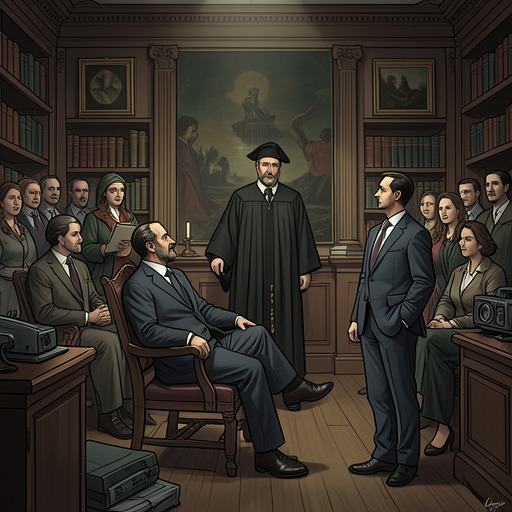
George Harding Jr.
The Minds of Billy MilliganGeorge Harding Jr. is the medical director of Harding Hospital and a pivotal psychiatrist in the early legal and clinical response to William Stanley Milligan. His evaluation placed Milligan’s inability to participate in his defense before the court, and his decision to advocate for hospital admission brought the case into a demanding treatment setting. At the hospital, Harding also confronted a difficult question: how to recognize Milligan’s reported personalities without allowing their presence to disrupt care for other patients.
Identity and Position
Harding was forty-nine when Gary Schweickart first met him. The narrative presents him as an established, conservative psychiatrist, and notes his family connection to President Warren G. Harding through the president’s brother. His professional position gave him authority over both the assessment requested by the court and the hospital’s response to an unusual and demanding case.
The public defenders’ efforts to secure an evaluation formed part of the immediate context for Harding’s involvement. After Milligan’s lawyers continued visiting him in prison despite a letter dismissing them, the Public Defender’s Office released funds for a psychological assessment. Dr. Willis C. Driscoll tested Milligan in January 1978, recording an IQ score of 68 while noting that depression had lowered the result. Driscoll diagnosed acute schizophrenia and concluded that Milligan could not adequately understand events or assist his counsel, recommending hospitalization for further examination and possible treatment. On January 19, Judy Stevenson and Schweickart presented that report to Judge Jay Flowers in support of their argument that Milligan could not help with his defense.
Competency Evaluation and Hospital Admission
Harding’s own assessment addressed Milligan’s capacity to stand trial at that time. In a letter dated March 13, 1978, he concluded that Milligan could not cooperate with his attorney in preparing a defense and lacked the emotional integration needed to testify, confront witnesses, or maintain an effective psychological presence in court. The finding was about Milligan’s present ability to take part in proceedings, not by itself a decision about his responsibility when the charged acts occurred.
Schweickart and Prosecutor Bernie Yavitch asked Harding to go beyond the competency evaluation and seek Milligan’s admission to Harding Hospital for examination and treatment. Harding hesitated over the decision, but the unusual cooperation between the two sides mattered: they assured him that he would not be placed in an adversarial position and that his report would enter the trial record by stipulation. As medical director, he took the admission request to the hospital administrator and finance officer. He argued that the hospital should not turn away from difficult cases and presented the case as an opportunity for staff learning and a contribution to psychiatric knowledge. The committee agreed to admit Milligan for the three months mandated by the court.
Milligan arrived on March 16, two days ahead of schedule, while Harding was at a psychiatric meeting in Chicago. Harding had assembled and briefed a therapy team, but Dr. Shoemaker took personal charge until he returned. Stevenson and Dorothy Turner accompanied Milligan to Wakefield Cottage, a locked unit for fourteen patients requiring constant observation and personal attention. He was placed in one of its two rooms designated for special care, where a peephole allowed around-the-clock observation. The early arrival meant that Harding’s plan had to begin under the supervision of colleagues before he was back at the hospital.
Clinical Management on the Ward
Harding’s treatment approach took shape amid staff concerns about Milligan’s conduct on the unit. Staff reported that he denied actions they had witnessed, including playing the piano and writing notes, and that he moved from one staff member to another in search of what he wanted. They also felt that his references to Ragen taking over were threatening. These complaints made the personalities not only a clinical subject but a practical difficulty in a shared ward, where other patients could be confused by the names and claims they heard.
Harding proposed that he alone deal with Milligan’s other personalities, and only during therapy sessions. He instructed staff not to mention or discuss the other names on the unit, particularly in front of other patients. On March 28, nurse Helen Yaeger recorded the plan in a nursing-goal sheet: staff were to respond matter-of-factly when Milligan denied playing the piano or knowing about notes he had written, and to remind him that his name was Billy when he referred to himself as another personality. Harding explained that hearing the different names confused other patients. His policy therefore combined limits on where the diagnosis could be discussed with a routine of calmly identifying observable behavior and reinforcing Milligan’s legal name.
Confidentiality and Legal Significance
For much of the case, the multiple-personality diagnosis was kept from the public. The public defenders wanted secrecy because they feared that media attention would complicate treatment and the eventual trial; the prosecutor agreed that, in the absence of courtroom testimony on the diagnosis, it was appropriate not to disclose it. The diagnosis was nevertheless known to Milligan’s treating clinicians, the prosecutors, and the judge. Harding’s work thus unfolded while clinicians and lawyers were managing both the patient’s condition and the public consequences of naming it.
The later trial addressed a different legal question from Harding’s competency report. Judge Flowers dismissed the first rape count for lack of corroborating evidence and a similar modus operandi. On the remaining counts, the judge relied on stipulated medical evidence that Milligan had been mentally ill when the acts occurred, could not distinguish right from wrong, and could not refrain from them; the court found him not guilty by reason of insanity. Harding’s March evaluation and the later verdict belong to separate stages of the case: one concerned Milligan’s ability to assist in a present-day defense, while the other concerned his mental state at the time of the offenses. The distinction clarifies the significance of Harding’s role without making his competency finding stand in for the court’s eventual determination.