Harding Hospital
The Minds of Billy MilliganHarding Hospital becomes the decisive clinical setting in William Stanley Milligan’s case: a court-ordered place of observation where staff had to test a diagnosis they did not all accept, and where treatment changed the legal assessment of his ability to stand trial. The hospital’s work did not end with a simple declaration of recovery. Its clinicians distinguished Milligan’s present capacity to participate in court from their opinion about his mental state when the charged conduct occurred, while later events exposed how much his care depended on the institution in which he was placed.
A difficult case enters the hospital
Gary Schweickart recognized Harding Hospital as a possible destination after recalling his own earlier work there as a psychiatric aide. He went to speak with Dr. George Harding, the hospital’s medical director, who was also described as the grandson of the brother of President Warren G. Harding. The visit brought a public defender into contact with a psychiatrist whom Gary perceived as representing a conservative establishment; the meeting was a practical effort to find a treatment setting for an unusually difficult case.
Before Milligan’s admission, the Public Defender’s Office funded a psychological evaluation. Clinical psychologist Dr. Willis C. Driscoll administered a battery of tests on January 8 and January 13, 1978. Dr. George Harding later interviewed Milligan and concluded that he could not then stand trial: in his view, Milligan could not cooperate effectively with his attorney or sustain the emotional integration needed to testify and confront witnesses. This was a judgment about Milligan’s capacity at that time, not by itself a conclusion about his responsibility when the alleged crimes occurred.
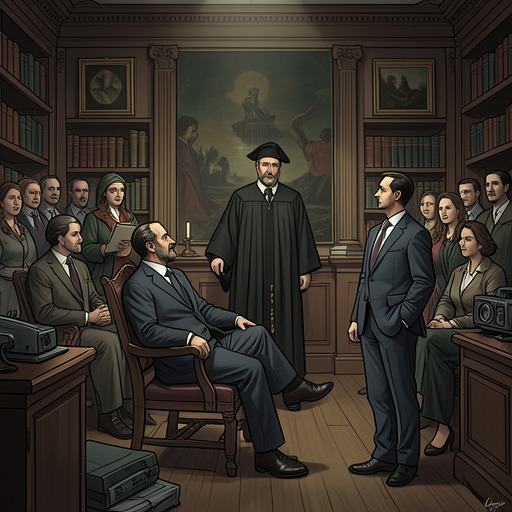
As medical director, Dr. George Harding sought approval from the hospital administrator and finance officer to admit Milligan. The court required a three-month stay. Dr. Harding presented the case as a difficult problem that could also teach the staff and contribute to psychiatric knowledge, and the hospital’s committee agreed to accept him. The decision placed the institution inside a legal process as well as a clinical one: the hospital was expected to observe and treat Milligan, while its findings would help determine what could happen in court.
Wakefield Cottage and the treatment team
Milligan arrived on the morning of March 16, two days ahead of schedule, after transfer from the Franklin County Jail. Dr. George Harding had prepared a therapy team but was away at a psychiatric meeting in Chicago. Judy Stevenson and Dorothy Turner accompanied Danny to Wakefield Cottage, a locked psychiatric unit intended for fourteen patients requiring constant observation and personal attention. A bed was prepared in one of its two special-care rooms; heavy oak doors had peepholes for around-the-clock observation. A psychiatric aide brought a meal, and the two women remained with him while he ate.
The unexpected arrival disrupted Dr. Harding’s carefully arranged introduction. On his return, he was frustrated that he had not been present to greet Milligan, but the team he had assembled was broad: psychologist, art therapist, adjunctive therapist, psychiatric social worker, doctors, nurses, psychiatric aides, and the Wakefield coordinator. He had briefed them on multiple personality. Some staff members openly doubted the diagnosis. Dr. Harding did not demand instant agreement; he acknowledged his own skepticism and asked them to keep open minds and work together to understand Milligan. The hospital’s treatment therefore began amid uncertainty, not consensus.
The first therapy meeting was strained. Milligan sat facing a window in the Wakefield interview room and initially avoided eye contact. He seemed to recall little of his past, though he spoke freely about abuse by his adoptive father. The mismatch between limited access to personal memory and the ability to discuss some traumatic experiences became part of the clinical problem the team had to address. Around the same period, nurse Helen Yaeger, who had spoken with Arthur on the first day, entered material into a nursing-goal sheet, bringing the hospital’s everyday care routines into contact with the personalities being discussed in therapy.
From observation to staged fusion
By the end of April, with six of the twelve weeks elapsed, Dr. George Harding thought progress was too slow. He wanted to establish communication between the personalities and the core Billy, but had not seen Billy since an earlier session in which Dr. Cornelia Wilbur persuaded Ragen to let him come forward. The difficulty was not simply identifying distinct personalities; it was creating a way for them and the core personality to share information and remain in contact.
The shift became visible when Billy returned to therapy and, by the movement of his knees, Dr. Harding recognized him as the core personality. Billy had heard the names Arthur and Ragen and wanted to know who they were. His questions marked a change in the work: the treatment now had to help him acknowledge the other personalities rather than leave them as names or experiences held at a distance.
Dr. Cornelia Wilbur’s visit drew unusual attention. She had lectured at Harding Hospital in 1955, but the present occasion was different: staff were observing a patient they understood to be the first person with multiple personality to be monitored around the clock in a mental hospital. The staff remained divided about the diagnosis, yet were eager to hear her discuss Milligan. After the visit, the treatment strategy changed again, and Dr. George Harding concentrated on fusion.
Dr. Marlene Kocan arranged regular sessions in which the personalities recalled memories of abuse and torture and worked through the anguish associated with the major dissociation at age eight. The core Billy was encouraged to listen to the others, answer them, acknowledge that they existed, and become familiar with them. Constant suggestion helped him remain in the consciousness spotlight for longer periods. Fusion was planned in stages: compatible personalities would first be joined in pairs, and the resulting pairings would then be combined, through intensive suggestion, into the core Billy. The procedure made the hospital’s therapeutic aim explicit—not merely to observe the divisions, but to build communication and integration across them.
Clinical judgment and the court
By late August, Dr. George Harding believed Milligan was fused or close to fusion and probably could be brought to a state in which he could stand trial. The prospect troubled him for a different reason: he questioned whether using the multiple-personality diagnosis as a defense against serious crimes was morally right. His uncertainty concerned the implications of the diagnosis, not simply whether the treatment was working.
Dr. Harding believed Milligan had not controlled his actions on the three days in October 1977. He sought advice from other professionals, consulted his staff, and prepared a nine-page report dated September 12, 1978, describing Milligan’s medical, social, and psychiatric history. In it, he concluded that Milligan was competent to stand trial after achieving fusion, while also judging him mentally ill and not responsible for the criminal conduct at the time it occurred. The two opinions addressed different questions: current capacity to participate in proceedings and mental condition during the earlier conduct.
Until then, the multiple-personality diagnosis had been known only to Milligan’s treating clinicians, prosecutors, and the judge. The public defenders wanted it kept secret because a media event, they feared, would make treatment and a subsequent trial more difficult. At the eventual court proceeding, the prosecution agreed to the evidence from Dr. Harding, Dr. Dorothy Turner, Dr. Stella Karolin, and Dr. Cornelia Wilbur supporting Milligan’s mental condition when the crimes were committed. Harding Hospital’s clinical work thus moved beyond its locked unit: its observations and conclusions became part of the evidentiary basis for the legal case.
Records, transfer, and institutional limits
Two court-ordered electroencephalograms taken at Harding Hospital in May 1978 later became part of the book’s reconsideration of Milligan’s case. On May 9, Dr. P. R. Hyman described an abnormal tracing, including slow-wave activity in the right rear hemisphere, but considered a technical problem a possible explanation and recommended a repeat test. He noted that the technologist had not resolved the question even after changing the electrode. On May 22, Dr. James Parker reported that the localized abnormality from the first tracing was absent; the second showed bilateral theta and delta activity and bilateral temporal sharp waves that could be epileptiform.
Years later, after learning of new research, Daniel Keyes returned to the reports. An EEG technologist told him the descriptions seemed to concern two different people. Keyes presented the possibility that the tests had been administered to different personalities, perhaps children, as an interpretation consistent with that research—not as a settled finding in the original reports. The contrast between the two tracings extends the hospital’s significance from treatment into the book’s later examination of how clinical records may be read and re-read.
Dr. George Harding continued to support Athens Mental Health Center as the proper place for Milligan’s treatment. Yet on October 4, 1979, Milligan was handcuffed and belt-shackled and taken 180 miles to Lima State Hospital for the Criminally Insane, with time to say goodbye only to Dr. David Caul. At a later hearing, Dr. Harding again testified that Athens was the appropriate treatment setting. Milligan recalled first believing in the multiple-personality account at Harding Hospital, and said that seeing videotapes at Athens made him know it. These later references preserve Harding Hospital as the beginning of an institutional and therapeutic history, while the transfers show that a clinical judgment about suitable care did not itself determine where Milligan would be held.
Harding Hospital’s role is therefore defined by a tension between observation, treatment, and legal consequence. Wakefield Cottage imposed close supervision, while the therapy team worked toward communication and fusion; the resulting clinical judgments informed the court, but did not settle every question of responsibility or placement. The hospital made Milligan’s inner divisions available to sustained professional attention, yet the record it produced remained open to later interpretation, and the treatment’s continuation depended on decisions made beyond its walls.