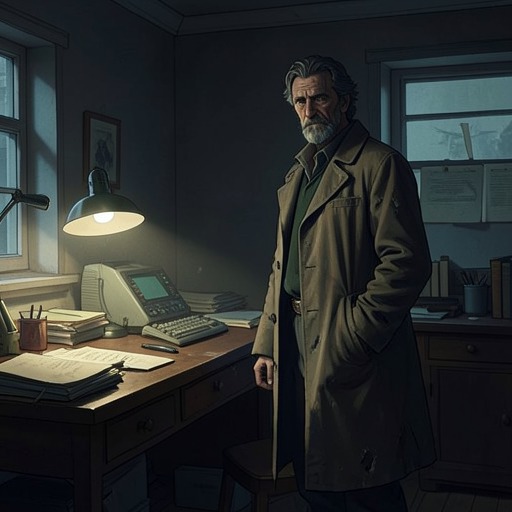
Johnny Morrison's Suicide Letter
The Minds of Billy MilliganJohnny Morrison's Suicide Letter is both a final appeal and a contested account of the family Billy Milligan had been taught to remember. Preserved among practical instructions and other papers, the letter portrays Johnny as a father who feared for his children and blamed Dorothy Moore for the collapse of their home. Its arrival in Billy's hands turns a document written at the end of Johnny's life into the beginning of an investigation: Billy reads, doubts, checks, and ultimately has to reckon with a history more complicated than either filial reverence or accusation can contain.
The Document and Its Contents
The letter reached Billy inside a bulky envelope that Kathy had kept from him because she feared it would upset him. The envelope held correspondence from the Office of the Medical Examiner in Dade County, Florida; four separate pages of instructions addressed to four people; an eight-page letter to Herb Rau, a reporter for the Miami News; and a two-page note that had been torn up and later pieced together by police. That fragment appeared to be part of a second, unfinished note to Rau. The surviving copy of the eight-page letter was unreadable in places, marked with asterisks in the account, so the reader encounters Johnny's testimony as an incomplete record rather than a seamless confession.
The practical instructions give the papers an unexpectedly domestic scale. They concerned payment of outstanding debts and loans ranging from twenty-seven to one hundred eighty dollars. One note to Louise ended with a joke about a boy and a werewolf; another, addressed to Miss Dorothy Vincent, directed that debts be paid from Johnny's insurance and asked that he be cremated, adding that he could not bear the thought of her dancing over his grave. These details sit beside the more consequential letter, making the envelope at once a set of last arrangements and an argument about what Johnny believed had happened to his family.
Addressing Rau, Johnny wrote that his world had collapsed and that the small amount of insurance he left was the only possible temporary security for his three children, James, William, and Kathy Jo. He asked the reporter to see that their mother, Dorothy Vincent, did not receive the money. Johnny alleged that she associated with people around the nightclub where she worked, including procurers and moneylenders, and that those relationships had broken up the home. These are the claims of a letter written by a man in crisis, not independently established findings; their force in the narrative comes partly from the urgent, self-defending way he presents them.
Johnny also described the children's births outside marriage as something Dorothy might use for publicity, and recounted repeated attempts to persuade her to marry him. He said he had introduced her to his family as his wife and intended to marry her in a small town after their first child was born. The surviving passage breaks off before that account is complete. Later in the letter, he said that Dorothy had caused him to lose two jobs, disappeared for one to three days at a time, and threatened that he would be driven out of Miami if he fought for the children. He framed his decision in terms of an unbearable choice: remaining in the situation to protect the children or ending his life. He asked Rau to have agencies investigate their welfare and closed with a plea for mercy on his soul.
Billy's Reading and Investigation
Kathy finally gave Billy the envelope after hearing him speak about Dorothy's suffering and condemn Johnny as a rotten father. She had worshiped Johnny's memory all her life, but her anger made her decide Billy should know what the letter said. She handed it over and left him alone. Billy was stunned. He read it repeatedly, trying to remain skeptical, yet the more he read, the more he wanted to establish whether Johnny's account could be checked.
Before leaving Kathy's home in Logan, Billy called the Florida Bar Association to locate Johnny's lawyer. He learned that the lawyer had died. A call to the hall of records produced another concrete result: there was no record of a marriage license for Johnny Morrison or Johnny Sohraner. That absence did not settle every question raised by the letter, but it gave Billy a record he could compare with Johnny's story of an intended marriage and a family presented as legitimate.
Billy kept making calls until he reached the former owner of a nightclub where Johnny had worked. Now retired, the man still had a boat in Key Biscayne and brought seafood to the club. He said he had expected that one of Johnny's children would eventually ask about their father. He had fired Billy's mother from the nightclub because of the people she was bringing around, and remembered Johnny trying, without success, to keep her away from them. His account supported part of Johnny's description, though it remained one witness's recollection rather than a complete verification of the letter.
Billy also located a man who had worked at the Midget Motel and remembered Johnny. The man recalled that telephone calls during the Christmas holiday had left Johnny depressed. This seemed consistent with Johnny's claim that Dorothy had been calling and taunting him. The match between the recollection and the letter strengthened Billy's sense that there was something to investigate, but the evidence remained partial: a dead lawyer, a missing marriage record, and witnesses whose memories corroborated particular circumstances without resolving the whole relationship.
Dispute, Reconciliation, and Significance
Dorothy Moore denied the accusations in the suicide letter and agreed to its publication. She said Johnny had been mentally ill before his death and had been involved with another woman, a stripper; in her account, he may have confused that woman with Dorothy when describing the people around her. Her response directly challenged the letter's account while also supplying an alternative explanation for its allegations. The document therefore does not function as a final verdict on either parent. It preserves Johnny's version, Dorothy's rebuttal, and the limits of what Billy could establish by making calls years later.
Billy made his peace with his mother. That outcome gives the letter a consequence beyond the facts it records: reading it first sharpens his anger and sends him searching for corroboration, but the inquiry does not end in a simple choice between believing Johnny and rejecting Dorothy. The letter had seemed to promise a hidden explanation of the family. Instead, it opened a contested record in which each voice was shaped by a different position: Johnny writing to protect his children and defend his conduct, Dorothy answering allegations she rejected, and Billy trying to test inherited memories against documents and other people's recollections.
The papers also belong to a broader story in which personal testimony can become public evidence. Johnny addressed a newspaper reporter and asked him to investigate the children's welfare; years later, Billy's discovery of the letter made its claims newly consequential within the family. Its damaged copy, torn companion note, practical debt lists, and disputed accusations all resist the neatness of a single authoritative account. For Billy, its decisive significance is not that it settles who his parents were, but that it forces him to question the story he had received and to pursue the truth without mistaking partial corroboration for certainty.