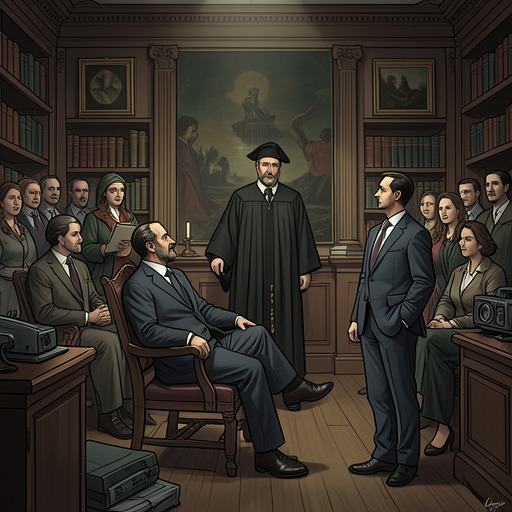
Judy Stevenson
The Minds of Billy MilliganJudy Stevenson, a public defender in Columbus, is one of William Stanley Milligan’s principal legal advocates. Her role grows from representing a defendant in a highly publicized rape case into confronting evidence that his shifting behavior may reflect a profound mental illness. She works to secure evaluation and treatment without surrendering the protections of the legal process, and ultimately helps present the psychiatric case that leads to Milligan’s acquittal by reason of insanity.
Identity and First Recognition
Stevenson is identified as one of the public defenders whose cooperation and investigative work contributed to the book. She shares the defense with Gary Schweickart, and the two remain involved through the case’s disputes over psychiatric examinations, Milligan’s capacity to participate in his defense, and the eventual trial. Their work requires them to respond not only to the charges but also to uncertainty about Milligan’s condition and the consequences of where he might be treated.
The case begins to acquire a different dimension when Milligan requests a woman lawyer. Schweickart brings Stevenson into his office and shows her a newspaper story bearing Milligan’s photograph, published before a scheduled identification lineup. The defense office has asked other newspapers not to publish the image, fearing it could prejudice the identification. The episode places Stevenson’s representation inside a case already exposed to public attention, before the defense has established what is happening to its client.
A more unsettling clue comes through Dorothy Turner, who has interviewed Milligan in jail. Turner is troubled by a promise she made to David not to reveal a secret, but decides the defense must know something and telephones Stevenson. Rather than explain the matter directly, she urges Stevenson to read Sybil. Stevenson buys the book and recognizes a possible connection to the striking changes she has seen in Milligan: at times he has seemed withdrawn and trembling, at others talkative, quick-witted, and manipulative. She had previously attributed these shifts to depression. She also recalls reports of his ability to escape a straitjacket and of unusual strength, alongside Milligan’s stated lack of memory for the acts attributed to him. Turner’s warning does not itself establish a diagnosis, but it changes the questions Stevenson asks of the case.
Securing Evaluation and Treatment
Schweickart and Stevenson continue visiting Milligan in prison even after he sends a letter firing them. The public defender’s office provides funds for a psychological evaluation, and clinical psychologist Willis C. Driscoll examines Milligan on January 8 and 13, 1978. Driscoll reports an IQ score of 68, which he believes depression has lowered, and diagnoses acute schizophrenia. His report describes a serious loss of identity and difficulty distinguishing self from environment; it recommends hospitalization for further examination and possible treatment. Stevenson and Schweickart present the report to Judge Jay Flowers on January 19, arguing that Milligan cannot adequately assist in his own defense.
The court orders an examination by the forensic psychiatry unit at Southwest Community Mental Health Center. Stevenson and Schweickart worry that information disclosed in the examination could be used against their client, particularly because they distrust the unit’s position in relation to the prosecution. The dispute nearly brings the defenders into contempt of court. A compromise limits the prosecution’s ability to question Milligan about incriminating statements made during the examination unless he takes the stand. The defense accepts the arrangement, a guarded decision that allows the evaluation to proceed while preserving some protection for Milligan.
The question of treatment becomes equally urgent when Stevenson and Schweickart fear that Milligan may be sent to Lima before trial. They believe he has heard enough about the institution to be terrified of it, and Schweickart raises the danger of suicide if he is sent there. Stevenson insists that another placement must be found, rejecting the idea that Lima is the only option simply because Southwest recommends it. Her position reflects a central tension in the defense: a mental-health placement is not an abstract administrative detail when Milligan’s response to it may itself create serious danger.
The Defense and Its Limits
As treatment at Harding Hospital continues, Stevenson and Schweickart visit Milligan and pass along the court’s approval of at least three more months for observation and treatment. The extension gives him additional time to work toward fusion. Later, when the defense is discussing trial strategy, Arthur tells the lawyers that Ragen would accept punishment for three robberies but would not plead guilty to rape. Arthur also advances Adalana’s account that the three women had cooperated, had not been injured, and had received money back. Stevenson rejects that account as inconsistent with what the women say. She emphasizes that all three independently contradict it and had no contact with one another.
The exchange exposes the distance between a defense lawyer’s obligations and the account offered by the person she represents. Stevenson and Schweickart understand that Arthur is describing Adalana’s perception of events, not evidence that the women consented. When Arthur says Adalana cannot be consulted because she has been permanently banished from the spot, the lawyers cannot test her version further. Stevenson therefore supports maintaining the pleas of not guilty and not guilty by reason of insanity, which Arthur refuses to accept. The disagreement is not merely tactical: the defense must address competing accounts within Milligan’s inner system without allowing one account to erase the women’s testimony.
The conflict continues when a new letter arrives on lined yellow legal paper, stating that Milligan no longer wants Stevenson and Schweickart to represent him and intends to conduct his own defense. Stevenson agrees with Schweickart to treat the letter as though it has not arrived, joking about the office’s poor filing system and putting it away. The gesture keeps the existing defense in place, but it also shows how unstable representation has become: the lawyers must protect their client while managing repeated efforts to dismiss them.
Courtroom Evidence and Acquittal
After Dr. George Harding concludes that Milligan is competent to stand trial but was mentally ill and not responsible for his conduct during the offenses in the latter half of October 1977, Stevenson files a motion to amend the plea on September 19. The distinction matters to the case: being able to face trial now does not, in Harding’s opinion, mean Milligan was responsible when the charged acts occurred. The eventual proceeding rests on stipulated medical evidence rather than a contest between opposing psychiatric conclusions. The prosecution agrees to the findings presented by Dr. Harding, Dorothy Turner, Stella Karolin, and Cornelia Wilbur.
Stevenson reads the defense testimony, taken by deposition, into the record. The material describes abuse in Milligan’s childhood, including violence against his mother and abuse directed at him. As she reads, she looks toward Milligan and sees that he is pale; she worries that hearing the testimony might cause him to unfuse. Her part in the scene is both procedural and personal: she places the evidence before the court while watching for the effect its account of his life may have on the defendant whose mental state is central to the hearing.
Judge Flowers dismisses the first rape count for lack of corroborating evidence and a similar modus operandi. On counts two through ten, the court accepts the stipulated medical evidence that Milligan was mentally ill at the time, unable to distinguish right from wrong, and unable to refrain from the acts. Flowers finds him not guilty by reason of insanity. Stevenson squeezes him and draws him toward the holding cell to avoid the crowd. When Schweickart explains that they must go to probate court and then face reporters and television cameras, Milligan asks whether they can leave by the back way. The defense chooses to bring him through the lobby rather than appear to evade the press.
Advocacy Under Pressure
Stevenson’s work is marked by repeated efforts to hold together concerns that the proceedings can easily pull apart: a reliable defense, a meaningful psychiatric assessment, a treatment setting that does not worsen Milligan’s crisis, and a truthful account of the alleged offenses. She supports the insanity plea even when Milligan, speaking through Arthur, rejects it; she takes the victims’ contrary testimony seriously when Adalana’s version minimizes their experience; and she continues representing Milligan through attempts to fire his lawyers. After the acquittal, the case does not end with a simple return to ordinary life: the court’s next steps involve probate proceedings, and a later ruling describes Milligan as mentally ill and subject to hospitalization. Stevenson’s importance lies in this sustained, practical advocacy—not in treating diagnosis as a verdict by itself, but in helping the court confront both Milligan’s mental condition and the legal consequences of the evidence.