Milligan’s transfer to Ward 5
The Minds of Billy MilliganMilligan’s transfer to Ward 5, the men’s locked ward, turned a disputed medication scare into a sharp confrontation between institutional security and the internal system the hospital was treating. Milligan did not understand why the transfer had been ordered and knew nothing of the alleged overdose or the hospital trip. When staff came to move him, Ragen resisted; after the transfer, the other personalities surfaced amid the disruption of the locked ward. Dr. David Caul’s intervention the following day brought partial fusion, but not a return to wholeness: Arthur and Ragen remained apart, leaving Billy frightened and incomplete.
Background and Immediate Trigger
The transfer came against a background of disagreement over whether the hospital should recognize Milligan’s distinct personalities. Earlier, Allen had explained that everyone answered to Billy’s name to keep the secret from getting out, even though Billy had been asleep for a long time. Staff had taken a different approach: a nursing plan instructed them to remind Milligan that his name was Billy when he referred to himself as another personality. The contrast matters to the Ward 5 episode. The institution’s ordinary language treated the patient as one person, while the crisis played out through personalities with different knowledge, fears, and responses.
The immediate trigger was a possible overdose. Danny appeared groggy and said he thought he had taken too many pills; a few minutes later staff found him in bed and saw spilled pills beside a bottle. He denied taking any. The hospital arranged to have Milligan checked at O’Bleness Memorial Hospital, explaining that staff could not know how much medication he might have saved from his leave. At the hospital, Ragen took control when he believed Mike Rupe was going to hurt David. He grappled with Rupe, then both men let go and moved away. Dr. David Caul directed staff to proceed with the assessment; Ragen disputed the need for it, but Danny was taken to hospital. After Danny vomited, the doctor had it checked, and no signs of medication were found. The assessment therefore did not confirm the suspected overdose, but it did not prevent the next day’s transfer decision.
Resistance and Transfer
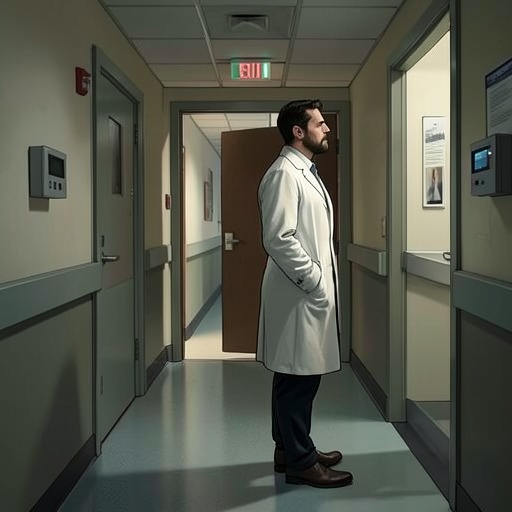
The following day, the therapy team told Billy he would be moved to Ward 5. He did not understand the decision because he knew nothing of the preceding events. When male attendants began entering his room, Ragen took the spot, broke a drinking glass against the wall, and warned them not to approach. The gesture made the disagreement physical: the team saw a security matter requiring a move, while Ragen understood the action as a betrayal of Billy.
Dr. David Caul came to the doorway and spoke with Ragen. Ragen accused the staff of having betrayed Billy and rejected Ward 5, while Caul said the decision was no longer his to change. Guards then restrained Ragen and carried out the transfer. During the restraint, Arthur tried to prevent the use of Thorazine, recalling Dr. Cornelia Wilbur’s warning that antipsychotic drugs could worsen splitting in people with multiple personalities. The medication was given despite his objection. The episode thus placed a treatment concern and a security response in direct conflict: the staff sought to manage immediate danger, while Arthur’s resistance reflected a fear that the intervention itself would intensify the fragmentation they were meant to treat.
Ward 5 and the Internal Crisis
The locked ward was not simply a new location. Its unfamiliar attendants, restricted room, and security procedures confronted personalities who had not agreed to the move and did not share the same information. Once Ragen was stopped, the spot passed among them. Samuel prayed in distress; Philip cursed; David felt pain; Christene wept; Adalana felt the tears on her face. Other personalities reacted in their own ways: Tommy tested the door, Allen called for his lawyer, and Jason threw a tantrum. Arthur could no longer control the personalities he regarded as undesirables. The scene shows the limits of his internal authority under pressure as clearly as the transfer shows the limits of Billy’s understanding of events happening to him.
From the observation window, Ward 5 attendants saw Milligan move between voices and behaviors, and concluded that they were witnessing a raving lunatic. Their view contrasted with the treatment team’s earlier decision to address him as Billy rather than discuss the other names. In one setting, the multiplicity was institutionally suppressed; in the other, it became visible as an apparent crisis. The transfer therefore altered not only where Milligan was held but how his behavior was interpreted by the people responsible for his care.
Aftermath and Significance
The next day, Dr. David Caul administered Amytal, which the narrative identifies as having a calming and restorative effect. Billy felt himself coming together into partial fusion. The improvement had a limit: Arthur and Ragen remained apart, as they had before the trial, and Billy experienced himself as unfused, frightened, and lost. He asked to return to the open ward, but was told that staff there were now afraid of him. The transfer’s consequence was therefore not a simple change of accommodation: it deepened the divide between the open treatment setting he wanted and the locked setting the institution considered necessary.
The episode also sits within a larger conflict over diagnosis and treatment. The multiple-personality diagnosis had earlier been kept from the public, and the court later formally found Milligan mentally ill, identified the condition as multiple personality, and ordered hospitalization and treatment consistent with that diagnosis. Those later findings do not erase the immediate contradiction of Ward 5: a diagnosis could be formally recognized while a particular crisis was still managed through containment, medication, and the suppression of the personalities’ names. The transfer makes that contradiction concrete. It is both an institutional decision about risk and a rupture in the fragile internal arrangements that had allowed Milligan’s personalities to coexist.