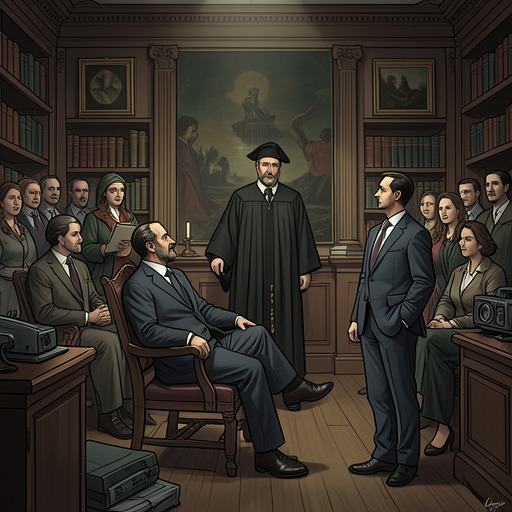
Multiple-personality insanity defense
The Minds of Billy MilliganThe Multiple-personality insanity defense became the legal route through which William Stanley Milligan’s psychiatric condition was presented at trial, but it rested on two distinct questions: whether he could participate in his defense at the time of the proceedings, and whether mental illness had impaired his responsibility when the charged acts occurred. The court’s verdict made the case a landmark, described in the book as the first decision of its kind, while leaving treatment and confinement to continue beyond the acquittal.
Background and the Defense Dilemma
After Milligan was arrested and jailed, his public defenders, Gary Schweickart and Judy Stevenson, pursued a psychological assessment even after Milligan sent a letter dismissing them. The public defender’s office released funds for an evaluation, and clinical psychologist Dr. Willis C. Driscoll administered tests on January 8 and 13, 1978. Milligan’s measured IQ was 68, although Dr. Driscoll attributed the low score in part to depression. He diagnosed acute schizophrenia and described a severe loss of identity, poorly defined boundaries between self and environment, and voices that Milligan understood as people tormenting him. Dr. Driscoll concluded that Milligan could not adequately understand the proceedings or counsel in his own defense, and urged hospitalization for further examination and possible treatment.
At a January 19 hearing, the lawyers presented Dr. Driscoll’s report to Judge Jay C. Flowers to argue that Milligan could not assist in his defense. The judge directed the forensic psychiatry unit of Southwest Community Mental Health Center to examine him. Schweickart worried that the unit might align with the prosecution, and he insisted that information disclosed in the examination remain privileged and unavailable for use against Milligan. The prosecutors objected, and the dispute nearly resulted in the public defenders being held in contempt. The eventual agreement permitted questioning about potentially incriminating disclosures only if Milligan testified. The lawyers accepted that limited protection and allowed the examination to proceed.
The proposed insanity defense also presented a strategic problem. Gary Schweickart argued that multiple personality was officially classified as a neurosis rather than a psychosis, and that psychiatrists did not necessarily regard people with the condition as legally insane. Judy Stevenson considered a different approach: contesting whether the acts had been purposeful, without relying on an insanity plea. Schweickart doubted that such a defense would succeed in a notorious case. He also feared that an insanity finding could lead to Milligan’s transfer to Lima State Hospital, a prospect that had caused particular concern in the jail. The legal strategy therefore involved more than choosing a label for Milligan’s condition; it carried consequences for both the verdict and his likely placement.
Competency and Hospital Evaluation
The competency question concerned Milligan’s ability to participate in the trial, not by itself his responsibility at the time of the alleged offenses. In a letter dated March 13, 1978, Dr. George Harding Jr. concluded that Milligan could not cooperate with his attorney in his own defense and lacked the emotional integration needed to testify, confront witnesses, or maintain an effective psychological presence in court. The public defenders and prosecutor Bernie Yavitch had asked Dr. Harding to go beyond assessing competency and request admission to Harding Hospital for evaluation and treatment. Dr. Harding agreed that his report would enter the trial record by stipulation, rather than being used exclusively by one side.
Milligan was transferred from Franklin County Jail to Harding Hospital on March 16, two days ahead of schedule. He arrived while Dr. Harding was away, so Dr. Shoemaker took personal responsibility until Dr. Harding returned. Judy Stevenson and Dorothy Turner accompanied Milligan to Wakefield Cottage, a locked unit for patients requiring constant observation and personal attention. He was placed in a special-care room with a door fitted with a peephole for observation. These circumstances made the difference between a courtroom competency assessment and a clinical admission concrete: the evaluation unfolded alongside intensive hospital care.
Trial and Verdict
At trial, the court separately addressed the evidence for the charged counts and the insanity defense. Judge Flowers dismissed the first rape count, citing the absence of corroborating evidence and the lack of a similar pattern of conduct. For counts two through ten, the evidence consisted of stipulated medical testimony. The doctors testified that Milligan had been mentally ill at the time of the offenses, that his illness left him unable to distinguish right from wrong, and that he lacked the ability to refrain from the acts. With no contrary evidence before him, Judge Flowers found Milligan not guilty by reason of insanity on those counts.
The result was not simply a clinical diagnosis converted automatically into a verdict. Dr. Driscoll’s report and Dr. Harding’s opinion addressed Milligan’s capacity to take part in legal proceedings; the trial finding addressed his mental state when the offenses occurred. The book presents the acquittal as the first such court decision in history and as the event that brought Milligan’s multiple-personality diagnosis before the public. The court’s ruling established the legal result for the charged counts, but it did not amount to a finding that Milligan no longer needed care or supervision.
After the Acquittal
After the trial, Dr. David Caul told Milligan that the hospital did not regard him as a criminal and urged him to work toward recovery and integration. That assurance stood beside the continuing institutional reality: Milligan remained under psychiatric care, and later treatment arrangements imposed detailed limits on his movement, visitors, calls, possessions, and access to painting materials. A treatment contract restricted his privileges and made their restoration conditional on compliance. The acquittal therefore changed his legal status without bringing an immediate end to institutional authority over his daily life.
The distinction became explicit in later proceedings. In 1979, Milligan was handcuffed and belt-shackled and transferred from Athens to Lima State Hospital. A December 10 court order found him mentally ill, identified his condition as multiple personality, and concluded that he was subject to hospitalization because of risks of harm to himself and others and a need for treatment. This was a later hospitalization determination, not a reversal of the insanity acquittal. By November 1980, Milligan had been moved to the Dayton Forensic Center, a maximum-security facility. He hoped a later hearing would return him to Athens, where he believed Dr. Caul could continue treatment and help restore integration. The defense thus opened a path to acquittal while leaving unresolved the tension between recognizing illness, protecting the public, and deciding what treatment and confinement that recognition would entail.