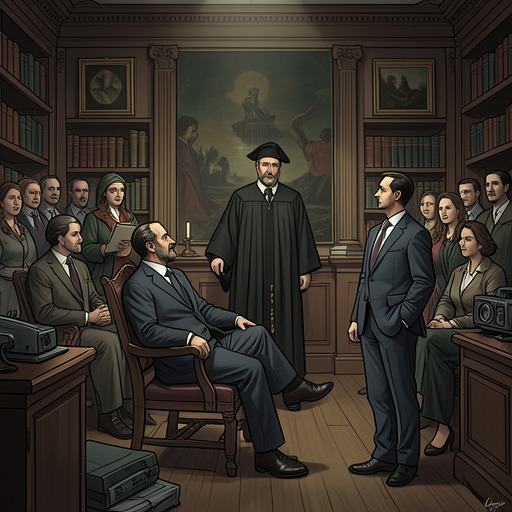
Probate Court of Franklin County
The Minds of Billy MilliganThe Probate Court of Franklin County appears in the book at the boundary between criminal adjudication and continuing psychiatric custody. After Judge Jay Flowers found Billy Milligan not guilty by reason of insanity on the remaining charges, he placed Milligan under the probate court’s authority. The court then reviewed psychiatric recommendations and committed Milligan to the Athens Mental Health Center, making it central to the legal transition from acquittal to hospitalization.
Role in the Legal Transition
The probate court’s role followed a criminal proceeding in which questions of present ability to participate in a defense and responsibility at the time of the offenses were distinct. In January 1978, Dr. Willis C. Driscoll evaluated Milligan and concluded that he could not adequately assist in his own defense or understand events around him, recommending further examination and possible treatment. The defense presented the report to Judge Jay Flowers as evidence that Milligan could not assist with his defense. Flowers ordered an examination by the forensic psychiatry unit of Southwest Community Mental Health Center. A dispute over whether statements made during that examination could be used against Milligan ended in a limited agreement: prosecutors could question him about incriminating statements only if he took the stand.
That competency-related dispute formed part of the procedural background, but it was not itself the probate court’s later hospitalization decision. At the criminal proceeding, Judge Jay Flowers dismissed the first rape count for lack of corroborating evidence and a similar pattern of conduct. On the remaining counts, he relied on stipulated medical evidence that Milligan was mentally ill when the offenses occurred, could not distinguish right from wrong, and could not refrain from the acts. He therefore found Milligan not guilty by reason of insanity and placed him under the authority of the Probate Court of Franklin County.
Commitment to Hospital Care
After the acquittal, Judge Metcalf reviewed the psychiatrists’ recommendations and committed Milligan to the Athens Mental Health Center in the custody of Dr. David Caul. The legal disposition thus did not end with release from the criminal case: it transferred responsibility to a court overseeing hospitalization. Milligan was taken from the courthouse to the hospital that day, leaving before he could say goodbye to his attorneys, Judy Stevenson and Gary Schweickart.
The commitment gave institutional form to a different question from the one answered at trial. The criminal court had determined Milligan’s responsibility at the time of the charged acts; the probate proceeding addressed whether he should remain hospitalized for treatment. The book presents these as connected decisions, but not interchangeable ones: a diagnosis informed the proceedings, while the courts made separate legal determinations about defense participation, criminal responsibility, and continued care.
Later Hospitalization Finding
The court’s authority remained significant in the later proceedings. On December 10, 1979, the court found that Milligan was mentally ill, identified his condition as multiple personality, and determined that hospitalization by court order was warranted. Its stated grounds included a substantial disorder affecting thought, mood, perception, orientation, and memory that impaired judgment, behavior, and recognition of reality. The findings also identified risks of physical harm to Milligan and to others, and concluded that he would benefit from hospital treatment.
This later finding shows the probate court’s continuing function in the book: it did not merely receive Milligan after the acquittal, but assessed whether legal authority for hospitalization remained justified. The institution’s decisions consequently shaped where Milligan could receive care and under what authority, even as clinicians and witnesses disputed the diagnosis and the appropriate treatment setting.