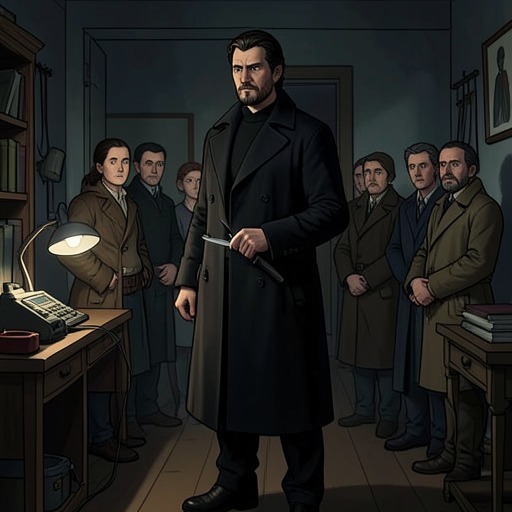
Ragen’s Protector Code
The Minds of Billy MilliganRagen’s Protector Code is an internal rule that makes Ragen the group’s designated protector while limiting how he may use his weapons and strength. It gives him authority in dangerous situations but frames that authority as service to others: protection and survival are permitted, while harming others is forbidden. The code’s reach and its contradictions become clear when Ragen discusses criminal allegations and the possibility of imprisonment.
Responsibility and Authority
Ragen’s role combines unusual capacities with a defined obligation. He is the group’s weapons and munitions authority, a karate expert, and capable of extraordinary strength through control of his adrenaline. His assigned charge is to protect the inner group and women and children more generally; he takes control in dangerous places, where this protective role is most directly invoked.
The rule is also a system of permission. When Judy asks who decides which member may handle guns, Arthur explains that only Ragen is permitted to do so. Tommy likewise identifies Ragen as the sole member allowed to handle firearms. That restriction concentrates responsibility in one person rather than making weapons generally available within the group.
Limits on Force
Arthur describes the conditions attached to Ragen’s authority: firearms may be used only for protection and survival, and Ragen’s strength only for the common good, never to harm others. The rule therefore does not simply authorize force; it attempts to confine force to defensive purposes and make its use answerable to the group’s welfare.
The code operates alongside external legal constraints. During the discussion, Judy warns that possessing guns would violate parole. The internal permission granted to Ragen thus does not remove the group’s exposure to outside rules: what the inner group authorizes can still carry legal consequences.
Conflict and Significance
The limits are tested when Gary connects Ragen’s use of guns to allegations involving robberies and sexual offenses. Arthur rejects the claim that Ragen committed rape. Ragen, in turn, says he will confess to three robberies near the university but denies the other alleged acts, including any sexual crimes. These are the characters’ stated positions, not a resolution of the allegations.
Ragen also argues that imprisonment would endanger children, threatening to kill them there and presenting this as a protective act. That claim collides directly with the code’s prohibition on using strength to harm others and exposes the instability in Ragen’s conception of protection: a duty intended to preserve vulnerable people becomes, under the threat of confinement, a justification for violence against them. The code sets a boundary, but this exchange shows that the boundary can be overtaken by Ragen’s own interpretation of what protection requires.