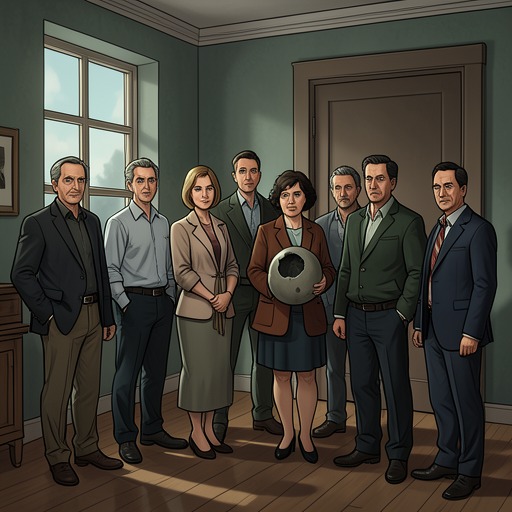
Rosalie Drake
The Minds of Billy MilliganRosalie Drake is an occupational therapist and co-therapist in Wakefield Cottage’s mini-group, and one of the people most closely involved with Billy Milligan from day to day. Her role takes shape through small acts of participation and recognition: inviting him into group work, noticing the distinctions between personalities, and remaining beside him as treatment gives way to transfer. In a hospital divided over whether Billy is a multiple or a fraud, Rosalie’s attention is both clinical and personal.
Identity and Work
Rosalie works alongside Nick Cicco in the mini-group program at Wakefield Cottage. At ten in the morning and three in the afternoon, seven or eight patients gather for projects and activities. Rosalie has never worked with a multiple personality before, and the staff briefing leaves her confronting an institution split between belief in Billy’s diagnosis and suspicion that he is pretending to avoid prison. She struggles to keep an open mind rather than simply adopting either camp’s certainty.
Her work gives that openness a practical form. The group is not limited to discussion of illness: its projects ask patients to make something, take part, and encounter one another through shared activity. Rosalie’s interactions with Billy repeatedly begin in that ordinary setting, where inclusion is offered without requiring him first to explain or prove himself.
Trust Through Group Activities
When the mini-group decides to make collages for someone each patient loves, Billy sits apart at the end of the table and says he has no one to make one for. Rosalie answers by inviting him to make it for the group, adding that she and Nick are making collages too. The invitation gives him a way to participate without contradicting what he has said. He works silently with magazine photographs on a sheet of construction paper. The finished image shows a frightened child beneath an angry man, with the name Morrison, the word danger, and a skull. Rosalie has heard about Billy’s artistic ability, but the collage makes the work of seeing him more immediate: it gives the group a concrete expression of fear and danger without requiring him to explain it aloud.
On April 19, the group prepares trust exercises in a rec room arranged as an obstacle course of tables, chairs, couches, and boards. Because the staff knows Billy fears men, Nick suggests that Rosalie blindfold and guide him. She tells Billy that working with her is a way to build confidence in other people and to prepare for life in the world outside the hospital. He eventually allows her to blindfold him. The episode places trust in a physical, bounded task: Rosalie leads, Billy agrees to follow, and the exercise asks him to rely on another person rather than merely discuss the difficulty.
Later, she encounters Billy outdoors after he catches a butterfly and sees that it has fallen. He is frightened and tearful, and Rosalie senses that this is someone different from the others she has met. Instead of treating the moment as another demonstration of switching, she approaches him and addresses him by name, saying she has been waiting a long time to meet him. She sits beside him as he hugs his knees and looks at the grass, trees, and sky. A few days later, when Arthur allows Billy to take the spot in mini-group again, Billy spends nearly an hour shaping a clay head at Nick’s encouragement. Rosalie’s recognition and the group’s repeated invitations help make space for Billy’s own presence within treatment.
Witness to Exposure and Change
Rosalie is among the people affected when Dr. George shows hospital staff videotapes of himself and Dorothy Turner working with different personalities. The audience sees Arthur and Ragen, whom staff outside Wakefield have not seen, and Adalana, whom only Dorothy Turner has met. The core Billy then appears on the monitor and cries out in distress about not being allowed to stay awake. Rosalie has to fight back tears. Afterward, Dr. Cornelia Wilbur brings Billy into the room and interviews him and several other personalities. Rosalie can see how upset they are.
The visit leaves the Wakefield staff angry for different reasons. Some nurses complain that Billy is once again being treated as special and given the spotlight; Rosalie, Nick, and Donna Egar are angry that he has been put on display. Her response marks a distinction between making a diagnosis visible and making a patient an object of attention. She has participated in treatment that asks Billy to be seen, but the public viewing troubles her when the exposure appears to serve the audience rather than him.
During the work toward fusion, Rosalie also observes what integration may cost. On June 14, in the music building, she watches Tommy play drums, although only Allen had played them before. In the fused state Tommy is not as skilled as Allen had been alone, and he worries that he is stealing Allen’s talent. The scene gives Rosalie a view of fusion not as a simple erasure of difference but as a change in which abilities and identities may be experienced differently. Later, a painting of a beautiful young woman with a tortured gaze is identified by Nurse Nan Graves as Adalana. Rosalie’s part in these developments is that of a witness within the treatment community, attentive to both the patients’ distress and the changes taking place among them.
Farewell and Narrative Significance
As Billy prepares to leave Harding Hospital for the Franklin County Jail, he tells Rosalie he does not want to attend mini-group and needs to prepare to be alone. He wants to harden himself and avoid good-byes. The group makes farewell cards anyway, and when Rosalie brings them to him, he lets himself cry. He describes having mixed emotions as a new kind of human reaction. The contrast is telling: Billy tries to make departure manageable through emotional distance, yet the cards and Rosalie’s presence allow grief and attachment to enter the moment together.
Friday, October 6, is Rosalie’s day off, but she comes to the hospital to be with him. She and Donna Egar walk with Billy to the administration building, where a sheriff’s deputy waits. When the deputy takes out handcuffs, Rosalie steps in front of Billy and challenges the need to cuff him. Billy holds out his wrists; Rosalie sees him wince as the cuffs close. He climbs into the paddy wagon, and she and Donna walk beside it along the curving road toward the stone bridge before waving goodbye. Back at the unit, they cry.
Rosalie’s significance rests in this continuity of attention. She sees Billy in the group room, in the treatment session, on the video monitor, and at the threshold of confinement; her response changes with the circumstances, but she does not reduce him to a diagnosis or a spectacle. Her final presence cannot prevent the transfer, yet it makes the departure a human separation rather than only an institutional procedure. In that way, her mini-group work and her protest at the handcuffs form a single arc: participation and trust are affirmed even when the hospital’s treatment and legal process reach their limit.