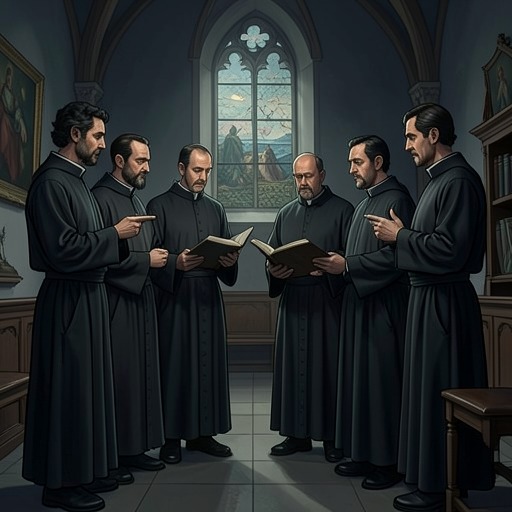
“History must be corrected”
The Moon and the Sun“History must be corrected” is both an admission and a contested command. Spoken by Pope Innocent XII after Yves de la Croix names the Church’s treatment of the sea people, the phrase recognizes a history of persecution even as the Pope’s next act—burning Marie-Josèphe de la Croix’s dissection sketches—makes the meaning of correction uncertain.
The phrase takes shape
At the confrontation, Yves begins to accuse the Church of causing the sea people’s near-extinction. His broken, interrupted speech names how they were tormented as demons and preyed upon as cattle. Innocent completes the exchange with the word “corrected,” then repeats, “History must be corrected,” turning a fragment of their overlapping dialogue into a decisive declaration.
The phrase follows a dispute over who gets to define the sea people. Earlier, Lucien de Barenton, Count de Chrétien, argues that their status has changed before and that Marie-Josèphe should be allowed to prove her claim that the creature speaks a human language. The demand for proof challenges the Church’s authority to classify unfamiliar beings as demons or beasts. Against that background, Innocent’s declaration acknowledges that the inherited account cannot simply stand unquestioned.
Admission and contradiction
Yves’s accusation gives the phrase its immediate moral force: the Church did not merely misunderstand the sea people, but persecuted and exploited them. Innocent’s response is striking because it concedes damage to the Church’s influence. His words appear to open the way to acknowledging a history in which religious power helped bring a people close to extinction.
But the phrase does not settle what correction will mean. After repeating it, Innocent opens a drawing box, takes out Marie-Josèphe’s dissection sketches, crumples one, and thrusts its edge into a candle flame. The page burns to his fingers before he drops the ashes into a golden Aztec dish. The physical destruction of evidence immediately complicates his verbal commitment: the scene offers no simple assurance that correcting history will preserve the records needed to establish it.
A contested record
The expression joins two conflicts: the sea people’s struggle to be recognized as people rather than classified as monsters, and the struggle over who controls the account of their past. Yves’s accusation makes the Church answerable for violence; Innocent’s reply seems to accept that the record must change. Yet the burning sketches shows how an appeal to correction can accompany the suppression of evidence, leaving the practical meaning of the phrase unresolved.
That tension gives the repeated sentence its force. It is not merely a promise to amend an error: it raises the question of whether those who hold authority will make the past more truthful or decide which traces of it may survive. In the final scene, the words remain audible, but the drawings that might have helped document the truth are reduced to ashes.