Erasure of the sea people’s history
The Moon and the SunErasure of the sea people’s history is a deliberate campaign to eliminate not only records of the sea people but also the cultural memory that might preserve their humanity. Pope Innocent orders Yves de la Croix to destroy evidence across books, letters, chronicles, images, myths, and memory itself; Yves carries out the public act of destruction, then secretly gathers and protects the very materials that the command is meant to abolish. The contrast makes historical erasure both a form of power and a contested choice about what the future will be allowed to know.
The Church’s project of correction
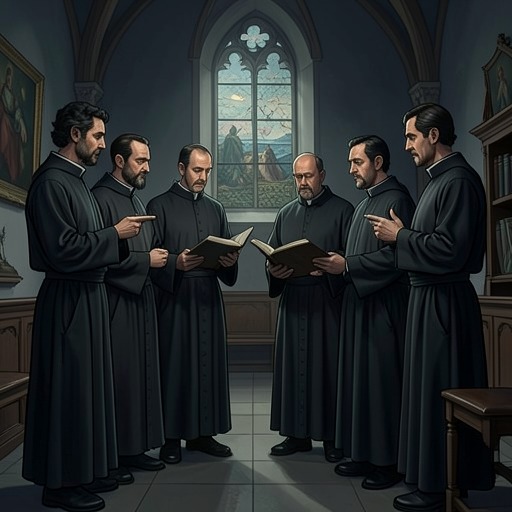
Pope Innocent frames erasure as correction. After acknowledging that people had tormented the sea people as demons and preyed on them as cattle, he repeats that history must be corrected. The wording turns a record of violence into an argument for controlling its record: the evidence of persecution is not to remain available for judgment, but to disappear. His order extends well beyond a single account or official document. Yves is to search out every mention of the sea monsters, while the materials Pope Innocent identifies range across books, private correspondence, chronicles, broadsheets, paintings, myths, and memory.
The order reaches directly into the records of the Carrousel week at Versailles, which Pope Innocent calls a self-indulgent celebration that must vanish utterly. He tears pages from the current volume of M. de Dangeau’s journal and scatters letters taken from the King’s Black Cabinet, including many addressed in Madame’s handwriting. He also flings down the Stories of Sherzad broadsheets and M. Boursin’s book. These are different kinds of testimony: a court chronicle, private letters, printed stories, and a book. Their variety shows that the proposed correction is not merely a revision of official doctrine. It is an attempt to prevent any surviving medium from carrying the history onward.
Destruction as penance
Pope Innocent makes Yves the instrument of the project by imposing the search as his penance. The command asks for comprehensive labor: not simply to burn the items already before them, but to seek out every mention and every chronicle. It also names less containable targets, from every painting and myth to every memory of the creatures. Erasure is thus described as an ongoing duty whose desired reach exceeds what can be gathered into one chamber or destroyed in one ritual.
The scene gives that duty physical form. Pope Innocent draws Marie-Josèphe’s dissection sketches from a drawing box, crumples one, and thrusts its edge into a candle flame. It burns to his fingers before he drops the ashes into a golden Aztec dish. He then hands Yves an illuminated vellum roll, inscribed in black ink and decorated with gold and scarlet, and commands him to erase the sea monsters’ existence from conscience and posterity. Yves unrolls it and holds it to the flame. The vellum smokes, contorts, and burns; the stench of burning leather fills the chamber, and Yves drops its ashes into the same dish with blistered fingers. The ceremonial destruction makes obedience visible, but its painful cost also marks the act on the body of the person carrying it out.
Yves’s hidden counter-archive
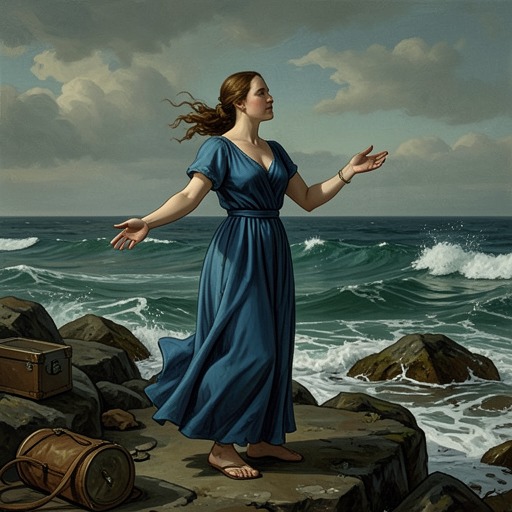
The epilogue reverses the apparent finality of Yves’s compliance. On Midwinter Night in Paris, he walks through sleet and darkness to his tiny house, lights a candle, opens a secret door, and enters a library. From his satchel he unwraps his latest discovery, a manuscript in which the sea people leap and play amid cerulean waves and sunlight rendered in pure gold. The images preserve what the Church’s order would exclude: not specimens or targets of persecution, but a people depicted in motion and at play.
Yves places the manuscript beside a carefully assembled collection of surviving works. Marie-Josèphe’s opera score is bound in calfskin; M. Boursin’s cookbook and Madame’s letters are also on the shelf. The letters are especially pointed in light of the earlier scene, where correspondence from the King’s Black Cabinet was scattered as material for destruction. Here, letters and books persist together with a musical work, making the library an alternative to the imposed silence: a private arrangement of documents and art that the official command sought to make impossible.
Other objects extend this preservation beyond written accounts. Candlelight falls on the sea monster medal and on two framed drawings by Marie-Josèphe, one of Sherzad and one of the male sea monster, each haloed with scraps of gilt and broken glass. The male sea monster’s skeleton lies in an ebony reliquary inlaid with mother-of-pearl. These items do not all preserve history in the same way: the manuscript depicts a living community, the drawings retain individual likenesses, and the skeleton preserves physical remains. Their presence together sets a private counter-record against the Church’s demand that every trace be removed.
Secrecy, memory, and the future
Yves’s final thought defines both the possibility and the limit of his resistance: “For now, I must protect the sea people with secrecy, Yves thought. For now. But not forever.” The secrecy is a practical answer to a command that has made open preservation dangerous; the qualification “for now” refuses to treat concealment as a permanent solution. His library keeps evidence safe in the present while leaving its future exposure unresolved.
The concept therefore turns on a struggle over who can decide what counts as history. Pope Innocent’s “History must be corrected” makes correction mean the destruction of records that would recall the sea people’s treatment and existence. Yves’s collection does not undo the burning or openly defeat the order; it preserves selected traces against it. The final image of the manuscript beside the score, letters, drawings, medal, and reliquary leaves the historical record neither fully erased nor publicly restored. Its survival depends, for the moment, on one person’s guarded archive and on the possibility that secrecy may someday end.