French Academy of Sciences
The Moon and the SunThe French Academy of Sciences is the principal scholarly institution through which the novel stages the observation, description, and public interpretation of the sea people. Its members examine Yves de la Croix’s work under Louis XIV’s patronage, but the Academy is more than a passive audience: its authority can turn private notes into public knowledge, while the limits of what its investigators disclose determine what that knowledge can become.
Identity and Intellectual Work
The Academy appears through its scholars, students, and senior members rather than through a detailed account of its formal organization. Its business in the scenes is natural philosophy: the study and description of living creatures and their bodies. That identity matters because the sea monsters are not merely courtly curiosities. Their classification bears on whether they will be treated as natural creatures or as something outside the ordinary natural order.
The distinction between natural philosophy and alchemy is established early. When Marie-Josèphe de la Croix is teased about practicing an alchemy of beauty, she corrects the assumption that she and her brother study alchemy: Yves studies natural philosophy, while she studies a little mathematics. The exchange establishes the intellectual vocabulary later used around the Academy and marks Marie-Josèphe as a participant in inquiry, even when her work is not accorded the same public standing as Yves’s.
The Academy’s presence is both collective and ranked. Scholars and their students attend a demonstration, while a senior scholar voices the group’s response to Yves’s work. The novel does not present a complete institutional charter or describe the Academy’s ordinary procedures; it shows its authority in action through royal orders, expert questions, public scrutiny, and the prospect of publication.
Royal Patronage and the Circulation of Knowledge
At a royal observation, Louis XIV calls Yves’s findings immeasurably interesting and directs Lucien de Chrétien to have the Academy publish Yves’s notes and sketches and commission a medal. The order links scientific circulation to royal favor: the King can authorize the work’s public presentation and give it a commemorative form. Lucien accepts the commission and is to inform Yves when the King will be free to observe again, with the possibility that the Pope might attend.
That prospect does not simply accelerate research. Marie-Josèphe fears that another delay will prevent Yves from completing the description of the sea monster. The King’s attention brings status and potential publication, yet the timetable remains subject to royal availability. The Academy’s work consequently depends on access granted from above, even as its scholars are expected to convert observations into enduring knowledge.
Yves also insists that the Academy must receive the sea monster drawings when he finishes the dissection. He treats the drawings as more important than Marie-Josèphe’s brief song, making a pointed contrast between visual documentation intended for scholarly use and music intended for performance. The distinction gives the Academy a defined place in the siblings’ disagreement: its anticipated need for records becomes a reason to prioritize Yves’s work, though the scene also shows that Marie-Josèphe is capable of making and preserving observations herself.
Instruments, Specimens, and Observation
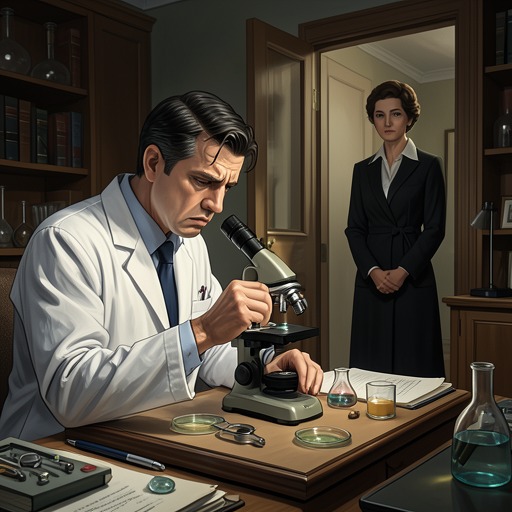
The laboratory scenes give the Academy’s intellectual program material form. After the sea monster’s organs, including its anomalous lung lobe, are preserved in spirits in heavy glass jars, Marie-Josèphe studies them at a laboratory table. She prepares samples of kidney, liver, pancreas, and lung, mounts them, and carefully draws each under Yves’s old microscope. The instrument has suffered during the sea voyage; she hopes to buy one of Mynheer van Leeuwenhoek’s lenses, said to be exceptionally good but difficult to focus.
Her examination of the anomalous tissue is especially significant because it moves from the visible specimen to a distinction revealed only under magnification. The tissue feels firmer and denser than ordinary lung. At the microscopic level, it does not have air sacs; instead, delicate overlapping leaves form its structure. Marie-Josèphe begins to draw what she sees. The finding gives specific content to a feature that might otherwise remain a mysterious anatomical claim, and her careful record-making shows that scientific knowledge depends on instruments and sustained attention as well as on access to a specimen.
The ordinary appearance of the organs in jars also tests the language of alchemy. Marie-Josèphe wonders whether an organ associated with immortality ought to shine or glow, but she has never believed in transmutation or immortality. Observation, description, deduction, and interaction make more sense to her. The contrast is not a claim that the Academy has settled every question about the sea people; it instead distinguishes her empirical method from expectations that extraordinary powers should announce themselves through visibly miraculous signs.
Public Demonstration and Its Limits
At a public dissection, footmen position the King’s portrait before Yves enters with six scholars and their students. The scholars bow to the portrait and to Lucien de Chrétien, who uses a step-stool to see the table. These gestures make the setting at once scholarly and royal: the demonstration addresses learned observers, but the King’s symbolic presence and the Count’s position shape its ceremonial order.
Yves presents the dead companion of the Sea Woman in Latin and argues that natural philosophy establishes the sea monsters as natural creatures, ugly but comparable to dugongs and sea-cows. He cuts into an arm to expose sinews, bones, and joints, while Marie-Josèphe documents the procedure. Knowing the dead being’s identity changes what she sees in the body: the long, fine finger bones now appear unmistakably human to her, and remind her of Lucien’s hands. The demonstration thus places dissection beside a recognition that its anatomical method alone cannot supply.
The Academy’s members ask Yves about his hunt, his research, and the King’s support. In answering, he reports that the creatures have large lungs and that he has observed one remain underwater for ten or twelve minutes. But he does not mention the anomalous lobe he has already identified. His account offers the Academy evidence while withholding a finding that could reshape its understanding of the creature. The omission is especially consequential because Marie-Josèphe has examined the lobe herself and knows what the public presentation leaves out.
Yves then declares that nothing remains to be learned from the carcass, adding that he will compare female and male specimens only insofar as the female’s fate allows. He dismisses the female as an imperfect copy of any creature. The Academy’s public setting gives his judgment an audience and authority, but it also exposes a limitation in his conception of evidence: the living female specimen is treated as secondary even though comparison may matter to the inquiry.
Authority, Evidence, and Exclusion
After the senior scholar praises Yves’s work, the Academy asks to see the living sea monster. The request tests the boundary between examining a dead body and observing a living creature. Yves tells Marie-Josèphe to call the monster, then leaves off speaking Latin as though unaware that she understands it. When she identifies the anomalous lung lobe before the scholars, still speaking Latin, Yves dismisses her comments as uninteresting. Her knowledge is not absent; its standing is contested.
Yves says he will write a paper on the lobe but has not studied it fully and does not want to communicate erroneous conclusions. The statement makes restraint part of scientific credibility, yet it sits beside his earlier omission of the finding during the Academy’s questioning. The novel leaves a tension between justified caution and controlled disclosure: an unfinished result should not be overstated, but withholding its existence also prevents the audience from weighing its importance.
The request for a glimpse of the living creature ends in a further demonstration of control. Yves thrusts a pike through the bars; the Sea Woman floats out of reach. Lucien then asks Marie-Josèphe to open the gate. The episode does not show the Academy reaching a conclusion about the living captive. Instead, it reveals the conditions under which its inquiry takes place: the scholars may request access, but the people controlling the enclosure and interpreting the evidence determine what can be seen.
Across these scenes, the French Academy of Sciences represents both a route toward recognition and an imperfect instrument of it. Royal support can secure publication and make research publicly consequential; anatomical observation can challenge supernatural explanations; and microscopes, drawings, and preserved samples can disclose differences invisible to the unaided eye. Yet the Academy’s record remains vulnerable to delayed access, selective reporting, and the exclusion of Marie-Josèphe’s contribution. Its scenes therefore make scientific authority depend not only on what is observed, but also on who is allowed to record, present, and interpret the evidence.