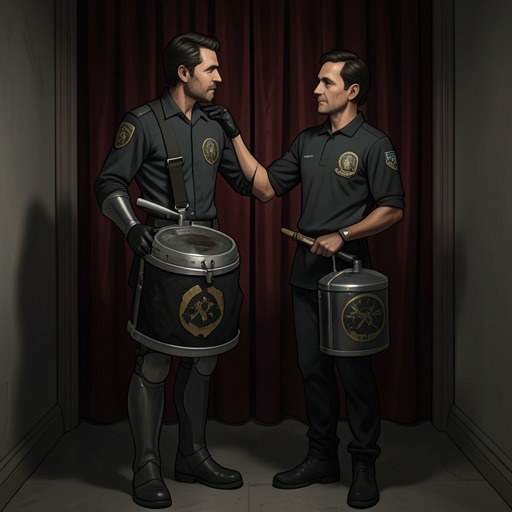
Louis XIV and Monsieur
The Moon and the SunLouis XIV and Monsieur are brothers whose relationship combines everyday familiarity with the unequal demands of royal rank. Monsieur appears beside the King in intimate morning ceremony, helping him rise from bed, while the court around them makes clear that the King alone commands the greatest share of glory. Their bond is neither presented as simple equality nor reduced to formality: it is lived through gestures of assistance within a world governed by Louis’s sovereignty.
Brothers in the Royal Procession
During the procession to Le Havre, Monsieur and Madame share their magnificent carriage with Marie-Josèphe, while their daughter sits beside her. The setting places the brothers within the same royal family and public spectacle, but distinguishes their positions: Monsieur is identified as the King’s brother, and his carriage is second in magnificence only to the King’s. Their kinship is visible, yet the procession’s order also displays the hierarchy surrounding it.
That hierarchy becomes explicit when the Chevalier de Lorraine remarks that there is not enough glory for the King’s nephew or the King’s brother, only for the King. Lorraine lays his hand across Monsieur’s jeweled fingers as he speaks; Madame immediately rebukes him for speaking that way of his sovereign. The exchange frames Monsieur’s closeness to Louis alongside its limits: royal blood does not grant him a share equal to the King’s, and even an intimate court circle must observe the distinction.
Care within Court Ceremony
The brothers’ most direct moment of tenderness occurs during the King’s morning rising. When Louis sits up, he greets Monsieur as “my dear brother” and says, “I am awake.” Monsieur helps him from bed and offers him a cup of chocolate; later, he again gives Louis his hand as the King steps down from the tall bed before the courtiers admitted to First Entry. These repeated acts make brotherhood practical and bodily: Monsieur assists the King through a private routine that is also a carefully staged public ritual.
The ceremony does not erase the roles each brother occupies. Louis receives the assistance, while Monsieur provides it; the court witnesses the King’s emergence in nightgown and short wig before the formal announcement that His Majesty has awakened. Familial affection and royal display therefore coexist in the same gestures. Monsieur’s help is intimate, but it also takes place within the ritual that presents Louis as monarch.
Rank, Familiarity, and the Limits of the Evidence
The scenes offer a compact portrait rather than a full account of the brothers’ history. They establish that Monsieur belongs to Louis’s close family circle and can assist him in an unguarded-seeming domestic routine, while the King’s affectionate greeting acknowledges that bond aloud. At the same time, the procession and Lorraine’s remark emphasize the political asymmetry between them: Monsieur may be the King’s brother, but the court’s allocation of glory remains centered on Louis.
Their relationship is thus shaped by a double structure. Familiarity appears in shared family settings and the King’s address to his brother; hierarchy appears in the distinctions of carriage, precedence, and sovereignty that surround them. The narrative lets care and rank occupy the same space without suggesting that one cancels the other.