Louis XIV and Pope Innocent XII
The Moon and the SunLouis XIV and Pope Innocent XII are cousins whose relationship brings family language into the center of a contest over power: the King’s authority to patronize and govern, and the Pope’s authority to define moral and religious limits. Their exchanges move between courteous courtly performance and direct disagreement, revealing neither a simple alliance nor a clean separation between personal regard and political interest.
Cousins at Court
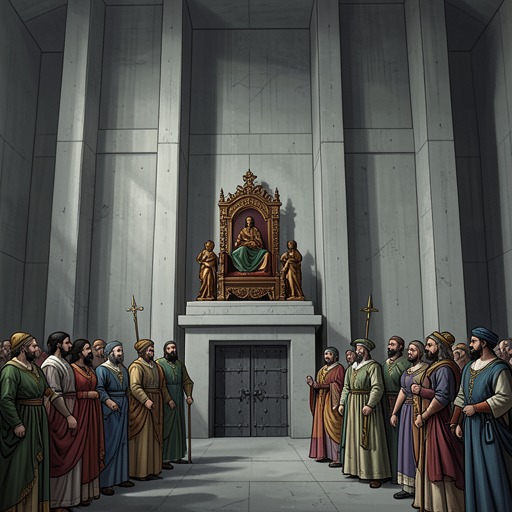
During Marie-Josèphe de la Croix’s musical performance, Louis XIV listens without moving, even though his gouty foot rests on a feather cushion. He sits upright and proud; beside him, Pope Innocent XII maintains a serene presence in a plain white robe that stands out against the salon’s cardinal red. The staging places the two men together as imposing figures, but their stillness does not mean agreement. The music soon gives them different grounds from which to exercise authority.
The scene also makes their kinship audible in Louis’s address to the Pope as cousin. That familial form of address accompanies a disagreement conducted before the court, where the King’s judgments and the Pope’s pronouncements have consequences beyond a private conversation. Courtesy remains part of the exchange, but it cannot contain the conflict over who may judge a composition and the women who make it.
The Music Dispute
Pope Innocent XII condemns Marie-Josèphe’s composition as indecent and argues that music should glorify God. He invokes the Church’s edict that women should remain silent, making the performance not only an aesthetic matter but also a challenge to religious rules about women’s speech and public agency. Louis does not answer by disputing the Pope’s theology point by point. Instead, he calls the piece charming and recalls happier, younger days, linking Marie-Josèphe’s music to a composition of his own from years earlier.
The Pope rejects the work’s story and music as expressions of heathen indecency, intrigue, and debauchery. Louis’s response is to preserve room for his own judgment: he speaks courteously, then smiles at Marie-Josèphe and praises the piece again. The difference between the cousins is sharpened when Pope Innocent XII says the women of France have become too worldly and too distant from Church influence. Louis counters that they are wise in the ways of the world. His defense is not an abstract declaration of women’s equality; in this scene, it is a royal judgment that the Pope’s disapproval does not settle the matter.
The exchange also exposes the limits of papal censure at Louis’s court. When the Pope rebukes Count Lucien de Barenton, Count de Chrétien, over Brittany’s supposed pagan heresies, Louis identifies him as a difficult province’s governor in the King’s name, a valued adviser, and a trusted friend. He adds that Lucien does not dance, answering a mocking challenge with a pointed statement of his own authority to define the courtier’s standing. The Pope’s disapproval remains visible, but Louis does not withdraw his protection. He then commissions Marie-Josèphe to compose a cantata for his anniversary, explicitly honoring her father’s memory. The commission turns the dispute into an act of royal patronage: Louis gives the musician a future task despite the Pope’s condemnation.
Shared Language, Competing Authority
Their disagreement is not a constant rupture. Louis’s recollection of his own music connects his approval of Marie-Josèphe’s composition to his past as a composer, and he says that he has not composed in many years but that this will soon change. The Pope hears the episode differently, treating the story and its music as evidence of moral disorder. Their opposing readings show how the same performance can become, for the King, a source of pleasure and renewed artistic possibility, and, for the Pope, a reason to enforce religious discipline.
The kinship between them supplies a language for exchange, not a guarantee of deference. Louis remains courteous while making decisions that frustrate the Pope’s position; Pope Innocent XII speaks as a spiritual authority even when the King’s court and appointments are at stake. Their conflict is consequently enacted through practical choices—the King’s praise, his protection of Lucien, and his commission to Marie-Josèphe—as much as through explicit disagreement.
The Debate over Immortality
A different exchange reveals more accommodation between the cousins. Yves de la Croix questions the claim that consuming sea monsters could confer everlasting life, observing that otherwise many sailors would already have lived for a thousand years. Louis dismisses the objection by pointing to the dangers of a sailor’s life: protection from old age and disease would not prevent accidents or drowning. Pope Innocent XII then concedes that the natural philosopher may be right and invokes the expulsion from Eden: humanity lost immortality, he argues, but may hope for everlasting life with God.
Louis advances a more immediate interpretation. If God created an organ of immortality and commanded humanity to use beasts as it wished, he reasons, then becoming immortal may accord with God’s will. Pope Innocent XII is troubled by earthly immortality, which he regards as a burden rather than a satisfaction. Yet he hesitates over the possibility that someone called to continue God’s work might submit to that burden. Louis identifies himself with that calling. The Pope’s argument does not simply reverse his position, and the King’s claim does not settle the theological question; instead, their exchange exposes the pressure Louis’s ambition places on religious reasoning.
Across these episodes, the cousins’ relationship is defined by negotiated limits. Pope Innocent XII can condemn music and question the moral consequences of human power; Louis can sustain a composer, protect a trusted adviser, and frame his own ambitions as service to divine work. Kinship keeps the disagreement personal in its address, while the unequal and competing forms of authority ensure that its consequences reach well beyond the family bond.