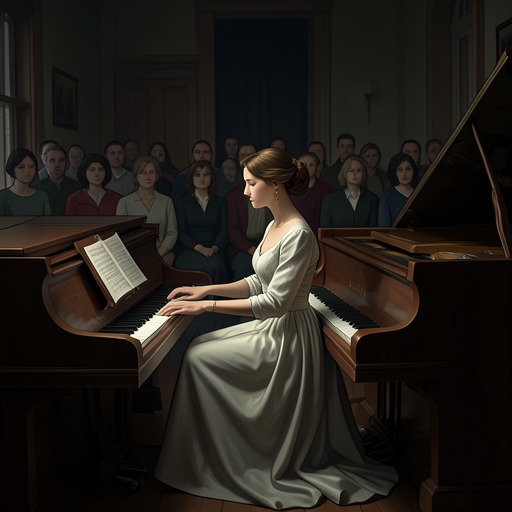
Louis XIV commissions a cantata from Marie-Josèphe
The Moon and the SunLouis XIV commissions a cantata from Marie-Josèphe de la Croix during a strained court gathering, making the capture of the sea monster the subject of a work for his anniversary. The commission honors her father and elevates her musical ability, but it also places her between the King’s patronage and Pope Innocent’s insistence that neither composing nor hunting suits the de la Croix family. The King’s courteous words, conspicuously controlled expression, and insistence on celebration make the appointment both an artistic opportunity and a test of authority.
Setting and Courtly Exchange
The commission emerges from a salon conversation in which Louis XIV takes his time answering Pope Innocent. Before addressing the Pope, he nods to Lucien de Barenton, Count de Chrétien, who presents M. Galland, Domenico Scarlatti, and M. Coupillet with heavy leather purses clinking with coins. The musicians and translator then withdraw, bowing as they ease out of sight. Their departure clears the space for the King’s exchange with the Pope and Marie-Josèphe, while the payment marks the musicians’ service as something the court can reward materially.
Louis tells the Pope that he considers the piece charming, maintaining a courteous voice even as his disapproval chills the salon. He then smiles at Marie-Josèphe, a genuine smile that nevertheless does not part his lips or reveal his toothless gums. The contrast makes the King’s approval feel personal but carefully managed: his expression warms toward the composer while the tension around the Pope remains. The scene gives the commission a setting in which music is not merely discussed as art; it is also bound up with rank, favor, and the power to decide whose work may be heard.
The King’s Musical Past and the Pope’s Objection
Louis recalls that Marie-Josèphe’s piece brings back happier, younger days and asks Lucien de Barenton, Count de Chrétien, whether he remembers a composition of the King’s. Lucien identifies it as music presented upon the return of the King’s embassy to Morocco, adding that the ambassador regarded the presentation as a great honor and that the court shared that view. The recollection gives the conversation a precedent: Louis has composed before, and his music once accompanied a diplomatic occasion. His appeal to that memory places his own artistic past beside Marie-Josèphe’s present work.
Louis says he has not composed for many years, calls age staid, and declares that this will soon change before laughing. Pope Innocent responds by condemning the story as indecent and its music as an expression of intrigue and debauchery. The disagreement is thus more than a difference in taste. The King treats music as a source of pleasure and a means of recalling his younger self; the Pope reads the work as morally dangerous. Louis’s later commission follows directly within this atmosphere of condemnation, turning his announced return to composition into a concrete act of patronage for Marie-Josèphe.
The Anniversary Commission
Louis addresses Marie-Josèphe in honor—and in memory—of her father and orders her to compose a cantata for his anniversary. He specifies its subject: the capture of the sea monster. His reason is pointedly personal: who, he asks, is better suited to write about the capture than the hunter’s sister? The assignment connects the family’s history to a royal celebration and makes Marie-Josèphe’s relationship to the hunter part of the public justification for her commission.
Marie-Josèphe first feels apprehension, then determination. The King’s approval outweighs Pope Innocent’s irritation, though accepting the honor does not make her physically composed: her legs tremble as she thanks Louis, curtsies deeply, and kneels on the polished parquet with her skirt spread around her and her head bowed. Her posture records both the force of court hierarchy and the strain of the moment. The commission is an elevation, but it arrives through a scene in which she must receive the King’s favor while the Pope openly declares her occupation unsuitable.
Authority, Resistance, and the Scene’s Close
Pope Innocent objects that hunting is not a suitable occupation for a Jesuit priest and composing is not suitable for his sister. His rebuke frames the commission as a challenge to the roles he assigns to the de la Croix siblings. Louis answers by asking his cousin to indulge him: he is an old man who desires a sea monster, a banquet, and a cantata for his celebration. Rather than debating the Pope’s judgment on its own terms, the King asserts his wishes through the contents of the coming festivities. He also proposes supper as a way to calm the company and settle their discord, joining the artistic commission to the social occasion meant to contain the argument.
The exchange does not end with Marie-Josèphe immediately rising. Still staring at the polished floor, she thinks that she must rise but cannot lift her head. Lucien de Barenton, Count de Chrétien, tells her coolly that she must rise and takes her hand in his long, slender fingers. The gesture helps bring the scene out of its suspended courtly tension without erasing the pressure that produced it. The commission therefore leaves Marie-Josèphe with a royal task, a subject drawn from her family’s experience, and the Pope’s explicit disapproval. Its significance lies in that conjunction: Louis’s favor makes her work possible at court, while the dispute over the work exposes the competing claims of royal patronage and religious authority.