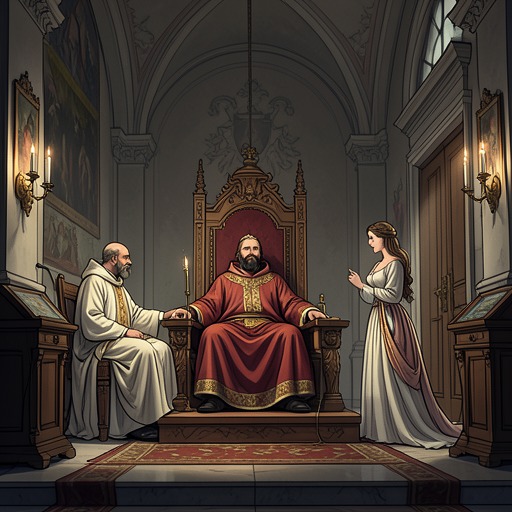
Louis XIV reconciles with Pope Innocent XI
The Moon and the SunLouis XIV reconciles with Pope Innocent XI in a public ceremony at Versailles that makes diplomacy visible as royal theatre. Before a crowd whose cheers fill the Marble Courtyard, the King welcomes the Pope as a cousin, acknowledges the sorrow of their estrangement, and declares their alliance. The pageantry culminates not in a private agreement but in a shared promise to suppress Protestantism, making the reunion a spectacle of political power and religious unity.
Diplomatic Setting
The ceremony takes place against the stakes of war: Pope Innocent holds a key to Louis XIV’s effort to win the war against the League of Augsburg, and the King will not risk the treaty by humiliating his visitor. The scene therefore distinguishes between the precedence Louis insists upon and the courtesy he chooses to extend. The Pope’s coach is permitted to reach the entrance of the chateau, but the Swiss Guards accompanying him must dismount and walk. Louis could have demanded that the Pope approach on foot; the narration recalls that he had once forced a predecessor’s representatives to yield precedence to France. Here, however, he judges that a conspicuous insult to an old, pious, and humble man would endanger the agreement he hopes to secure.
The arrival is framed as a public event from the outset. Cheers rise as the coach proceeds between orange trees, and the crowd follows it into the courtyard. The voices of thousands seem to make the carved philosophers and heroes, and the figures of Mars and Hercules on the pediment, join the celebration. This imagined animation turns the architecture into an audience for the reconciliation: the royal setting appears to acclaim a political settlement as a victory for Christianity.
The Procession and the King’s Appearance
The Pope’s approach is measured and ceremonial. His coach proceeds at a stately pace while he nods to the people, and the cheering tide follows him between the orange trees. At the chateau’s great doors, Louis appears. His leisurely crossing of the Marble Courtyard slows the moment before the two leaders meet and gives the crowd time to take in the King as the ceremony’s central figure.
Louis’s clothes make that authority dazzlingly concrete. He wears brown velvet set with tiger’s-eyes and edged with gold lace, a green satin waistcoat heavily embroidered in gold, and diamond garters and shoe buckles. For this particular occasion, he places the Order of the Holy Ghost outside his coat, over a long blue sash covered in diamonds. Rubies and sapphires adorn the gold scabbard of his ceremonial sword; Spanish point lace edges his hat, and white plumes sweep over his shoulder. The Pope, by contrast, descends from the dimness of his coach in white robes. The contrast does not prevent reconciliation, but gives its formal meeting a striking visual shape: the old religious authority approaches the magnificently arrayed King on the King’s ground.
The Meeting and Its Declaration
The crowd falls silent as Pope Innocent descends and Louis stands straight, gazing at him. Cardinals and bishops follow the Pope from the carriage and bow; when they rise, Marie-Josèphe and the other courtiers rise as well. The ceremony thus makes respect visible through a sequence of gestures, with the gathered court following the lead of the Church’s representatives. The narration marks the encounter as a meeting between the two most powerful men in the western world, while the waiting crowd makes their exchange consequential beyond the courtyard.
Louis opens with a familial form of address: “Welcome, Cousin. Our estrangement has caused great sorrow.” The Pope answers in the same register, rejoicing both in France’s reconciliation with Rome and in their alliance. The exchange presents the political rupture as a source of sorrow now overcome, and it gives reconciliation a personal as well as institutional language. Yet the ceremony’s warm address quickly leads to a harder public purpose. Louis declares, “Together, we will crush the Protestants. We will eradicate their heresy from France. From Europe. From the world. For the glory of God.” The accumulating geographical scope turns the welcome into a statement of joint religious policy: the restored relationship is not merely an end to estrangement but a union directed against Protestantism.
Public Acclaim and Aftermath
The enormous crowd answers Louis’s declaration with a spontaneous cheer of devotion to God and King. The response binds the two authorities together in the sound of public celebration, though the declaration itself also makes the alliance’s coercive aim explicit. The ceremony’s triumphal mood is thus inseparable from its promise to eradicate Protestant heresy. Its imagery of Christian ascendancy supplies a sacred frame for a political settlement and for the campaign the King announces.
The Pope’s courteous treatment of the Marquise de Maintenon provides a smaller, revealing gesture within the spectacle. When she approaches, he tells her, “Rise, sister.” His kindness supports those who believe she and the King are married. She is visibly moved by the public moment, clasping her hands before her lips as her eyes shine with tears. The King, the Pope, and the Marquise then walk together across the courtyard toward the chateau entrance. The royal family, bishops, and cardinals follow; courtiers bow as the party passes, and another cheer rises and echoes from the walls. Afterward, Marie-Josèphe accompanies Mademoiselle and Madame back to Madame’s apartments, while Madame grumbles about the Marquise’s triumph. The progression from diplomatic encounter to procession and then to private court reaction shows how the reconciliation reorganizes not only relations between France and Rome, but also the visible order and rivalries of the royal household.