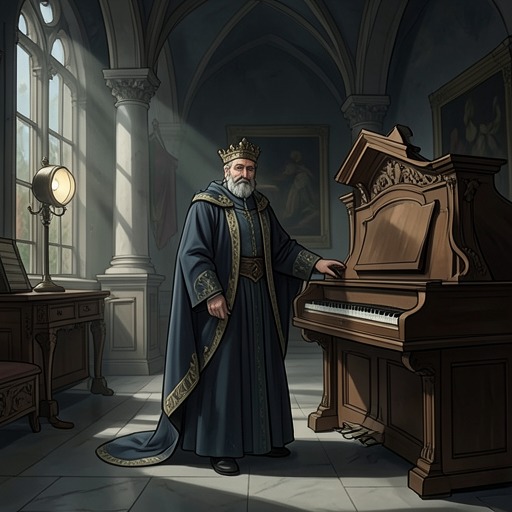
Louis XIV’s Secret Dissection of the Sea Monster
The Moon and the SunLouis XIV’s Secret Dissection of the Sea Monster turns a private examination of a dead creature into a test of what royal desire, natural philosophy, and bodily evidence can establish. Louis XIV seeks an organ of immortality; Yves de la Croix first finds familiar anatomy, then uncovers an unusual lung lobe that the King immediately treats as the object of his search. The discovery is decisive as a change in interpretation, not as demonstrated proof of the organ’s supposed power.
A private examination
The dissection takes place under conditions of deliberate concealment. Earlier, Marie-Josèphe de la Croix checks the heavy silk screens so that the living sea monster cannot see beyond them, then uncovers the dead specimen. The contrast between the screened living creature and the exposed carcass sets the examination apart from the creature’s public display: this is an inquiry conducted out of sight, in the presence of a chosen group, rather than an open spectacle. Marie-Josèphe remains beside her drawing box, protecting the record of what the examination may reveal.
Louis XIV arrives with Lucien de Barenton, Count de Chrétien, while Yves receives Pope Innocent and brings him into the room. The King comes to the dissection table in his wheeled cart and walks with some support; Pope Innocent, by contrast, is visibly exhausted and leans on Yves. Their different physical states frame a gathering that joins royal power, religious authority, and anatomical investigation without making them equal participants. Lucien attends closely to the King, while Marie-Josèphe keeps to the side and observes.
Familiar anatomy and the King’s demand
Yves begins with what the dissection has established about resemblance. He reports that the muscles and bones examined so far have counterparts in other animals known to natural philosophy. Opening the chest, he identifies lungs and a heart, and describes the creature’s internal organs as ordinary mammalian structures. It has neither gills nor a swim bladder; Yves compares it to a dugong. His findings place the sea monster within recognizable anatomy rather than confirming a wholly separate kind of body.
That account does not answer the question Louis XIV considers important. He distinguishes the search for what the sea monsters share with other animals from the search for what is unique to them, then names the goal: an organ of immortality. Yves answers that he has found no evidence for such an organ and associates immortality, like the transmutation of gold, with alchemy, which both the Church and natural philosophy abhor. The disagreement is not simply over the specimen’s classification. Yves appeals to the limits of evidence and accepted inquiry, while the King insists that the examination serve his particular hope.
The anomalous lobe
The turning point comes as Yves continues examining the heart and lungs. A lobe high in the chest resists his probe. He draws it farther into view and recognizes it as unlike the surrounding tissue: its color and texture differ, and a tangle of blood vessels covers its surface. Marie-Josèphe looks from the opened specimen to Yves, Pope Innocent, and Louis XIV; all are focused on the unexpected structure. The attention of the room gathers around a specific anatomical difference, replacing the earlier account of shared mammalian features with a claim of singularity.
Yves cuts the lobe free from the normal lung. Louis XIV immediately interprets the discovery as the organ he has sought, asking in effect what else the unique structure could be. The moment gives the King a compelling object for his belief, but the evidence described establishes only that this lobe differs in appearance and texture and can be separated from the rest of the lung. Neither its function nor any connection to immortality is demonstrated in the examination. The distinction between discovery and proof remains, even as the King treats the former as confirmation.
The record and the unresolved claim
Marie-Josèphe’s presence gives the discovery a second consequence: she has her drawing box with her and later hurries after Yves along the Green Carpet, holding it close to protect the record of her brother’s findings. The examination thus produces both a striking specimen and an account that can travel beyond the private room. Its secrecy does not mean the discovery remains unrecorded; her drawings preserve what the royal party has seen.
The scene’s central tension lies in the gap between an unusual organ and the meaning assigned to it. Yves’s earlier findings are careful and comparative, while Louis XIV’s search is directed toward immortality; the lobe answers the King’s demand for something unique without resolving whether it can do what he hopes. By ending on the excised structure and the King’s confident identification, the event leaves the claim poised between anatomical observation and alchemical expectation. The dissection reveals a difference in the sea monster’s body, not a settled answer to the question of death.