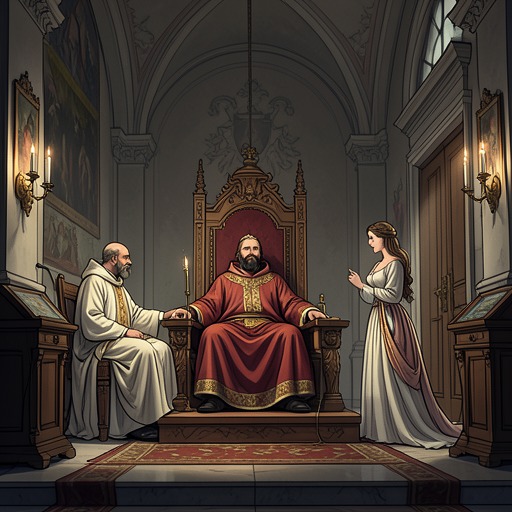
Louis XIV's judgment and censorship order
The Moon and the SunLouis XIV’s judgment and censorship order make the fate of the sea people a contest over who may define them and whether their history can survive. The King’s accusation of betrayal is followed by Pope Innocent’s startling recognition that the sea monsters are people, then by a Church-mandated campaign to erase the evidence of what was done to them. Yves de la Croix is charged with carrying out that erasure, turning priestly authority from a possible instrument of protection into an instrument of enforced forgetting.
The King’s Judgment
Louis XIV regards his prisoners in silence, surrounded by the strange eyes of gold statues. His words first sound like an inventory of attachment: he says he loved them all, naming what each had given him. Marie-Josèphe de la Croix had pleased him with her beauty, charm, and music; Yves de la Croix had amazed him with his discoveries, and the King says he was proud to be Yves’s sire; Lucien de Barenton, Count de Chrétien, had earned his regard through wit, bravery, loyalty, and truth. The speech makes the ensuing accusation more than a simple dismissal. The King describes real admiration and closeness, but sets those qualities against a breach of loyalty that, in his view, outweighs them.
The change in tone is made physical. Louis XIV flings a crystal skull to the floor and declares, “You betrayed me.” The skull smashes, its shards scattering across the parquet. The shattered object gives the judgment a visible finality: the King’s former regard remains present in his account of the prisoners, but it no longer protects them from his verdict. The episode establishes the emotional and political terms of the reckoning, though the censorship order itself is later delivered by Pope Innocent rather than by the King.
Recognition and Reversal
The confrontation shifts from royal judgment to the Church’s authority. Marie-Josèphe de la Croix reports that the sea woman declared war on the men of land and then disappeared. Yves de la Croix falls to his knees when Pope Innocent threatens excommunication, but the Pope withdraws that threat. Instead, he tells Yves that his priestly authority will be needed because the Church faces a grave threat involving the sea monsters.
Marie-Josèphe interrupts to insist, “They’re people, Your Holiness!” Pope Innocent answers, “Yes.” Lucien de Barenton, Count de Chrétien, is as surprised as Marie-Josèphe and Yves by the admission. It is consequential precisely because it comes from a religious authority whose influence would be damaged by conceding the point. The scene does not let recognition settle the dispute: Pope Innocent and Yves begin to describe the Church’s treatment of the sea people, speaking over one another about tormenting them as demons and preying on them as cattle. The Pope completes the thought with the demand that history be corrected. The correction he envisions, however, is not a public record of wrongdoing. It is the destruction of the records themselves.
The Scope of the Censorship Order
Pope Innocent opens Marie-Josèphe’s drawing box and takes out her dissection sketches. He crumples one, holds its edge to a candle, and drops the ashes into a golden Aztec dish. The image makes the order concrete before it becomes comprehensive: even a scientific drawing, made to record the creatures’ bodies, is treated as material to be eliminated. The Pope names Yves’s penance as a search for every mention of the sea monsters, then widens the command from individual references to the whole documentary world surrounding them.
Books are to go, including M. Boursin’s volume; so are letters, among them those awaiting examination by the King’s Black Cabinet. Pope Innocent tears pages from M. de Dangeau’s journal and condemns the chronicles of the self-indulgent monster celebration, declaring that the week of Carrousel must vanish. He scatters the broadsheets called the Stories of Sherzad, then extends the purge to paintings, myths, and memories. The order reaches even the Church’s own decree that had raised the sea people from the category of demons to that of beasts. Its reach is therefore not limited to suppressing one account or correcting one classification: it targets evidence, official records, public celebration, and recollection alike.
Yves’s Penance and the Erasure of Memory
The final instruction gives the campaign its largest scope: Yves must erase the sea monsters’ existence from conscience and posterity. Pope Innocent hands him an illuminated roll of vellum, inscribed in black ink and decorated with gold and scarlet. Yves bows his head, unrolls it, and holds it to the candle flame. As the vellum smokes, twists, and burns, its destruction turns the command into an enacted ritual. Yves drops the ashes into the same Aztec dish, his fingers blistered by the task.
The scene closes the immediate sequence with obedience rather than debate: Yves accepts the penance and burns the document, while the larger work of searching out every record lies ahead. The order’s contradiction remains exposed. Pope Innocent has acknowledged that the sea monsters are people, yet commands the destruction of the history that could establish their lives and the violence done to them. By making books, letters, images, chronicles, myths, and memories all targets, the episode presents censorship not as the removal of a single falsehood but as an attempt to control what future generations can know. The King's broken crystal skull and the burning vellum become opposing emblems of the same reckoning: a dramatic judgment in the present, followed by a planned erasure of its subjects from the past.