Louis–Yves relationship
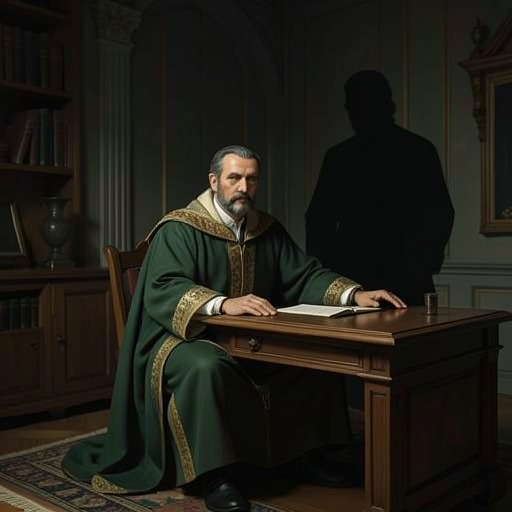
The Moon and the SunLouis XIV and Yves de la Croix are father and son, but their relationship is defined not only by recognition and pride: at the story’s decisive confrontation, Louis turns their intimacy into an instrument of command. He recalls marveling at Yves’s discoveries and being proud to be his father, then assigns him a church-supervised penance that makes Yves responsible for destroying the very knowledge through which he had earned the King’s admiration.
Recognition and Pride
In the final confrontation, Louis XIV addresses the prisoners individually, recalling what each had meant to him. To Yves he says, “I marveled at your discoveries. I was proud to be your sire.” The declaration makes their kinship explicit and gives it emotional weight: Yves is not merely a useful investigator in the King’s service but a son whose achievements have inspired paternal pride. Louis’s words join scientific accomplishment to family recognition, making the discoveries a source of both public value and private attachment.
That praise is delivered in a scene of royal display. Louis puts on a gold pectoral and arranges the curls of his black wig while the gold eyes of statues seem to watch the prisoners. The magnificence of the setting frames the father’s declaration within the King’s authority: Louis can acknowledge Yves as his son, but he speaks as sovereign, before people he holds in his power. The relationship therefore carries two forms of recognition at once, intimate and political, without allowing the first to cancel the second.
Pride Replaced by Judgment
The tenderness of Louis’s recollection does not protect Yves from condemnation. After telling the prisoners that he loved them, Louis accuses them of betrayal and smashes a crystal skull against the floor. The scene places affection and fury close together: his admission of love is followed not by reconciliation but by a violent gesture and the language of violated trust. The passage does not make Yves the sole object of the accusation; rather, his father’s words to him form part of a wider reckoning with the prisoners.
Louis then addresses him as “Father de la Croix,” a title that marks a changed immediate role. He gives Yves to Pope Innocent XII and commands him to obey without question. Yves answers, “Yes, Your Majesty,” then whispers the same assent again after the King’s command. The repeated response registers obedience, while its lowered volume gives the exchange a subdued quality. Louis does not withdraw the paternal recognition he has just voiced; instead, he uses sovereign power to place his son under another authority.
Penance and the Destruction of Knowledge
Louis defines Yves’s penance through a specific task: “You will search out every mention of the sea monsters.” He expands the command from a search through books to a demand reaching beyond any single text, insisting on “Every book.” Yves is made responsible for locating the written traces of a subject connected to his discoveries. The assignment thus reverses the direction of his earlier work: the investigator who had won his father’s admiration must now find and eliminate the evidence that might preserve what he investigated.
The command reaches its fullest expression in Louis’s order to erase the sea monsters’ existence from the King’s conscience and from posterity. Yves burns an illuminated vellum decree, holding it to a candle until it smokes and contorts, then drops the ashes into an Aztec dish. The task is not simply to destroy one object: Louis commands the removal of a history from both memory and future record. Yves’s compliance makes him the agent of that erasure, binding filial obedience to the suppression of the work that had helped make his father proud of him.
A Bond Recast as Obedience
The relationship’s final shape is therefore neither simple estrangement nor uncomplicated reconciliation. Louis still names Yves as his son and recalls his discoveries with admiration, yet those sentiments coexist with punishment, delegation to Pope Innocent XII, and an order to obey absolutely. Yves, in turn, acknowledges the King’s command and undertakes the assigned penance. Their bond remains legible in the language of fatherhood, but its immediate terms are set by royal authority.
This reversal gives the father-son relationship a particular force in the ending. The quality Louis once celebrates in Yves—his capacity to discover—becomes inseparable from a duty to suppress the discoveries’ historical traces. The son is not simply deprived of his work; he is commanded to undo its survival. Louis’s pride and his order of erasure remain side by side, leaving the relationship suspended between affection and coercion, recognition and obedience.