M. Coupillet
The Moon and the SunM. Coupillet, identified as a music master, is a minor court figure whose two appearances place him at the point where musical work meets royal recognition and expectation. At a performance before the King, he allows Marie-Josèphe’s composition to be credited to him; later, he presses her to discuss the cantata she is writing for the court.
The King’s Misattributed Praise
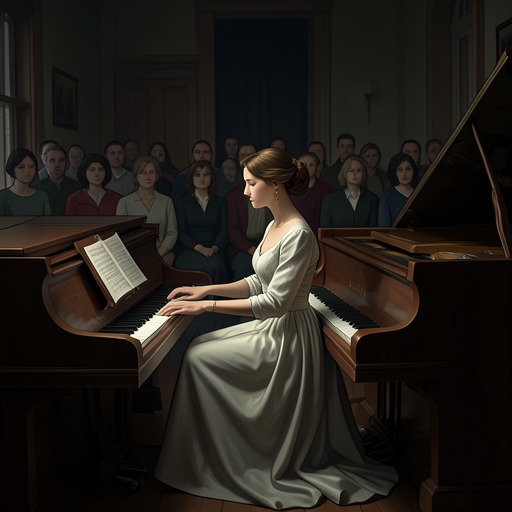
When Louis XIV praises a piece as charming, unfamiliar, and daring, he addresses M. Coupillet and asks whether it was composed for the occasion. Coupillet answers, “Yes, Your Majesty,” and the King responds, “Excellent, excellent — though rather daring.” Marie-Josèphe waits in bafflement that turns to outrage: the King believes Coupillet composed the piece, and Coupillet says nothing. The silence leaves the credit with the established music master until Domenico Scarlatti speaks up: “Signorina Maria composed it.” His intervention shocks the audience because he, the son of a commoner, has spoken unbidden to the King. Coupillet’s brief assent thus sits beside a more consequential act of disclosure by someone with less standing.
The Cantata and Its Demands
Later, Coupillet shoulders past visitors arriving to watch a dissection to ask for Marie-Josèphe’s time. He tells Yves de la Croix that he is anxious, then repeats the concern to Lucien de Barenton, Count de Chrétien, insisting that they must discuss the cantata. Marie-Josèphe replies that she has begun it and can work at night. Lucien observes that she will be occupied with composition at night and decomposition during the day. The exchange places Coupillet’s professional urgency against the demands already filling Marie-Josèphe’s days: her musical commission cannot be separated from the court’s other business, even when that business is a dissection.
A Limited but Revealing Role
The scenes establish Coupillet through his position in musical affairs and through his contrasting conduct in two moments of authorship. Before the King, he accepts praise attached to work that is not his; in the later encounter, he actively seeks the composer whose cantata requires attention. The text does not explain his silence or describe any consequence for him, but the juxtaposition makes Marie-Josèphe’s recognition contingent on someone else breaking the court’s silence. His appearances also frame composition as both an opportunity for royal notice and an obligation competing with the physical and intellectual pressures of court life.