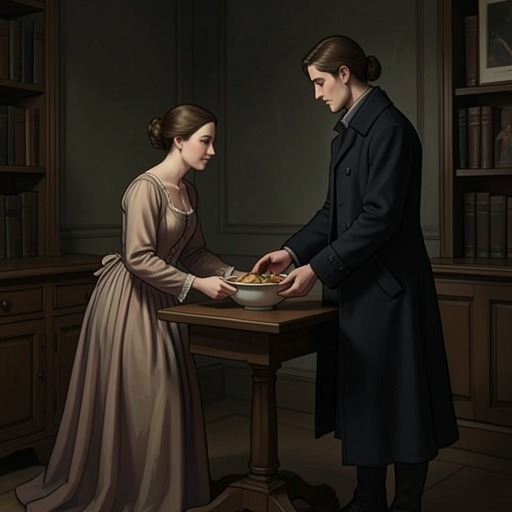
Marie-Josèphe begins taming the captive sea monster
The Moon and the SunMarie-Josèphe de la Croix’s first sustained effort to tame the captive sea monster in the Fountain of Apollo turns feeding into a tentative exchange: the creature approaches, accepts food, and responds to touch, but an attempt to pull Marie-Josèphe closer breaks the fragile trust. The scene’s movement from careful invitation to frightened retreat makes clear that familiarity is beginning, not that the sea monster has become safe or obedient.
Setting and Approach
Marie-Josèphe enters the tent at night to feed the sea monster. She shuts her lantern so its light will not frighten the creature, then gives her eyes time to adjust. Near the pool, new heavy white silk screens, patterned with gold sunbursts and fleurs-de-lis, shield the dissection table from the living captive’s sight. The screens place the work of dissection and the living animal close together, while also separating them from one another. Marie-Josèphe unlocks the cage and brings small fish in a jug of seawater.
A faint glow suffuses the Fountain. At first Marie-Josèphe wonders whether a candle on the stairs might be reflected in the water; the ripples soon glow with phosphorescence, which is reflected in the gilt figures of Apollo’s dolphins and tritons. This unfamiliar light alters the terms of the encounter: the pool is not simply a dark enclosure in which she must locate the animal, but a space whose changing surface makes the sea monster visible on her own terms.
Rather than call the creature out or approach it abruptly, Marie-Josèphe speaks quietly and explains that she has brought supper. When the first ripples spread, she waits. She then sits at the fountain’s edge and hums a different melody. The pause and the humming matter as practical choices: she leaves room for the sea monster to respond rather than treating the locked enclosure as permission to command it.
Food and First Contact
A bright wake crosses the pool as the sea monster swims toward the platform. Her tails move beneath the water, while her eyes and hair remain visible above it. Marie-Josèphe sits on the lowest step, with her feet on the wet platform, and holds out a fish. She considers holding it tightly to keep the creature nearby, but decides that forcing the animal to remain would probably frighten it. The meal becomes a test of whether the sea monster will choose to approach, not a means of restraining her.
The creature does not seize the fish and disappear into the dark. Instead, she swims close, turns, and passes beneath Marie-Josèphe’s hand. The pressure of the water brushes Marie-Josèphe’s skin. When she asks whether the sea monster is hungry, the creature surfaces nearby and says a recognizable word for fish. Marie-Josèphe answers by confirming the object of the exchange. The brief verbal response does not establish that they can converse freely, but it makes the feeding more than a one-sided human gesture: the sea monster identifies what she wants.
The creature dives again, and Marie-Josèphe remains still despite the cold water numbing her fingers. Beneath the glowing surface, the sea monster rises face-up and places her webbed claws beneath Marie-Josèphe’s hand. Marie-Josèphe releases the fish into her grasp. Each stage depends on the previous one: the sea monster approaches without being trapped, presents her hand beneath Marie-Josèphe’s, and receives the food without Marie-Josèphe having to seize or hold her.
Touch, Care, and Caution
After taking the fish, the sea monster rolls and strokes her arm along Marie-Josèphe’s palm. Marie-Josèphe lays a hand on her back, an act she associates with gently calming a colt. The creature trembles, then quiets when she floats face-down beneath Marie-Josèphe’s touch. This exchange suggests a moment of calm, but not certainty: Marie-Josèphe recognizes that reassurance may not be entirely honest, and the sea monster’s trembling shows that the contact has not erased her apprehension.
Marie-Josèphe also smooths the creature’s dark green hair, strand by strand. Its glossy strands appear iridescent in the faint light, and a knot resists being straightened. The sea monster draws the tangled strand away from her. This small interruption establishes a limit within the apparent gentleness: Marie-Josèphe can offer care, but she cannot assume that the creature welcomes every form of it. The sea monster remains an active participant, able to withdraw from an unwanted touch.
The creature rolls onto her back and eats the fish, including its head. Marie-Josèphe watches her double tail fan the water and studies the differences between it and the tails or fins she knows. The observation shifts the scene briefly from feeding and touch to attentive examination. Yet the animal is not reduced to an object of study: she is also the one accepting or refusing contact, eating, trembling, and making sounds. Marie-Josèphe pets her before preparing to leave, and the encounter appears to have ended peacefully.
The Attempt to Draw Marie-Josèphe Closer
As Marie-Josèphe says goodbye, the sea monster grasps her wrist, sings, and draws her toward the water. Marie-Josèphe asks to be released and tries to turn her hand, but the creature holds it in place and pulls it beneath the surface. Marie-Josèphe becomes frightened and frees herself from the grip. The change is abrupt: the same hand that had accepted food and rested on the creature’s back is now caught in an approach Marie-Josèphe has not consented to.
The sea monster releases her. Marie-Josèphe falls back, gets to her feet, and scrambles away. The creature watches from the pool, keeping only her eyes above water, and continues to sing. The song reaches Marie-Josèphe through the water, stone, and wooden platform as vibration rather than as a message she understands. It therefore offers no explanation for the creature’s attempt to draw her closer. The scene leaves intent unresolved: the song and physical pull may accompany an effort to communicate, but Marie-Josèphe experiences the action as frightening and escapes.
She shuts and locks the cage, takes up her lantern, and hurries from the tent. Outside, she gives a brief reply to a man who greets her and asks whether the sea monster has been fed, then continues along the Green Carpet past potted flowers and silent fountains. Her fear troubles her because she is not accustomed to being frightened by animals. The event’s ending does not cancel the earlier approach and care; it shows instead how little either person can yet rely on shared understanding.
Significance
The encounter begins the work of taming without delivering a tame animal. Marie-Josèphe’s patience allows the sea monster to approach and accept food, while their gestures establish a limited intimacy that neither speech nor command could secure. At the same time, the attempted pull beneath the water exposes a boundary that the two do not yet share: the sea monster initiates contact, and Marie-Josèphe withdraws when it becomes frightening. The locked cage remains in place when she leaves, so the creature’s captivity is unchanged even as the interaction briefly becomes reciprocal.
The scene also distinguishes observation from understanding. Marie-Josèphe notices the glow, the creature’s unusual tail, her hair, and her response to touch; she hears the song only as a physical vibration, not as a message. The first signs of communication are therefore concrete but incomplete: a word for food, an offered hand, an accepted fish, and contact that changes from welcome to alarming. The attempt to tame the sea monster begins in careful attention, but the ending insists that trust cannot be inferred from a single quiet exchange.