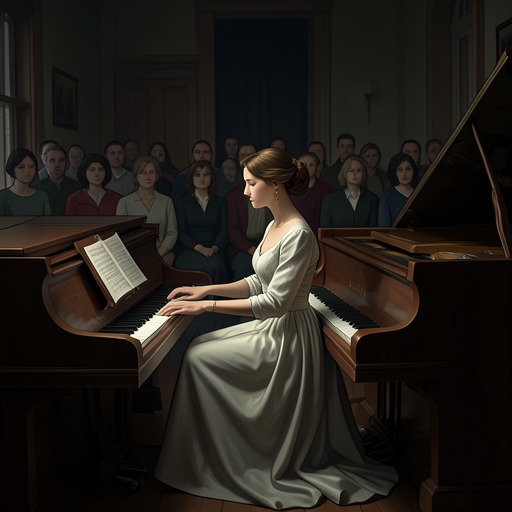
Marie-Josèphe transcribes the sea monster’s song while composing
The Moon and the SunMarie-Josèphe transcribes the sea monster’s song while composing during a night in which drawing, music, and uncertain visions become entangled. The episode begins with separate royal commissions and ends with a musical refrain captured on paper: not a finished cantata, but a moment of contact in which the sea monster’s song becomes part of Marie-Josèphe’s work. Its uncertainty matters. The text presents the melody as something she hears and records, while leaving open whether the visions surrounding it belong to waking perception, imagination, or dream.
Two commissions, two kinds of work
In Yves de la Croix’s sitting room, Marie-Josèphe covers the harpsichord with a tapestry and arranges drawing paper and music paper on a small desk by the window. She would like to draw and compose at once, but chooses the drawing first: the design for Louis XIV’s medal seems more immediately manageable. The cantata, by contrast, has no settled direction. She expects that tuning and playing the harpsichord might give her an idea, so she postpones composing rather than force a musical conception she does not yet have.
The choice gives the episode its governing contrast. The medal must communicate a royal image; the cantata’s form is still undetermined. Marie-Josèphe’s first available material for the drawing is a group of dissection sketches. They can inform her technique, but their clinical subject matter obstructs rather than stimulates invention. The medal is supposed to show the sea monster alive, formidable, and fit to be imagined as dangerous prey for the King. An image of a dead specimen cannot do that work. The distinction is not simply between accurate and inaccurate representation: the assignment requires her to turn knowledge of the creature into a purposeful public image.
From the dissected specimen to an imagined creature
Trying to picture the male sea monster alive, Marie-Josèphe instead draws the face she remembers seeing, framed by broken glass and pieces of gilded lead. When the image is complete, she recognizes why Yves had burned her earlier version. In this drawing the creature resembles a dead god, its face recalling a gargoyle and its head the image of Christ crowned with glass. The result revives the associations that had led earlier generations to regard sea monsters as Satanic. Rather than use that unsettling image for the King’s medal, she slips it to the bottom of her box.
She then imagines the female sea monster differently: swimming, leaping like a dolphin, singing like a nightingale, and also capable of the fearsome power of a kraken. On the page she draws the creature free, with waves around its tails. The contrast is sharp but not a simple opposition between a frightening male and a harmless female. Her imagined female is both beautiful and dangerous; what changes is her condition. She is no longer rendered as a dead object or a specimen. The drawing gives her motion, a marine setting, and freedom of movement, qualities absent from the dissection studies that had stifled Marie-Josèphe’s inspiration.
The drawing crosses into a vision
In the candlelight, the drawing seems to tremble at the edge of life. The creature appears to cry out, and the cry is associated not with fear or fury but with fierce joy. Marie-Josèphe gasps and sits upright, her body shaking with an intense pleasure that also terrifies her. The scene makes the act of imagining bodily and immediate: the image does not remain a controlled design on paper but seems to affect the person making it.
Outside, fog fills the Gardens of Versailles. The marble statues appear to stand above clouds, while the sea monster’s tent seems like an island. A warbling melody sounds, and shadows move among the orange trees. Marie-Josèphe wonders whether the figures might be Duke of Chartres and his lover, or supernatural beings. When the shadows turn toward her, they beckon and promise pleasure in exchange for submission. She is troubled by their power, but cannot simply classify them as evil. The episode therefore brings temptation and uncertainty into the same scene without resolving either. Marie-Josèphe soon blinks herself more fully awake, still unable to tell imagination from dream.
The melody becomes a score
The sea monster’s song, however, remains. Marie-Josèphe opens the window and takes up a pen, transcribing the refrain for the cantata. The movement from hearing to notation is the scene’s concrete outcome: although her musical plan had been unclear earlier, the melody gives her something specific to set down. The song does not arrive as a fully explained message, and the passage does not establish that Marie-Josèphe understands its meaning. What it does establish is that she treats the refrain as worth recording, and that it enters the pages of the work she is composing.
That act also changes the relation between the two commissions. The medal asks Marie-Josèphe to construct an image of a living sea monster for royal display; the cantata now draws on a sound associated with the creature itself. One medium makes the monster visible to the King, while the other begins with a melody heard in the night. The episode does not claim that the drawing or the music solves the question of how to represent the creature. Instead, it shows Marie-Josèphe moving between observation, imaginative invention, and transcription, with the sea monster’s song supplying an impulse her earlier deliberation could not.
Dawn and the unfinished work
Hours pass, the moon sets, and a false dawn turns the ground mist silver. The melody stops, and the shadows disappear. Marie-Josèphe’s pen slips from her cramped fingers. Papers lie scattered around her: drawings as well as the score for the cantata. Exhausted, with aching eyes and hands, she gathers them, shuts the window, and huddles in a luxurious cape. The scene closes not with a completed composition or a confirmed explanation of the night, but with its material traces: pages, a transcribed refrain, and the fatigue of someone who has remained at work until dawn.
The uncertain status of the visions limits what can be claimed about their cause, but not about their effect on the composition. The song persists after Marie-Josèphe questions whether she was dreaming, and she records it. In this episode, artistic work becomes a point of contact between the royal commission and the sea monster’s presence: the image she first struggles to invent and the melody she finally writes down arise through different forms of attention. The final papers preserve both the labor of making and the night’s unresolved disturbance.