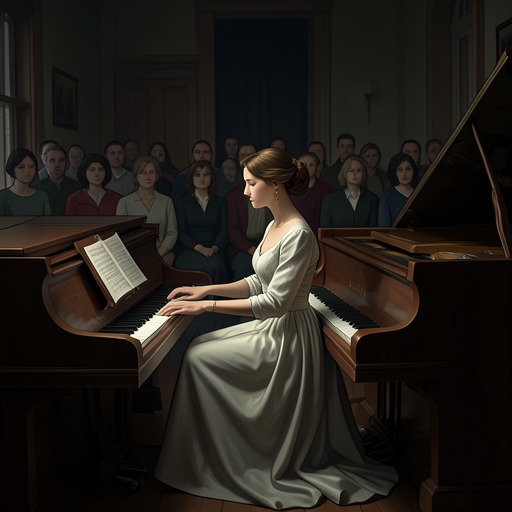
Marie-Josèphe’s composition is performed before the King
The Moon and the SunMarie-Josèphe de la Croix’s composition is performed before Louis XIV within a court entertainment that joins instrumental music to M. Antoine Galland’s reading of Arabian stories. The scene turns on more than the success of the music: Marie-Josèphe must wait while another man receives credit for her work, until the young Domenico Scarlatti interrupts the court’s assumptions and names her as its composer. Louis XIV’s eventual recognition gives her authorship a public place in the performance, even as the scene shows how easily that authorship might have gone unacknowledged.
The performance takes shape
The entertainment unfolds in a crowded salon. As the prelude approaches its end, Marie-Josèphe stands behind Mademoiselle d’Orléans, Lotte. The room has grown warm; Lotte fans herself with a sandalwood fan, and Marie-Josèphe gently dabs perspiration from her cheek. These small gestures place Marie-Josèphe among the courtiers, but not yet at the center of the event. Her composition is about to be heard, while she herself remains behind another woman and waits for the music to begin.
M. Coupillet closes the prelude with a flourish. The master of ceremonies announces Domenico Scarlatti, dressed in satin and ribbons and wearing a perruke, as the harpsichord player. The audience murmurs over the child’s youth and reputation as he bows to the King. M. Galland is then introduced as the reader of his translations of Arabian stories, made at Louis XIV’s command. His slender, jeweled book, the ceremonial bows, and the King’s nod establish an ordered court spectacle: performers are named, their roles publicly framed, and the music and reading are brought together under royal attention.
The scene’s formal arrangement also determines where Marie-Josèphe’s work can be heard. M. Galland reads aloud while Domenico and the orchestra play; the story is the announced centerpiece, but Marie-Josèphe listens for what the musicians make of her own composition. She lets her eyes close and imagines herself alone, shutting out the restless courtiers and the whispers about her brother. The music carries her attention toward the daring, erotic tale set in mysterious Arabia. Her inward absorption contrasts with the salon’s visible ceremony: the audience receives an entertainment, while Marie-Josèphe hears her imagination taking shape in performance.
A story and a musical ending
Galland’s reading gives the performance a narrative frame. He speaks of Scheherazade, whose husband grants her one more night to tell a story while threatening her with death afterward. The account of a woman forced to keep telling stories to survive resonates within a scene where Marie-Josèphe’s own creative contribution is not yet publicly identified. The parallel is not stated as an explanation by the characters; instead, the reading and the concealed authorship coexist in the same entertainment, placing a woman’s creative voice inside a story about a woman whose speech determines whether she lives another night.
The tale and Marie-Josèphe’s song end with Domenico’s flourish at the harpsichord. The completion of the piece leaves her breathless, her heart pounding. She experiences the performance as extraordinary, elevated by both the orchestra and Domenico’s playing. Yet the scene does not let the emotional climax settle into private satisfaction. The performers bow, the room holds its silence, and Marie-Josèphe fixes her attention on the King, waiting for a sign of pleasure. The court’s response matters because the work has been heard in public, before the sovereign whose judgment organizes the occasion.
Authorship is challenged and restored
Louis XIV praises a charming piece unfamiliar to him and asks M. Coupillet whether it was composed for the occasion. Coupillet answers that it was, but does not identify Marie-Josèphe as its composer. The omission produces a reversal: the music has succeeded, yet the person who made it remains uncredited at the moment when its authorship is discussed. Marie-Josèphe waits in bafflement that gives way to outrage. The scene makes the distinction between hearing a work and recognizing its maker explicit; musical excellence alone does not ensure that its creator will be named.
Domenico breaks the silence by declaring that Signorina Maria composed it. His intervention is striking in the courtly setting because he is the son of a commoner and speaks to the King without being called upon. He clutches a gold piece between both hands, holding it before his chest like a talisman, and then shrinks with fright, as if wishing he were six again. His action is therefore both a public disclosure and a personal risk: he supplies the name that the official exchange has left out, but his fear makes visible the social pressure surrounding even this brief act of candor.
Louis XIV turns to M. Coupillet to verify the claim. The scene thus shifts from a performance arranged by the master of ceremonies to an impromptu inquiry into who created it. Marie-Josèphe, still positioned within the crowd, is no longer merely an unseen listener to her own music. The King’s question makes the disputed authorship audible to the assembled audience, and Domenico’s statement has forced the court to confront it rather than let the initial attribution stand unchallenged.
Royal recognition and its limits
After curtsying, Marie-Josèphe finds Lucien de Barenton, Count de Chrétien, standing before her with his arm offered. He guides her through the crowd, giving her a path toward the King. The movement is a sharp contrast with her earlier position behind Lotte: first she waits at the edge of the performance, then she is physically escorted through the courtiers and brought into direct view. Her own impulse is to rush toward the King, but Lucien’s offered arm turns that imagined leap into an orderly passage through the room.
Louis XIV smiles and praises Marie-Josèphe as a woman of many talents, naming her as a tamer of sea monsters, a companion to Apollo, and a new Mlle de la Guerre. His recognition links the composition to accomplishments already known at court and treats music as part of a wider public identity. Marie-Josèphe resists the comparison, calling Mlle de la Guerre a genius and herself only an amateur. The exchange registers both her modesty and the unequal status of the two composers in the King’s eyes; Louis replies that Mlle de la Guerre is in Paris, where she is creating both a child for her husband and an opera, which he hopes she may dedicate to him.
The performance therefore ends with a double acknowledgment. Domenico’s intervention identifies Marie-Josèphe as the composer, and Louis XIV’s words recognize her work before the court. But the path to that recognition has exposed its contingency: M. Coupillet’s silence could have left her composition attributed to someone else, and the correction comes from a child willing, despite his fear, to speak. The scene makes the music’s success inseparable from the question of who is permitted to claim it.