Mating haze
The Moon and the SunThe Mating haze is a communal gathering of the Sea People, joining family reunion, shared mourning, and the adults’ coming together. Its significance changes after an assault in which Sherzad was captured and many of her family’s elders died: the gathering remains a source of connection and relief, but daylight now represents a danger the Sea People cannot risk. Their revised meeting will take place in moonless darkness, and the coincidence that makes it possible will not recur for fourteen years.
The gathering and its participants
The Mating haze brings Sea People families together at a meeting place in the depthless ocean trench. Sherzad anticipates returning there after her captivity, where other families will rejoice at her return and welcome her child. Her brothers and sisters, who survived the assault, swim around her and hurry toward the gathering. Their movement places the event within a wider community: it is not only Sherzad’s reunion, but a gathering of families making their way together.
The gathering includes different generations and forms of companionship. Children play with tame giant octopuses and tease dolphins, while adults join the whirlpool of the Mating haze. These activities make the event more than a private encounter between adults. It is a shared occasion in which children, siblings, and other families occupy the same communal world, with the adults’ gathering forming one part of a broader reunion.
Grief and return
The Mating haze follows a devastating loss for Sherzad’s family. Her brothers and sisters survived the assault during which she was captured, but her mother, aunt, and uncle—all elders of the family—were killed. Sherzad grieves by singing phrases from her mother’s death-song and shaping an image of her mother looking upon her granddaughter. The memory of the dead therefore accompanies Sherzad’s return to the living community; reunion does not erase bereavement.
The gathering is expected to ease that grief for a time. That relief is temporary, not a cure or a reversal of what happened. Its importance lies in allowing the survivors to come together again, welcome Sherzad and her child, and share a communal experience after loss. The passage holds these meanings side by side: the siblings’ urgent movement toward the gathering and the mother’s absence, carried into it through Sherzad’s song.
A ritual changed by danger
The Sea People will never again mate beneath the sun. Their decision is a direct consequence of their vulnerability to the men of land and of how few Sea People remain. Having already endured an assault, they cannot afford another. The change is collective and lasting: the gathering continues, but the conditions under which they can safely come together have narrowed.
This year, Midsummer Night coincides with the dark of the moon. The Sea People will gather at sunset, rise together to the surface, and meet in darkness. They will whisper songs and bathe in luminescence, their bodies glowing as they come together in the Mating haze. The night setting preserves the possibility of the gathering while acknowledging the danger that has made a sunlit meeting untenable. The passage gives the altered practice both practical and communal force: darkness is a means of reducing exposure, but also the setting in which the survivors can be together.
A rare convergence and an interrupted journey
The meeting’s timing is unusually significant because the dark of the moon will coincide with Midsummer Night only once again in fourteen years. The Sea People will not gather again under this same conjunction until then. This long interval gives the present occasion added weight: it is a rare opportunity for Sherzad to return, for families to welcome her child, and for the community to meet despite the danger and losses that now govern its choices.
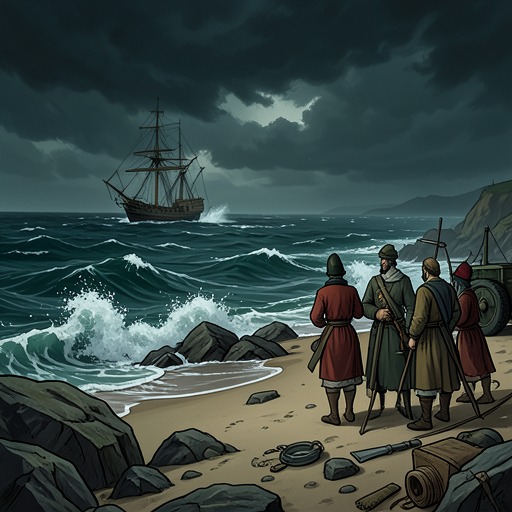
Before Sherzad can turn toward the meeting place, another obligation intervenes. Far ahead, two ships cross the Sea People’s domain: one flees while the other pursues and gains on it. Sherzad’s younger sister sings of the encounter she witnessed. The ships make noise for half a day, and their iron balls enter the water, driving the Sea People to dive for safety. Eventually the ships sink each other, and the men aboard drown. Sherzad’s sister laughs and hopes that two new ships will meet the same fate. This episode places the anticipated Mating haze alongside the continuing threat from human vessels: the Sea People’s reunion is not removed from the danger that forced its transformation. The passage ends before Sherzad reaches the gathering, leaving its return and its rare night-time meeting in prospect.