Midsummer mating-ground massacre
The Moon and the SunThe Midsummer mating-ground massacre is the destruction of a yearly Sea People gathering by sailors from a storm-damaged ship. Sherzad recounts it before Pope Innocent in a performance carried jointly by her song and Marie-Josèphe de la Croix’s speech. The account explains how the Sea People’s efforts to find refuge failed, and places the massacre’s human violence beside the religious language used to justify it. The Pope’s stony reception leaves the testimony without the compassion Sherzad seeks.
Causes and Background
The Sea People had tried to evade human incursions by fleeing to birth islands far out in the ocean and by sheltering among dense mats of seaweed that ships could not cross. They nevertheless kept their traditional mating ground: indigo depths lying between treacherous shallows. Once each year, families gathered there for a single day and then dispersed, trusting the location’s hazards to keep them beyond the reach of men from land. Their refuge depended on separation, not on any truce or understanding with humans.
The gathering took place after a great storm had preceded Midsummer’s Day. The Sea People had ridden the waves and rested beneath the surface when the weather became too violent. Once the storm passed, they returned to the sunlit surface. Adults gathered at the mating ground while adolescents watched the children. The ship’s arrival therefore interrupts a recurring communal occasion whose safety seemed to rest on remoteness and the expectation that outsiders would not find the gathering.
The Attack
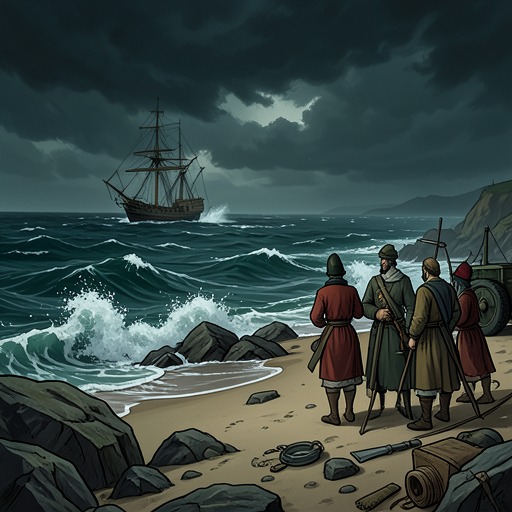
The intruder was a lost galleon whose sails had been torn by the storm. A cross painted amid the rips in its mainsail caught the sunlight as the ship approached. The crew encountered the Sea People gathered in their mating haze and interpreted them as a mass of demons. The ship pitched directly toward the gathering, passing among Sea People who had not noticed it.
The ship crushed those in its path; they did not try to flee before the danger reached them. Sailors threw casks overboard and called the Sea People demons. The casks exploded, sending fragments across the water. The attack transformed the gathering’s communal pleasure into panic and loss. As the whirlpool created by the swimmers disappeared beneath the ship’s passage, young survivors were left with the children they had been minding and saw their families die. The scene makes the catastrophe more than an encounter between a vessel and an unfamiliar people: it is the destruction of families assembled for an annual event, with the youngest survivors abruptly made witnesses to that loss.
The Cross and the Claim of Responsibility
The cross on the ship’s sail links the sailors’ religious identification of the Sea People with the violence that follows. The sailors call them demons, and the priest at the stern holds up a cross while proclaiming responsibility for the devastation of wounded and dying Sea People. In Sherzad’s account, that gesture does not offer protection or comfort. The religious emblem accompanies the claim to have acted against demons, even as the people harmed are presented as families whose lives and joy have been destroyed.
This contrast is sharpened by the two responses to the event. The priest proclaims responsibility for the devastation; Pope Innocent, listening to the account, stares stonily at Sherzad and shows no more pity than the priest. His reaction does not establish that he accepts the sailors’ justification. It does establish that Sherzad’s testimony produces no visible kindness from him. The account thus makes the massacre’s aftermath a question of recognition as well as physical destruction: whether the Sea People will be understood as people who feel joy and suffer loss, rather than reduced to the category their attackers impose on them.
The Testimony at Court
The massacre is presented as a remembered event within Sherzad’s testimony, rather than as a scene narrated in ordinary chronological sequence. Marie-Josèphe speaks in single notes because her voice is untrained, while Sherzad answers with harmonies and fixes her gaze on Pope Innocent. When Marie-Josèphe falters, Sherzad grips her wrist and urges her to continue so the listeners will understand that the Sea People feel joy. Marie-Josèphe then faces the Pope and speaks while Sherzad sings.
The performance makes the telling itself part of the event’s significance. Sherzad does not present the gathering only as evidence of an attack; she insists on the life that preceded it and on the joy that the violence interrupted. At the conclusion, the Pope rises and Sherzad releases Marie-Josèphe’s wrist. Marie-Josèphe steadies herself against the cage bars, while the spectators applaud the story’s pathos and tragedy. Their applause registers an emotional response from the audience, but it does not change the Pope’s earlier impassivity. The massacre remains a record of the Sea People’s vulnerability: refuge failed, their families were destroyed, and the testimony that follows must struggle to make their humanity legible to those in power.