Music as communication
The Moon and the SunMusic as communication links Marie-Josèphe de la Croix’s inner imaginative life to the sea monster’s distinct, responsive songs. At court, music makes a story vivid to Marie-Josèphe even when she scarcely attends to its words; beside the pool, singing becomes an exchange that speech cannot achieve. The bond is powerful but not infallible: the sea monster can send a warning that Marie-Josèphe does not understand, while Marie-Josèphe later preserves part of the creature’s melody in writing.
From private imagination to court performance
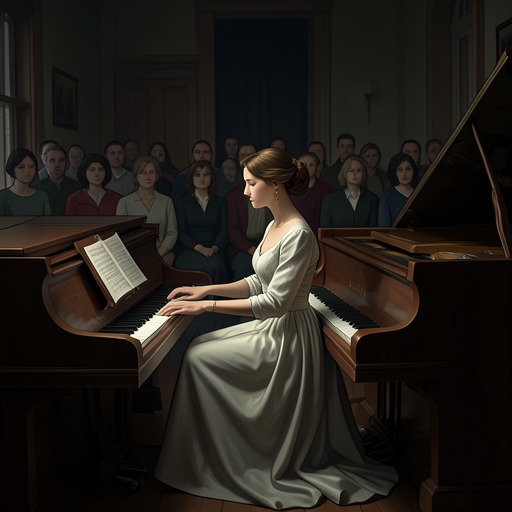
For years, Marie-Josèphe’s music had existed only in her mind. During a royal entertainment, M. Galland reads a story while Domenico Scarlatti, M. Coupillet, the orchestra, and a little boy perform. Galland’s translation is the formal centerpiece, but Marie-Josèphe hardly perceives its words. She listens instead to her own imagination made audible through Domenico and the orchestra. The distinction matters: the music does not simply accompany the story for her; it gives sound and shape to an imaginative world that language alone does not command.
Her song seems to spin with the candlelight, building a background of distant deserts and gardens, dangerous adventures, scents, and other songs. The imagined setting is Arabia, and the story’s sensual and perilous character reaches her through the music as much as through Galland’s reading. After living with music that played only inwardly, she experiences the performed piece as a melody flooding the court of the Sun King. Its realization is exhilarating, although also difficult to measure against what she had imagined: music, she feels, could sound as she had conceived it only if angels or demons performed it. That uncertainty gives artistic creation an uncanny edge without establishing a supernatural explanation.
The performance concludes with a flourish at the harpsichord, ending both the story and Marie-Josèphe’s song. Breathless, she opens her eyes with her heart pounding and judges the piece unimaginably wonderful, raised to that height by the orchestra and Domenico’s playing. Her attention then fixes on the King, as she hopes for a sign of his pleasure. Music has carried private invention into a public royal setting, but its success still appears exposed to judgment: the work can become real before an audience without guaranteeing that its composer will receive recognition.
Singing across the species divide
At the pool, Marie-Josèphe first tries to teach the sea monster spoken words by pairing phrases with fish. The creature repeats a sound associated with the fish, then lets its attempted speech dissolve into a long, complex song of melody and whistles. It snaps up the fish in two quick bites. When Marie-Josèphe asks it to say her name and then a phrase of royal gratitude, the spoken lesson continues to fail. The scene makes the gap between human speech and the creature’s expression concrete: the sea monster does not answer by mastering the verbal formula Marie-Josèphe offers.
Frustrated, Marie-Josèphe sings back. The sea monster falls silent and stares at her; when she continues the wordless song she had played before the King, it drifts closer and hums a second melody. The new line is described as exotic, compelling, and haunting, and as breaking every rule of music. Rather than repeat a human phrase, the creature answers in its own musical form. Marie-Josèphe weeps without initially knowing why, then wipes away her tears. The encounter registers in her body before she can name its emotional meaning: the music has produced an intense response, but the passage does not reduce that response to a simple, consciously understood message.
The exchange becomes collaborative. The sea monster takes Marie-Josèphe’s hand as she continues singing, and it embroiders variations on her melody. A net leaves her hand and returns; when the creature notices the fish, it ends the song, accepts the reward, and submerges with the morsel held delicately between its claws. Song, touch, food, and repeated attention belong to the same interaction. The fish does not prove that every musical phrase has been translated into a human meaning. It does show an exchange shaped by response: the creature approaches, joins the melody, varies it, and accepts the reward in turn.
Warning, misrecognition, and listening
The sea monster’s music also carries alarm. In a scene of danger, it crawls up the steps to the edge of the water, crying with despair and warning as the land-woman walks, bleeding, toward predators whose roars and snarls fill the dark and dawn. The creature echoes the woman’s simple song of childish babble, but receives only silence. Its warning song then bursts through the gardens, fills them, and fades. The sea monster washes salt tears from its eyes before swimming toward shelter beneath the hooves of a statue.
This sequence distinguishes the ability to sing from the ability to make oneself understood. The creature sounds an urgent warning, yet the land-woman does not answer its echo, and the threatened woman continues toward danger. From the sea monster’s perspective, the danger is stark: if land predators can smell as keenly as ocean sharks, the woman is doomed. Music can cross the physical distance between pool and garden, filling the surrounding space, without crossing the interpretive distance between the two beings. The creature’s despair and tears make the failure of communication consequential rather than merely technical.
Notation and the limits of translation
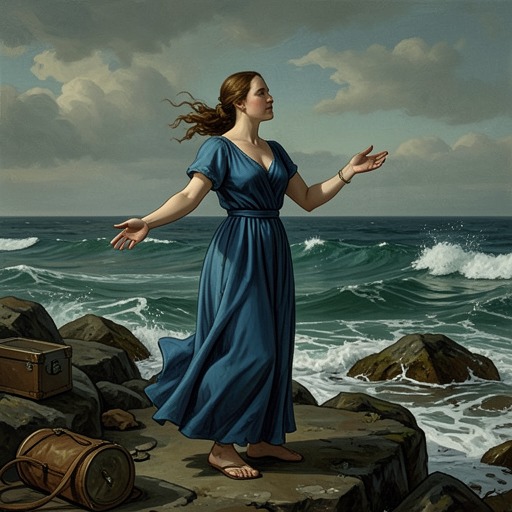
Elsewhere, Marie-Josèphe imagines the female sea monster swimming in the sea, leaping like a dolphin, singing like a nightingale, and ruthless as a kraken. As she draws it amid waves caressing its tails, the image seems to tremble at the edge of life; the creature’s cry is characterized as fierce joy rather than fury or fear. The episode binds visual imagination to music, but keeps the creature’s response outside ordinary explanation. Marie-Josèphe’s body quivers with intense, frightening pleasure, leaving the experience charged without clarifying precisely what has passed between image, song, and listener.
Later, the sea monster’s melody remains with Marie-Josèphe after she wakes, blurring the boundary between imagination and dream. She opens a window to the cold, damp night air, hears the delicate melody, takes up a pen, and transcribes its refrain. The creature eventually falls silent as the moon has set and false dawn turns the mist silver. Notation offers Marie-Josèphe a way to retain a fragment of a sound that might otherwise disappear; it does not establish that the written refrain exhausts, translates, or explains the sea monster’s song.
Significance
Across these scenes, music moves between solitary imagination, public performance, reciprocal contact, failed warning, and written record. Marie-Josèphe’s court composition makes inward invention audible, while her later singing meets a response that is not reducible to spoken language or human musical rules. The sea monster’s variations suggest attention and participation; its warning shows that musical expression alone cannot ensure comprehension. The relationship therefore rests on listening and response, not on a simple claim that the two species share a fully translated language.
The contrast between the court and the pool further defines music’s possibilities. At court, Marie-Josèphe’s composition is heard within a formal entertainment and awaits the King’s approval. Beside the water, singing becomes personal and reciprocal, accompanied by touch and the practical exchange of fish. In both settings, music carries more than verbal content: it gives form to imagined worlds and can draw two beings into shared attention. Yet its limits remain audible in the unanswered warning. Music as communication is thus both a means of connection and a reminder that a message can be offered with urgency, heard as sound, and still go unrecognized.